
Postiz Review and Why Free Self Hosting Is Not Really Free
Postiz Review and Why Free Self Hosting Is Not Really Free
Postiz promises a free open source social scheduler, but self hosting has hidden costs. See what breaks and whether the paid cloud plan is the smarter pick.
- 1Is the Postiz Self Hosted Version Really Free?
- 2What Postiz Costs in the Cloud
- 3How Reliable Is Postiz for TikTok, Instagram, and YouTube
- 4The Maintainer Burnout Risk Nobody Mentions
- 5Postiz Pros and Cons
- 6Who Should Use Postiz and Who Should Skip It
- 7The Verdict on Postiz
- 8Frequently Asked Questions
- Is Postiz really free?
- How hard is it to self host Postiz?
- Can Postiz schedule TikTok, Instagram, and YouTube?
- Is Postiz better than Buffer or Metricool?
- What happens if the Postiz developer stops maintaining it?
- 9Quick Takeaways
Bottom Line: Postiz is a genuinely capable open source social media scheduler, and the self hosted version is free in the sense that the code costs nothing. It is not free in practice, because it spawns six to nine containers and needs a 2GB to 4GB server to stay alive. For most solo creators, the $29 a month cloud plan is the saner choice, and self hosting only pays off if you are comfortable running your own infrastructure.
I went into this Postiz review expecting a simple answer to a simple question: is the free, open source scheduler good enough to replace a paid tool like Buffer or Metricool? The answer turned out to be yes and no, and the gap between those two words is where most creators get burned.
Here is the part the marketing pages skip. The “free” self hosted version of Postiz is not a lightweight app you drop on a cheap server. It runs as a stack of six to nine separate containers, and if you try to host it on a $5 a month box with 512MB of memory, it crashes on boot before you schedule a single post.
So the real Postiz question is not “free or paid.” It is “do you want to run server infrastructure, or do you want to make videos.”
I have a strong opinion on which one most creators should pick, and I will get to it. First, let me show you exactly what self hosting costs once you add up the parts nobody lists.
What is self-hosting: Running the software yourself on a server you control, instead of paying the company to host it for you in the cloud.

Is the Postiz Self Hosted Version Really Free?
The Postiz self hosted version is free to download but not free to run.
The AGPL-3.0 code costs nothing, yet a working install needs a 2GB to 4GB server, and the time to maintain it is the real bill.
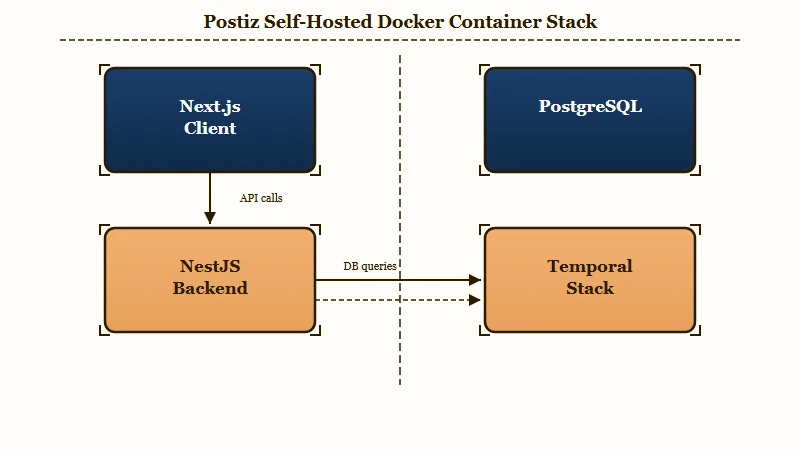
When I traced what a self hosted instance spins up, it was heavier than I expected. Postiz runs a Next.js front end, a NestJS back end, a PostgreSQL database, a Redis cache, and as of version 2.12.0, a full Temporal orchestration stack that brings its own second PostgreSQL database and an Elasticsearch cluster. That is six to nine Docker containers fighting for memory on one machine.
On a 2GB server you need to add a 2GB Linux swap file or the whole thing gets killed by an out of memory error mid task.
The community consensus for a budget host lands on an Oracle Cloud free tier ARM box, which gives you 24GB of RAM for nothing, or a Hetzner CX22 at roughly $4 a month. Either works, but both assume you know how to provision and secure a Linux server.
Then there is the part that surprised me most. Self hosting does not hand you the social platforms. You still have to register your own developer apps with TikTok, Meta, and Reddit and get each one approved, and creators report TikTok approval as close to impossible and Meta as a multi week verification slog.
Postiz quietly sells app approval as a paid add on, which tells you how often people hit that wall.
Before: You read “free, open source, self hosted” and budget zero dollars and one evening.
After: You budget $4 a month for a real server, a weekend for setup and platform approvals, and ongoing time every time an upgrade breaks something.
What Postiz Costs in the Cloud
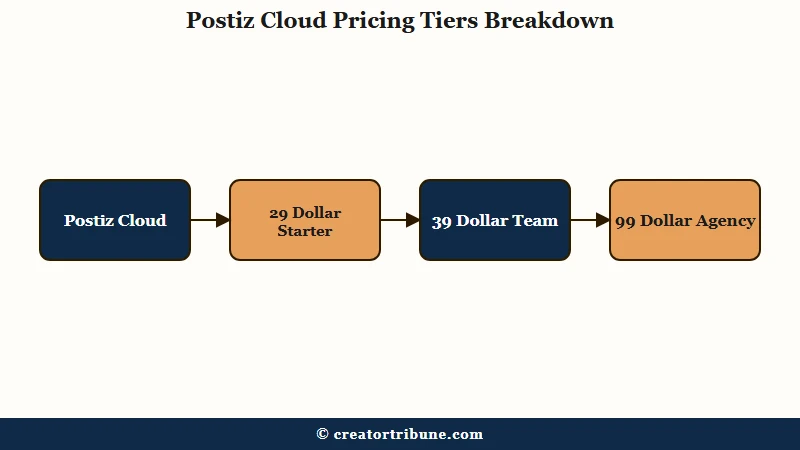
Postiz cloud starts at $29 a month for 5 channels and 400 posts, and the $39 Team plan adds unlimited posts and unlimited team members.
That makes it cheaper than Hootsuite and more generous on team seats than Metricool, but pricier per channel than Buffer.
If you do not want to touch a server, the hosted version is the product you are really buying, and I think it is priced fairly for what it bundles. The standout is that the AI image and video generation is built in, which Buffer does not offer at any tier. Here is how the major options compare on the numbers that matter to a creator.
| Tool | Entry price | Channels | AI image and video |
|---|---|---|---|
| Postiz | $29 a month, or free self hosted | 5 (Standard), 10 (Team) | Yes, built in (metered credits) |
| Buffer | $5 to $6 per channel a month | Free tier covers 3 | AI text only, no image or video |
| Metricool | About $22 a month for 5 brands | 5 brands on Starter | Team access locked to $67 plan |
| Hootsuite | $99 per user a month | 10 accounts, no free plan | Add on, not standard |
The cost math gets interesting when you compare self hosting against the cloud plan honestly, time included. I ran the numbers the way I would for my own setup.
Self hosted Postiz, true monthly cost
  Hetzner CX22 server........ $4.00
  Your setup time............ ~6 hours once (approvals + config)
  Your maintenance time...... ~1 hour a month (upgrades, breakage)
  Cash cost.................. $4/mo
  Real cost.................. $4 plus the value of ~1 hour/month

Postiz Cloud Standard
  Cash cost.................. $29/mo
  Your setup time............ ~15 minutes
  Your maintenance time...... zero
If your time is worth more than $25 an hour, the cloud plan wins for most months. If you genuinely enjoy running servers, or you bill a lot of client channels, self hosting flips back in your favor.
For a full side by side of the major options, the scheduling tool comparison breaks down where each one fits, and the Metricool review covers the closest paid rival in depth.
How Reliable Is Postiz for TikTok, Instagram, and YouTube
Postiz posts reliably to TikTok, Instagram, and YouTube once it is set up, but a handful of silent failures can stall your queue without warning.
The failures are specific and fixable, as long as you know they exist.
The pattern I want creators to understand is that these errors do not announce themselves. A post sits in the queue, nothing publishes, and there is no obvious red banner telling you why. Here are the three that trip people up most, and the fix for each.
| Symptom | Likely cause | Fix |
|---|---|---|
Threads post crashes with a bad_body error |
The post contains 4 or more URLs, an undocumented Threads limit | Keep Threads posts to 3 URLs or fewer |
Instagram fails with a deleted_object error |
Meta triggered an identity checkpoint on the linked Facebook Page | Open the Facebook mobile app and clear the verification prompt |
| Posts stuck in queue after a restart | You rebooted during the 90 to 150 second worker compile window | Wait the full grace period before touching the system |
A few platform specifics matter before you commit. TikTok requires MP4 video files, and sandbox developer accounts are forced to “Self Only” privacy until your app is approved, so test posts will look like they failed when they did not.
YouTube handles standard videos and Shorts well, but it cannot schedule community posts. Instagram covers Reels, Stories, and carousels through the Graph API, which is also where that checkpoint error comes from.
The reason I still rate it reliable is that none of this is random. Once you know the 3 URL Threads limit and the checkpoint quirk, your failure rate drops close to zero. If your goal is turning one long video into a week of clips across these platforms, the workflow in repurpose YouTube videos into Shorts pairs naturally with a scheduler like this.
The Maintainer Burnout Risk Nobody Mentions
The biggest long term risk with Postiz is that it is maintained by one person who has publicly said he can no longer keep up.
For software that holds the keys to your social accounts, that single point of failure deserves more weight than any feature.
This is the part of the review I did not expect to be writing. The sole maintainer posted openly that after the birth of his daughter he is burned out and can no longer review community pull requests, because contributors now flood the repo with unchecked, AI generated code that he described as “100% more slop, and a lot of spam.” Development has shifted to bug fixes and technical debt rather than new features.
There is an irony here that the community did not miss. An AI powered tool built to mass produce social content is being buried under AI generated code submissions, and one Reddit commenter put it bluntly by asking if he was building the tool for his own demise. I find it genuinely funny, and also a real reason to think twice.
To be fair, the project is not abandoned. It has 32.4k stars and roughly six million Docker downloads on its public GitHub repository, which is real proof the core is battle tested at scale.
My concern is forward looking. If you build your posting on self hosted Postiz and the solo developer steps back, you own every future bug yourself, while the cloud version softens that because someone is paid to keep the lights on.
Postiz Pros and Cons
Postiz earns its reputation on platform breadth and built in AI, and loses points on setup complexity and single maintainer risk.
Here is how I would weigh it for a creator deciding today.
What I think Postiz gets right:
- It posts to 25 or more networks, including TikTok, Instagram, YouTube, X, LinkedIn, Threads, Reddit, Bluesky, Mastodon, and Google Business.
- The AI assistant generates platform aware text, plus images and short videos, which Buffer does not include at any price.
- The $39 Team plan gives unlimited posts and unlimited team members, which undercuts Metricool’s team pricing badly.
- It ships a real public API, a Node SDK, and a native Model Context Protocol server, so AI agents like Claude Code can schedule posts directly.
Where Postiz frustrated me:
- Self hosting needs a 2GB to 4GB server and six to nine containers, so it is not the cheap weekend project the marketing implies.
- You must get your own developer apps approved by TikTok and Meta, which can take weeks or stall entirely.
- Cloud channel limits are tight, with only 5 channels on the $29 plan when rivals like AdaptlyPost offer 30 for less.
- The solo maintainer has paused community contributions, which raises long term reliability questions.
The AI media generation is genuinely useful, though the credits run out fast on the entry plan. If graphics are your bottleneck, the picks in AI tools for social graphics cover dedicated options that outrun a metered scheduler credit.
Who Should Use Postiz and Who Should Skip It
Postiz is right for technical creators and agencies, and wrong for non technical solo creators who just want to schedule and move on.
The real question is whether you want to run server infrastructure at all, because budget barely enters into it.
I would tell you to use Postiz if you fit one of these:
- You are comfortable with Docker, Linux, and securing a server, and you want to self host for near zero cash cost.
- You manage many client channels and the unlimited team seats on the Team plan save you real money.
- You are building AI agent workflows and want a scheduler with a native MCP server and API.
I would steer you away if any of these sound like you. If you are a solo creator who wants to connect three accounts and schedule a week of Reels without reading a runbook, the self hosted route will eat your weekend, and even the cloud version asks more of you than Buffer does. A simpler automation tool like the one in the Manychat review may fit better if your real goal is engagement rather than cross posting.
What is AGPL-3.0: An open source license that lets anyone use, modify, and host the code for free, as long as they publish their own changes.
The Verdict on Postiz
Postiz is worth it as a cloud tool for creators who value built in AI and team seats, and worth it as a self hosted tool only if you are technical enough to run it.
It is not the effortless free Buffer replacement the listicles sell.
The way I see it, the open source promise is real but oversold. The code is free, the project is popular, and the feature set is wide.
The hidden costs are the server, the platform approvals, the upgrade breakage, and the one person holding it all together. Price those in honestly and the $29 cloud plan stops looking expensive.
Whichever version you pick, the deeper lesson is that a scheduler rents you reach on platforms you do not own. The creators who last are the ones who turn that reach into something they control, which is exactly what the free Creator Money Page template is built to help you do, and what converting views to subscribers walks through step by step.
Frequently Asked Questions
Is Postiz really free?
Postiz is free if you self host the open source code, but you pay for the server and your own time. A working install needs a 2GB to 4GB machine, around $4 a month, plus setup and maintenance hours. The cloud version starts at $29 a month.
How hard is it to self host Postiz?
It is moderately hard and not beginner friendly. You run six to nine Docker containers, configure a database stack, and get your own TikTok and Meta developer apps approved. If you are not comfortable with Linux and Docker, the cloud plan will save you a frustrating weekend.
Can Postiz schedule TikTok, Instagram, and YouTube?
Yes. Postiz schedules TikTok videos, Instagram Reels, Stories, and carousels, and YouTube videos and Shorts. It cannot schedule YouTube community posts, and a few silent errors can stall the queue until you apply the known fixes.
Is Postiz better than Buffer or Metricool?
It depends on your needs. Postiz beats Buffer on built in AI media and beats Metricool on team seats. Buffer is cheaper for a single creator with a few channels, and both paid tools are far easier to set up than self hosted Postiz.
What happens if the Postiz developer stops maintaining it?
If you self host and development slows, you inherit every future bug and security fix yourself. The cloud version reduces that risk because the company maintains it. The maintainer has already paused community pull request reviews, so this is a live concern, not a hypothetical.
Quick Takeaways
- Postiz self hosting is free in code only, since it needs a 2GB to 4GB server and real maintenance time.
- The $29 a month cloud plan is the smarter pick for most non technical solo creators.
- Know the three silent failures before you rely on it: the Threads 3 URL limit, the Instagram checkpoint error, and the boot window crash.
- One maintainer runs the project and has paused community contributions, so weigh the long term risk before self hosting.
- Use a scheduler to grow reach, then turn that reach into an audience you fully own.