The Average YouTube View to Subscriber Conversion Rate
The Average YouTube View to Subscriber Conversion Rate
Convert YouTube views to subscribers with the 30-day playbook. Why people watch without subscribing, the channel page conversion lever, and what to fix this week.
- 1What a Healthy View-to-Subscriber Conversion Rate Looks Like
- 2What YouTube’s August 2026 View Count Change Does to Your Conversion Rate
- 3Why Viewers Watch but Refuse to Subscribe
- 4Where to Place Your Subscribe CTA So It Converts
- 5Why Your Channel Page Is the Real Conversion Asset
- 6The 30-Day Playbook to Convert More Views Into Subscribers
- 7How Shorts Conversion Differs From Long-Form
- 8Frequently Asked Questions
- What is a good view-to-subscriber ratio for a new channel?
- Should I ask viewers to subscribe at the start of the video?
- Does the bell notification really matter?
- How long should it take to see conversion-rate improvements?
- Are Shorts viewers worth pursuing for subscribers?
- What is the average view-to-subscriber conversion rate on YouTube Shorts?
- How do you convert YouTube viewers into subscribers?
- Did YouTube change how views are counted in 2026?
- What if I run the playbook and my conversion rate does not move?
TL;DR: Most channels lose subs because the ask comes before the value lands, the channel page is treated as storage instead of a landing page, and the CTA is generic. A healthy view-to-subscriber rate is 1 to 2 percent, and Shorts convert far lower at 0.05 to 0.5 percent. Fix the hook, fix the channel trailer, place the mid-video ask after the peak moment, and pin a specific incentive in the comments. The 30-day playbook below is what to run.
The reason your views look healthy but your subscriber count refuses to move is almost never the algorithm. It is the gap between the value you delivered in the video and the moment you asked viewers to commit to seeing more.
If you are getting 5,000 views a video and gaining 10 subscribers, you are running a 0.2 percent conversion rate. The healthy benchmark across most niches is 1 to 2 percent, with educational content reaching 1 to 3 percent and entertainment hovering at 0.5 to 1.5 percent. Closing that gap is a series of small fixes you can apply this week.
The way I see it, view-to-sub conversion is the most underrated lever in creator analytics. Watch time gets all the attention, but a creator with strong watch time and weak sub conversion is still building a transient audience that does not return. Below is the framework I would run, ordered by the size of the fix.
What a Healthy View-to-Subscriber Conversion Rate Looks Like
The average view-to-subscriber conversion rate sits between 1 and 2 percent across most niches, with educational content reaching 1 to 3 percent. Anything below 0.3 percent signals a content or CTA failure, not a YouTube problem. On YouTube Shorts the average runs far lower, closer to 0.05 to 0.5 percent.
Conversion rates are not the same across niches, and comparing yourself to the wrong benchmark is the fastest way to misdiagnose the problem.
| Niche | Typical conversion rate | Click-through-rate benchmark | What it tells you |
|---|---|---|---|
| Educational / Tutorial | 1 to 3 percent | 4.5 percent | High loyalty, viewers return for the next lesson |
| Entertainment / Creator | 0.5 to 1.5 percent | 6 percent | High volume, lower loyalty per view |
| Gaming | 0.5 to 1 percent | 8.5 percent | Huge view counts but viewers subscribe to specific creators, not channels |
| Business / B2B | 0.3 to 1 percent | 3 percent | Lower views but high-intent audience |
| General healthy band | 0.5 to 2 percent | varies | Below 0.3 percent means a real issue |
Two different ratios circulate under confusingly similar names and they measure opposite things. Mixing them up is why benchmark advice online contradicts itself so often, and it is worth settling before you compare yourself to anything.
View-to-subscriber conversion rate is new subscribers divided by views, which is what this page measures. At the healthy 1 to 2 percent that works out to roughly one new subscriber per 50 to 100 views.
Subscriber-to-view ratio is the other one: views per video divided by the subscriber count you already have. Circulating benchmarks for it sit around 5 to 20 percent, because it measures whether your existing audience still turns up when you post.
A 10 percent figure sitting next to a 1 to 2 percent figure looks like a contradiction until you notice the two measure different things. Check which of them a benchmark is quoting before you judge your own channel against it, since the two typically land about an order of magnitude apart.
What is the view-to-subscriber funnel: A four-step path from discovery to commitment: viewer lands on your video, decides whether to watch in the first 30 seconds, receives value, then encounters a CTA that asks them to subscribe at the peak of that value.
Return viewer rate deserves more of your attention than raw view count does. YouTube’s systems treat a returning audience as evidence that a channel is worth distributing further.
No published threshold exists for this number. Watch which direction your own figure moves across a run of uploads and treat that trend as the signal.
An audience that watches once and never comes back caps how far the algorithm will push the next upload.
For context on the broader ranking signals creators should monitor, the posting cadence guide covers the algorithmic logic that applies similarly to YouTube uploads. The signal hierarchy across platforms now reads “do viewers come back” before it reads “how many views did this get.”
What YouTube’s August 2026 View Count Change Does to Your Conversion Rate
Since August 24, 2026, YouTube counts a view the moment a video starts to play across every format, which brought long-form and live streams onto the looser standard Shorts already used. If your channel runs on long-form, the denominator in your conversion rate got bigger overnight, and the same channel now reads a lower view-to-subscriber rate than it did in July with nothing about the content having changed.
YouTube’s documentation on how engagement metrics are counted states it plainly: “Beginning August 24, 2026, views are counted the moment a video starts to play across all formats, including Shorts, long-form videos (VOD), and live streams.” YouTube does not publish what the threshold was before that date, so the size of the step in your own numbers around late August is the only read you get on it.
That reaches every long-form benchmark on this page and every one you will find elsewhere. A 1 to 2 percent figure measured in early 2026 was calculated against a stricter view count than the one YouTube Studio shows you today, while the Shorts figures further down were already running on play-start counting and did not move.
Two things follow from it in practice. Rebaseline your conversion rate from late August 2026 forward instead of comparing it against older months, and treat a September drop against a July figure as a measurement change before you go rebuilding a funnel that was never broken.
Your monetization numbers did not move with it. The same YouTube page confirms the change “won’t impact your YouTube Partner Program (YPP) earnings or eligibility”, because earnings still run on engaged views and engaged watch hours while eligibility runs on qualified views.
Your Studio dashboard therefore carries two denominators at once. Conversion rate now sits on the loose count while revenue is still calculated on the strict one, so any comparison you draw between the two will mislead you.
The change also narrows the Shorts gap described further down. Shorts moved to play-start counting on March 31, 2025, more than a year before long-form did, so part of the spread between the two formats was an artifact of counting them differently rather than a real difference in viewer intent.
Why Viewers Watch but Refuse to Subscribe
Viewers watch and do not subscribe because the ask is generic, the timing is wrong, or the channel page does not signal that more of this value is coming. The video does its job; the conversion infrastructure around it does not.
The psychology is more useful than it sounds. A viewer who finished your video and walked away enjoyed the content enough to stay for the full duration. They did not subscribe because subscribing is a commitment to future content, and you did not give them a reason to expect future content worth committing to.
Three failure modes dominate, in this order:
- The ask is generic. “Don’t forget to subscribe” earns roughly the conversion rate of an empty room. “Subscribe, I post a new short-form analysis every Tuesday” earns a real answer because it gives the viewer a specific reason to expect a specific kind of future content on a specific cadence.
- The ask comes before the value lands. Asking for a subscription in the first 60 seconds, before the viewer has decided your content is worth their time, is what I call premature ask syndrome. Subscription intent is earned during the value-delivery phase. Ask before delivery and the viewer reads it as begging.
- The channel page is a dead end. Viewers who liked your video often click your channel name to see what else you have. If the page they land on is a wall of random thumbnails with no trailer, no playlist organization, and no clear value proposition, they bounce. They watched one video, almost subscribed, and then could not find the rest of the value they expected.
The third failure is the most expensive of the three, because it costs you conversions the viewer had already half decided to make. They liked the video enough to click through to your channel, which is further than most viewers ever get.
What I find interesting is how often creators try to fix conversion by changing the CTA wording and skip the channel page entirely. The channel page is doing more work than any single video CTA ever will. Treat it as a landing page, not a storage area.
Where to Place Your Subscribe CTA So It Converts
The best-converting subscribe CTA placement is immediately after the peak value moment in the video, paired with a verbal ask that names a specific reason to subscribe. End screens convert second-best, pinned comments third.
Most creators put the subscribe ask at the start (“hit subscribe before we begin”), at the end (a generic outro), or both. Both placements miss the moment when the viewer is most likely to commit.
The peak value moment is the segment where the viewer learns the most surprising or most useful thing in the video, and that is when subscription intent peaks. Place a one-sentence CTA right after it, before attention starts drifting toward whatever they will watch next.
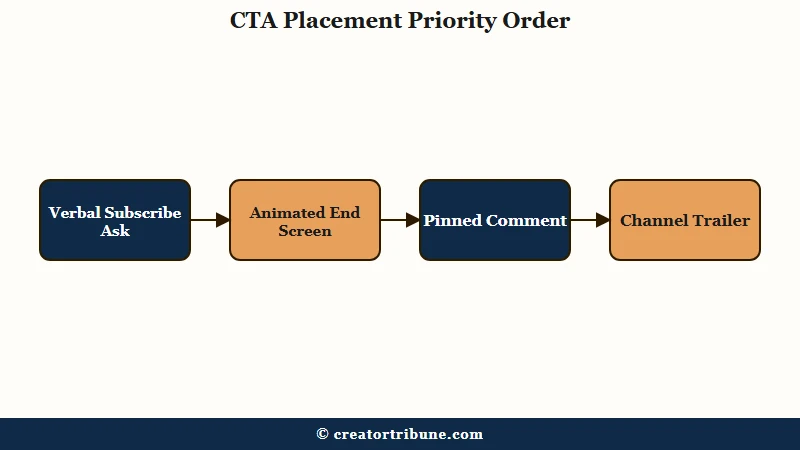
Here is the placement priority I would use:
- Mid-video, after the peak value moment. Verbal CTA tied to a specific reason: “If you found this useful, subscribe, I break down a new creator-economy fix every Tuesday.”
- End screen with an animated subscribe element. Creator tool guides commonly put animated end-screen subscribe elements around 22 percent ahead of static ones, though YouTube publishes no figure of its own, so treat that as directional. Pair it with a verbal callback to the same reason from your mid-video ask.
- Pinned comment with a time-bound incentive. “Subscribe and I will share the spreadsheet from this video in a Community post by Friday” outperforms “subscribe for more” by a meaningful margin because it converts the action into a small contract.
- Channel trailer (the silent CTA). Your 60 to 90 second channel trailer auto-plays for visitors who are not already subscribed. It is doing CTA work 24 hours a day in the background.
Vague: “Hey guys, don’t forget to subscribe and hit the bell.”
Specific: “If the framework I just walked through saved you an hour, subscribe. I post one creator workflow audit every Tuesday and the next one breaks down how to fix a stalled Reels reach in three signals.”
The specific version names the value you just delivered, names the reason for the future commitment, names the cadence, and names what the next piece of content will be. It is four moves stacked into one sentence, and it converts an order of magnitude better than the vague version.
The bell notification is a separate consideration. A subscriber with the bell on drives early views in the first one to two hours after upload, which is the most algorithmically valuable window for triggering wider distribution.
A channel with 5,000 bell-enabled subscribers will often outperform a channel with 50,000 passive subscribers on individual video performance.
Why Your Channel Page Is the Real Conversion Asset
Your channel page is the highest-leverage conversion asset on YouTube because it answers the one question every almost-converted viewer asks: “is there more like this video, on a schedule I can rely on?”
If your channel page does not answer that question in 10 seconds, the almost-conversion turns into a bounce. The page has three levers, and most creators ignore all three.
The first lever is the channel trailer. A 60 to 90 second video that runs automatically for non-subscribers, the trailer is your dedicated landing page video.
It should name the niche, the cadence, the audience, and show one or two best moments from your strongest videos. Most channel trailers either do not exist or were uploaded two years ago and no longer represent the channel.
The second lever is playlist organization. Random thumbnails on the channel page tell a visitor “I do whatever I feel like.”
Three to five well-organized playlists with clear titles tell a visitor “here is what this channel is about, in depth, by topic.” The depth-by-topic signal is what converts a casual viewer into a subscriber.
The third lever is the banner. Most channel banners are decorative. The banners that convert state the upload schedule explicitly: “New videos every Tuesday and Friday.”
The viewer sees a commitment from you, returns the commitment by hitting subscribe. The scheduling tool comparison covers how to maintain that posted cadence consistently across platforms once the banner promises it.
Subscriber acquisition on most channels concentrates in a small slice of the catalogue. How small varies enormously from channel to channel, so the only number worth acting on is the one in your own Studio data.
Whatever your split turns out to be, the channel page is what puts those few high-converting videos in front of someone who arrived from a weaker one. It does that around the clock for every visitor who clicks your channel name.
For context on how the channel page sits inside the broader cross-posting workflow, the native versus reupload breakdown covers how cross-platform uploads affect what shows up first on your channel page and which videos get the early discovery views that drive subscribers.
The 30-Day Playbook to Convert More Views Into Subscribers
The 30-day playbook is four phases: audit your conversion rate, fix the channel page, rewrite the CTA pattern, then publish series content. Run it in this order because each phase amplifies the next.
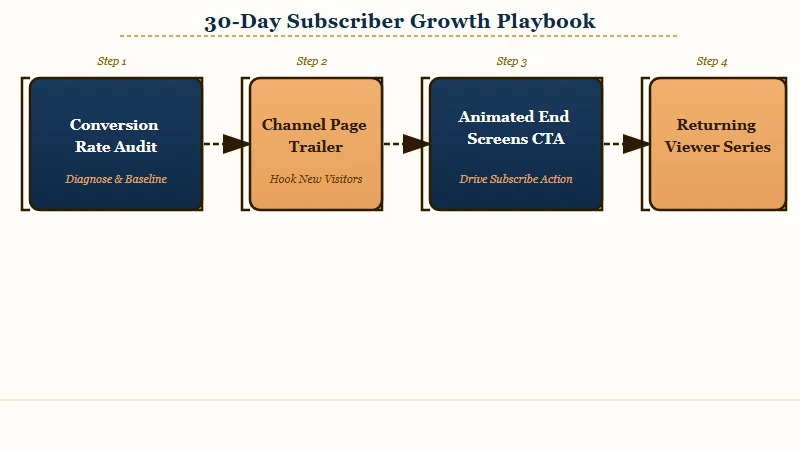
Here is the week-by-week sequence I would run on a channel sitting below 1 percent conversion.
- Week 1: Audit. Open YouTube Studio analytics. Pull subscribers gained and total views for the last 90 days. Calculate your conversion rate. Identify the three videos with the highest view count and the three with the highest conversion rate. Note what the high-conversion videos have in common (likely topic, hook, or value density).
- Week 2: Fix the channel page. Record a fresh 60 to 90 second trailer that names the niche, cadence, and best-of moments. Organize your videos into 3 to 5 playlists with clear titles. Update the banner to state the upload schedule. This is the phase that acts on traffic already arriving, which is why it tends to show in the numbers before anything else you change.
- Week 3: Rewrite the CTA pattern. Edit your next 4 uploads to include a mid-video CTA right after the peak value moment. Use the specific-ask format shown earlier: name the value you just delivered, name the cadence, and name what the next video covers. Add animated end screens to the last 20 seconds of each video. Pin a comment with a time-bound incentive on every new upload.
- Week 4: Launch a series. Pick one topic with proven view performance. Plan a 3 to 5 part series with clear part numbers in the titles. Multi-part series tend to convert better than standalone uploads because viewers subscribe to catch the next installment. No published study fixes a number to that gap. Treat the size of the gain as unknown until your own channel has run one.
Before: A channel runs 0.4 percent conversion on 4,000 views per video and gains 16 subs per upload. The CTA is “guys, smash that subscribe button” at the 30-second mark, there is no channel trailer, and the banner says “Welcome to my channel.”
After: The same channel runs the 30-day playbook. New trailer in week 2 names the niche and cadence. CTA moves to the peak moment and names a specific reason.
In that same scenario, the series launches in week 4 and conversion reaches 1.1 percent by day 30. The same 4,000 views would then produce 44 subs per upload, a 2.75x increase on identical traffic.
The compounding kicks in around day 60 because the new subscribers have the bell on, drive early views, trigger broader distribution, and bring more viewers into the funnel you just fixed.
How Shorts Conversion Differs From Long-Form
Shorts convert to subscribers at a lower rate than long-form because the audience is more passive and the viewing context is built for swipe-through, not commitment. Use Shorts as the discovery layer and long-form as the conversion layer.
The 70 billion daily Shorts views figure that still circulates in creator guides is years out of date. YouTube has since reported Shorts averaging more than 200 billion views a day, and part of that jump is definitional rather than growth, because Shorts began counting a view at play start on March 31, 2025.
The same caveat applies to the widely quoted slide in Shorts engagement rate, from around 3.73 percent to 2.34 percent. Once every scroll-past counts as a view, a per-view engagement rate falls on arithmetic alone, so some of that decline is arithmetic and not evidence that the audience went cold.
The concrete 2026 benchmark is easier to plan around than a bare percentage. One million Shorts views typically converts to somewhere between 500 and 5,000 subscribers, a 0.05 to 0.5 percent rate. The same million views delivered through long-form usually converts three to five times higher, because a viewer who chose a ten-minute video already showed the intent a swipe-fed Short never asks for.
The strategic move for creators is to stop treating Shorts as a sub-conversion machine and start treating them as the discovery layer that feeds your long-form conversion. Every Short you publish should include a verbal callback that names a specific long-form video on your channel, ideally one that matches the same topic the Short opened.
| Format | View source | Audience intent | Subscriber conversion rate | Strategic role |
|---|---|---|---|---|
| Shorts | Swipe feed, autoplay | Passive | 0.05 to 0.5 percent | Discovery, top of funnel |
| Long-form (under 8 min) | Search, suggested, channel page | Active | 1 to 2 percent | Conversion |
| Long-form (over 15 min) | Search, suggested, returning audience | High intent | 2 to 4 percent | Loyalty deepening |
| Series / multi-part | Returning audience, suggested | Highest intent | 3 to 5 percent | Sub-locking |
For why your Shorts may have stalled at low views in the first place, the YouTube Shorts views stopped diagnostic covers the seed-audience test that explains whether the issue is the content or the algorithm.
Statista’s YouTube figures show the sheer audience scale creators are drawing from. Our reading of that scale is that reaching viewers stopped being the hard part some time ago, and converting them into a returning audience is where most channels now lose ground.
Frequently Asked Questions
What is a good view-to-subscriber ratio for a new channel?
Aim for 1 percent or better in the first 90 days. New channels often run below benchmark because the algorithm has not yet built a profile of who the content is for. Judge your conversion rate against your niche, not against creators in unrelated categories.
Should I ask viewers to subscribe at the start of the video?
No, this is the most common conversion-tanking mistake. The ask should follow the peak value moment in the body of the video, not the intro. Asking before delivery reads as begging and trains the audience not to take CTAs seriously.
Does the bell notification really matter?
Yes, because bell subscribers drive early views in the first one to two hours after upload, which are the most algorithmically valuable for triggering wider distribution. A channel with 5,000 bell-on subscribers will often outperform one with 50,000 passive subscribers on individual videos.
How long should it take to see conversion-rate improvements?
The channel page fix shows results in week one because it applies to traffic already arriving. CTA changes show results within two weeks of the first edited upload. Series content takes about 6 to 8 weeks to show full compounding because the algorithm needs time to recognize the series pattern and recommend later episodes.
Are Shorts viewers worth pursuing for subscribers?
Yes as a discovery layer, no as a primary conversion path. Treat Shorts as the funnel inlet and route viewers to long-form on the same topic for the actual subscribe action. The math works when the long-form completes the trust delivery the Short started.
What is the average view-to-subscriber conversion rate on YouTube Shorts?
Roughly 0.05 to 0.5 percent, which works out to about 500 to 5,000 new subscribers per million Shorts views. Shorts pull far more views than long-form but convert at a fraction of the rate, because the swipe feed serves passive viewers with no prior intent. Route those viewers to a long-form video on the same topic, where conversion runs three to five times higher.
How do you convert YouTube viewers into subscribers?
Move the subscribe ask to just after the peak value moment in the video and name a specific reason to expect more, then rebuild the channel page so it shows a niche, a cadence, and organized playlists. Both changes act on viewers who already watched, which is where nearly all of the available conversion sits.
Did YouTube change how views are counted in 2026?
Yes. From August 24, 2026 YouTube counts a view the moment a video starts to play across Shorts, long-form, and live streams, which in practice moved long-form and live onto the standard Shorts had used since March 2025. A long-form conversion rate therefore reads lower than it did before that date on identical performance, while Partner Program earnings and eligibility are unaffected because those still run on engaged views and qualified views.
What if I run the playbook and my conversion rate does not move?
Audit the hook in your first 30 seconds. Conversion rate below 0.5 percent after running the full playbook usually means the hook is not earning the watch time needed for the mid-video CTA to land. If retention drops below 30 percent in the first 60 seconds, no CTA placement will save the conversion rate.