How to Sell Digital Products Online as a Creator
How to Sell Digital Products Online as a Creator
How to sell digital products online as a creator, from picking the right product to pricing and your first sale without losing money to platform fees.
- 1How to Sell Digital Products Online When You Already Have an Audience
- 2What Digital Products Sell Best
- 3How to Price Digital Products Without Leaving Money on the Table
- 4Where to Sell Digital Products Online Without the Fee Trap
- 5The Simple Funnel That Turns Followers Into Buyers
- 6Selling to an Audience You Already Built
- 7Frequently Asked Questions
- How much can you make selling digital products?
- What is the best digital product to sell as a beginner?
- Do I need a website to sell digital products?
- Is Systeme.io really free to sell on?
- How do I get my first sale without a big audience?
- 8Quick Takeaways
TL;DR: You do not need a huge following to sell digital products online. Pick one specific product, price it in the $30 to $49 range where conversion is strongest, and host it on a platform that does not skim a percentage off every sale. The creators who win treat the audience as the asset and the product as the offer.
Learning how to sell digital products online is the moment a creator stops renting an audience and starts owning a business. You already make content that people watch, save, and share. The missing piece is an offer they can buy from you directly.
Most creators brace for the wrong risk. The costliest mistake is rarely the product you pick. It is the price you put on it, set so low that the sale barely clears the platform’s cut.
In a public breakdown of more than 146,000 digital products, items priced between $30 and $49 converted roughly 28% better than products under $10. Cheaper did not mean more buyers. It usually meant thinner margins, more refunds, and more support headaches for the same work.
This guide walks the whole path in the order I would follow today, from choosing a product to landing your first sale. You will come away knowing what to sell, how to price it, where to host it without bleeding money to fees, and how to turn the audience you already have into paying customers.
How to Sell Digital Products Online When You Already Have an Audience
Selling digital products online comes down to five moves: pick one specific product, price it in the proven range, host it on a low-fee platform, build a simple funnel with email capture, and point your existing audience at it. Everything past that is refinement.
The way I see it, most guides on this topic bury that simple spine under thirty tactics nobody needs on day one. You are not building a media empire this week. You are getting one product in front of people who already trust you.
Here is the spine I would run, start to finish:
- Choose one product that solves a single sharp problem for one type of person.
- Price it where conversion and margin both hold up, not at rock bottom.
- Put it on a platform that keeps its hands out of your revenue.
- Build a one-page funnel: a free lead magnet, an email capture, then the paid offer.
- Drive your current followers to that page and collect feedback from the first buyers.
Each of the steps below expands one piece of that spine. If you only act on the pricing and platform sections, you will already be ahead of most creators who launch.
What Digital Products Sell Best
The digital products that sell fastest are simple tools and templates, not sprawling courses. On Gumroad, digital downloads average around 293 sales each while courses average about 115, because a template delivers value the second someone buys it.
What surprised me is how lopsided the niches are. The Writing and Publishing category earned roughly $15,750 per product across only 226 products, a rare mix of high revenue and low competition. The single highest earner in that 146,000-product analysis was an AI Photoshop script that pulled in about $586,000, which tells you the winners are tools and workflows, not recycled prompt lists.
The lesson I take from that: sell something a person can use, not just read. A “complete guide to everything” gets bookmarked and forgotten. A narrow tool gets opened the day it is bought.
Vague: “templates for content creators”
Specific: “a Notion content calendar built for solo TikTok creators who post daily, with a hook bank, a repurposing tracker, and a 30-day posting schedule already filled in”
Here is how the common product types stack up when you are starting out:
| Product type | Effort to make | Typical price | Why it sells |
|---|---|---|---|
| Template or preset | Low | $15 to $49 | Instant use, easy to demo in a video |
| Toolkit or bundle | Medium | $39 to $99 | Feels complete, higher perceived value |
| Short workshop | Medium | $29 to $79 | One clear outcome, quick to deliver |
| Full course | High | $99 to $299 | Highest price, slowest to build and sell |
If this is your first product, I would start in the top two rows and grow into the bottom one once you have buyers and feedback.
How to Price Digital Products Without Leaving Money on the Table
The strongest price band for a first digital product is $30 to $49, which converts about 28% better than anything priced under $10. Pricing too low does more than shrink your margin, it signals low quality before anyone opens the file.
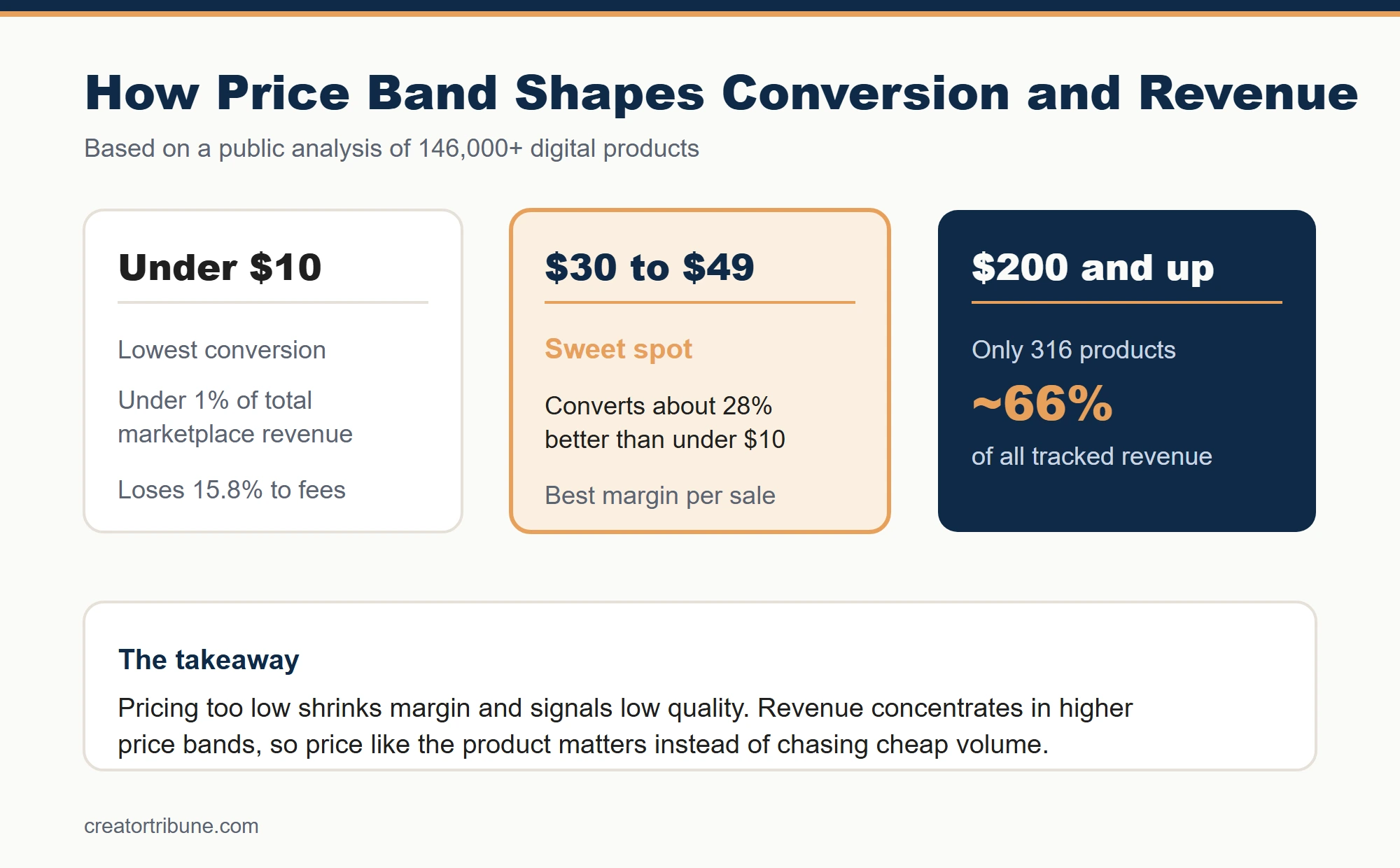
The revenue math is more brutal than most creators expect. In that same product analysis, just 316 products priced at $200 or more held about 65.7% of all tracked revenue, while thousands of sub-$5 products accounted for under 1%. Premium offers carry the business, not impulse buys.
Fees punish low prices twice. A product under $5 loses around 15.8% of its price to platform and processing fees, while a $100 product loses closer to 12.9%. Underpricing is the quiet tax most first-time sellers never notice.
Before: priced a $7 template, sold 200 copies, kept about $1,180 after fees.
After: repackaged the same template into a $39 toolkit, sold 120 copies, kept about $4,070 after fees.
Same work, more than triple the take-home. I would rather sell fewer copies of something priced like it matters than chase volume at a price that barely pays.
Where to Sell Digital Products Online Without the Fee Trap
The best place to sell hinges on one number: the cut each platform takes. A “free” platform that charges 10% per sale quietly becomes your most expensive option once you pass about $1,000 a month in revenue.
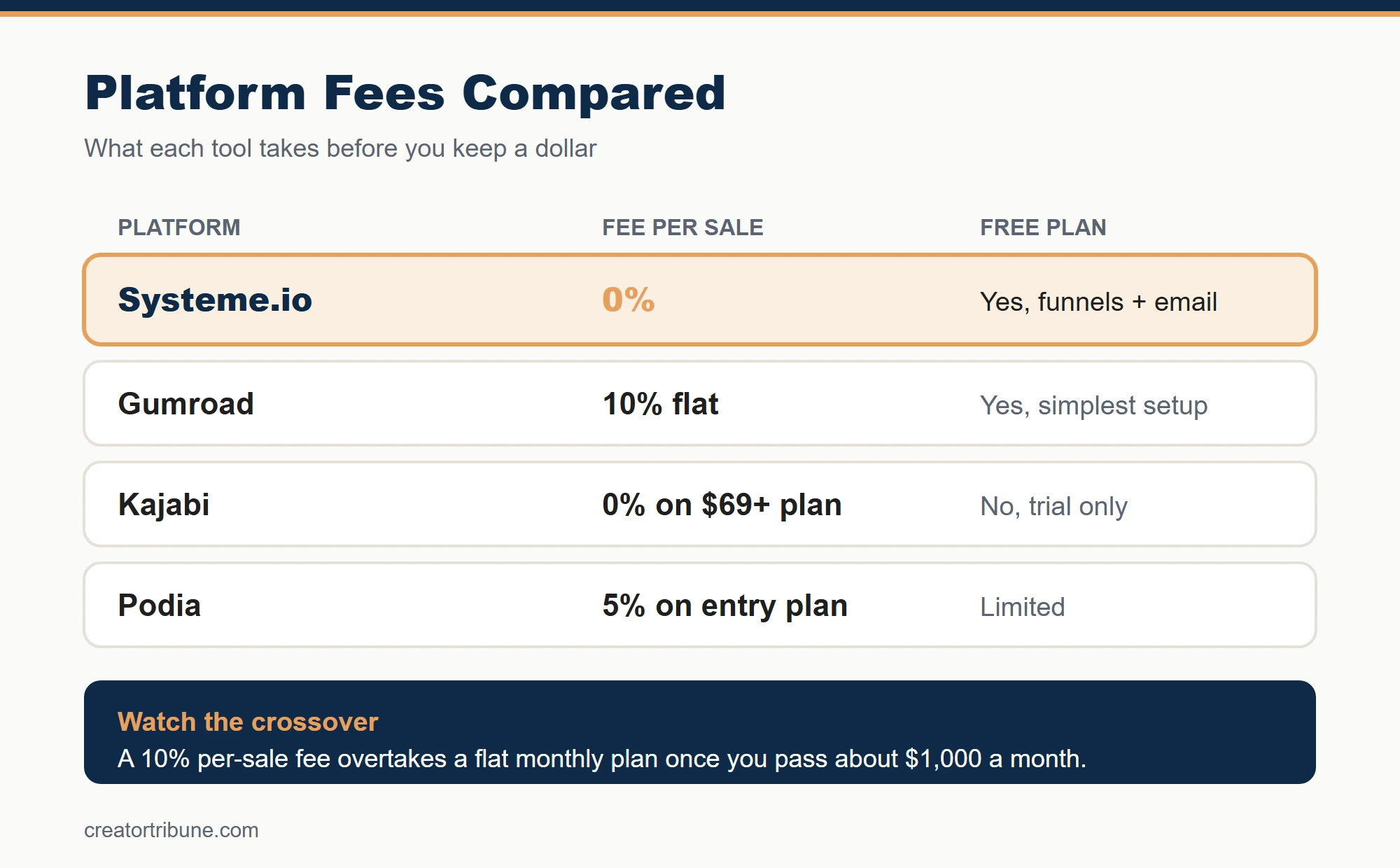
Run the math at $5,000 a month. A 10% transaction fee costs you $500 every month, while a flat plan around $17 to $49 costs a fraction of that and usually adds funnels and email on top. I would not stay on a percentage-fee tool that long out of habit, but plenty of creators do.
| Platform | Free plan | Transaction fee | Best for |
|---|---|---|---|
| Gumroad | Yes | 10% flat plus processing | The fastest possible first sale |
| Systeme.io | Yes, up to 2,000 contacts | 0% on all plans | Funnels and email in one free tool |
| Kajabi | No, trial only | 0% on a $69 plus plan | Established creators with budget |
| Podia | Limited | 5% on the entry plan | Coaches bundling sessions |
For a creator with no budget who still wants funnels and email, I point people to Systeme.io first, because the free plan charges nothing per sale and bundles the tools the others split across add-ons. If you are weighing the big paid names, our breakdowns of the leading ClickFunnels alternatives and the strongest Kajabi alternatives cover where each one earns its price and where it does not.
The Simple Funnel That Turns Followers Into Buyers
A digital product funnel is three steps: a free lead magnet, an email list, and a paid offer. The funnel exists so a casual follower has a low-risk way to raise their hand before you ask for money.
Email still does the heavy lifting here. It consistently drives more revenue per view than social posts, because an inbox is permission and a feed is a lottery. From my testing, the creators who capture emails early outsell the ones who post a buy link and hope.
Here is the sequence I would build first:
- Offer a free resource your audience already wants, like a checklist, a mini template, or a swipe file.
- Collect the email on a one-page opt-in before the download.
- Send a short welcome sequence that delivers value and introduces the paid product.
- Make one clear offer with a single button, not five competing links.
- Follow up with buyers for feedback, then use it to sharpen version two.
You can build all of that on a free plan without a website. If you want the whole opt-in, email, and delivery flow set up for you, we share a free creator money page funnel you can clone and rename in an afternoon.
Selling to an Audience You Already Built
Your existing audience is the warmest, cheapest market you will ever reach, and it matters most when platform payouts get shaky. Ad revenue and creator funds move at the platform’s discretion, but a product you sell directly is income you control.
That control is the whole point. Plenty of creators discover the hard way what happens when monetization gets denied or when TikTok payouts drop overnight. A digital product is one of the few levers that lets you build income beyond platform payouts.
The creator economy is on track to approach half a trillion dollars by 2027, according to Goldman Sachs, and a growing share of that is creators selling directly instead of waiting on brand deals. The shift toward owned revenue looks structural rather than temporary.
The trick is selling without souring the audience that follows you for free content. I keep to a rough 80/20 split, where most posts give value and a smaller slice points to the offer, with a clean path from a link in bio to a mobile page that loads fast and asks for one thing.
Frequently Asked Questions
How much can you make selling digital products?
Earnings vary widely. On Gumroad, digital downloads average around 293 sales each, and a single product priced at $39 can clear a few thousand dollars after fees. Premium products at $200 and up carry most of the revenue, so price and positioning matter more than raw follower count.
What is the best digital product to sell as a beginner?
A narrow template or toolkit. Downloads outsell courses by more than two to one because they solve a problem instantly and take far less time to build. Pick one specific outcome for one specific person rather than a broad “everything” product.
Do I need a website to sell digital products?
No. Platforms like Gumroad and Systeme.io host the page, the checkout, and the file delivery for you. A free Systeme.io plan can run your opt-in, email list, and product page without a separate website.
Is Systeme.io really free to sell on?
Yes. The free plan supports up to 2,000 contacts, unlimited course content, three funnels, and charges 0% transaction fees. Most creators only upgrade once they outgrow the contact limit.
How do I get my first sale without a big audience?
Lead with a free resource to build an email list, then make one clear offer to that list. A small, engaged list of a few hundred people converts better than thousands of passive followers, because email reaches them directly.
Quick Takeaways
- Price your first digital product in the $30 to $49 range, where conversion runs about 28% higher than sub-$10 pricing.
- Sell a tool or template before a course, since downloads outsell courses by more than two to one.
- Avoid percentage-fee platforms past $1,000 a month, a free Systeme.io plan charges 0% per sale and includes funnels and email.
- Build the simple funnel first: free lead magnet, email capture, one clear offer.
- Treat your existing audience as the asset, owned product income is the hedge against unreliable platform payouts.