Am I Shadowbanned and How to Test It on Any Platform
Am I Shadowbanned and How to Test It on Any Platform
Am I shadowbanned? Run this cross-platform diagnostic for Instagram, TikTok, YouTube, and Facebook before you panic. Free, no signup, three minutes.
- 1What a Shadowban Really Is
- 2The One Universal Symptom Worth Tracking
- 3The Cross-Platform Decision Tree
- 4Instagram-Specific Diagnostic
- 5TikTok-Specific Diagnostic
- 6YouTube and the Limited Status
- 7Facebook Page Reach Throttling
- 8What Triggers a Shadowban in the First Place
- 9The Cleanup Sequence That Works
- 10Common Myths That Make Things Worse
- 11Frequently Asked Questions
- How do I know if I am truly shadowbanned or just having a bad week?
- Does the hashtag test still work for diagnosing an Instagram shadowban?
- How long does a shadowban last across platforms?
- Will switching from a Business to a Creator account remove a shadowban?
- Can I use third-party tools to check if I am shadowbanned?
- What is the single most common trigger creators miss?
- 12What to Do Right Now
TL;DR: Most creators who think they are shadowbanned are not. The real signal is non-follower reach collapsing for three to five posts in a row, and the test most people still run on Instagram stopped working in 2026. This guide gives you the actual cross-platform diagnostic that holds up today.
There is a specific kind of panic that hits a creator at 11pm. You open Instagram and your last three Reels have a fraction of their usual views.
The For You page on TikTok has gone quiet. A Short you uploaded yesterday is still stuck at 47 views.
The first word that crosses your mind is the same word every creator reaches for now. Shadowbanned, the easiest explanation, and wrong about seventy percent of the time.
Am I shadowbanned is the right question to ask, but the answer requires more than a vibe check. It needs the same diagnostic across whichever platform you suspect, with a method that holds up in 2026, plus ruling out three explanations that look identical from the outside.
This is the cross-platform test. It works for Instagram, TikTok, YouTube, and Facebook, and it takes about three minutes per platform.
Run it once and you will know whether your reach problem is a shadowban, an algorithm reweight, or something else entirely, plus the recovery path that fits.
What a Shadowban Really Is
A shadowban is a silent, account-level reduction in how much your content reaches people who do not already follow you.
Your posts still publish, your profile still works, and your followers still see you in their feed.
The discovery engines, For You, Explore, Reels, Shorts, hashtag results, are the surfaces that go dark.
What is a shadowban: An unofficial visibility restriction where a platform reduces how often non-followers see your content, without sending you any notification.
The way I see it, the term has been stretched so far that it now means anything from “my Reel got fewer views than usual” to “my account is fully invisible.” Those are not the same thing.
A real shadowban behaves consistently. A bad post does not.
From what I have seen, the biggest creator-side mistake is reacting to a single underperforming post as if it were proof of a ban. One post is noise.
Three to five posts in a row with the same non-follower reach collapse, that is signal. The diagnostic in this guide is built around that distinction.
Recovery from a real shadowban takes anywhere from three days to several weeks depending on the platform and the trigger. Recovery from a bad post takes one good post.
The point of running the test is to find out which world you are in before you start “fixing” something that was never broken.
The One Universal Symptom Worth Tracking
Non-follower reach collapsing across three to five consecutive posts is the only symptom that matters across every platform.
Likes, comments, saves, and total views all swing for reasons that have nothing to do with restriction. Non-follower reach is the metric that maps directly to the discovery engines a shadowban targets.
In my experience, this is also the metric most creators never check. They look at total views, which conflates follower and non-follower audiences, and panic at numbers that are inside the normal weekly variance. The reach-from-non-followers number is buried two or three taps into each platform’s analytics, but it is the only number that gives you a clean read.
Here is the rule I would lock in before going any further. If non-follower reach is steady or only slightly lower, you do not have a shadowban. You have a content problem, an audience-overlap problem, or normal variance. Stop here, save the next three minutes, and read why your Instagram reach dropped overnight instead.
If non-follower reach is below twenty percent of your last 30-day average for three or more posts in a row, keep going. The platform-specific tests below will tell you which kind of restriction is in play.
The Cross-Platform Decision Tree
The decision tree is: check non-follower reach first, then run the platform-specific test only if reach has collapsed.
Skipping the reach check sends thousands of creators down platform-specific rabbit holes for problems that turn out to be normal week-to-week variance.
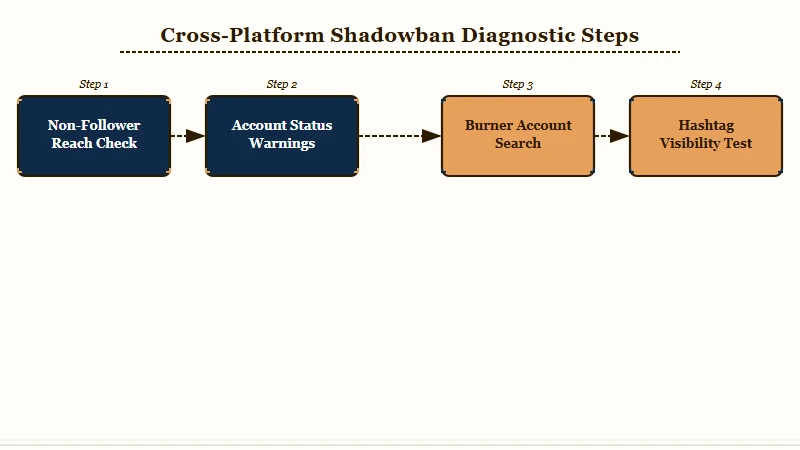
I would walk through this in order. The first three steps are the same on every platform. Steps four and five are where each platform diverges.
- Open the platform’s native analytics, not a third-party tool.
- Find your reach-from-non-followers number for the last five posts.
- Compare it to your trailing 30-day average for the same metric.
- If the last five are at or below twenty percent of the average, run the platform-specific test in the section below for that platform.
- If only one platform shows the collapse, the issue is platform-specific. If every platform shows it at once, the issue is your content pattern or, more rarely, an IP or device problem.
| Step | What you check | Pass result | Fail result |
|---|---|---|---|
| 1 | Last 5 posts’ non-follower reach | Within 60% of 30-day average | Below 20% of 30-day average |
| 2 | Account Status / Studio warnings | No flags | Content flagged or recommendation-ineligible |
| 3 | Burner/incognito search for your handle | Profile appears in results | Profile missing from public results |
| 4 | Hashtag visibility (TikTok only) | Tagged video appears under hashtag | Tagged video missing under hashtag |
| 5 | Recent third-party app connections | None active or all recognized | Unknown or scraping-tool integrations present |
A creator who passes step 1 does not need to keep running. That is the whole point of starting at the reach number.
Instagram-Specific Diagnostic
The Instagram shadowban diagnostic in 2026 is Account Status plus the non-follower reach trend, not the hashtag test.
Meta’s infrastructure changes made the old hashtag method unreliable, and creators who still rely on it get false positives roughly half the time.
What I would do first is the one diagnostic Meta itself documents. Open the Instagram app, go to your profile, tap the menu in the top right, then Settings and activity, then Account Status.
The screen lists three things: whether any of your content has been flagged or removed, whether your account is eligible for recommendations, and whether you have any monetization restrictions.
If Account Status shows a recommendation-eligibility flag, that is the closest thing Instagram offers to an official “you are shadowbanned” notification. If it shows a content removal you did not appeal, that single piece of content is likely the trigger.
If it shows nothing and your reach is still down, you are looking at either an algorithm reweight or a content-pattern problem, not a restriction.
The second Instagram check is the non-follower reach trend in Insights. Tap Insights on your profile, then Content, then filter to Reels.
Look at the “Reach from non-followers” number for your last seven Reels. If three or more are below twenty percent of your trailing average, the discovery engine has gone quiet for you specifically.
The third check is a sanity test, not a diagnostic. Log out of Instagram, open the app, search your username, and see if your profile appears.
If it does not appear in public search, you have either a shadowban or a separate account-discovery restriction. One number sets the threshold: a healthy Instagram post reaches 40 to 50 percent non-followers, and a real restriction drops that below 5 percent across three to five posts in a row.
What changed in 2026: Instagram’s discovery engine now weighs Sends per reach and Saves more heavily than any other signal when it decides whether to push a Reel to non-followers, and the restriction is granular rather than all-or-nothing. An account can be invisible in hashtag search while still surfacing on Explore, or the reverse, so check each surface on its own instead of treating reach as one switch. Meta also unified its reporting under a single Views metric this year, so the non-follower number now sits inside the Views breakdown in Insights.
Instagram flags more than two million accounts a day for spammy or inauthentic behavior, and it almost never notifies the account it just restricted. The four triggers behind nearly every case are automation, banned hashtags, fake engagement, and activity spikes that read as bot-like.
The activity limits that trip the wire: Instagram caps roughly 40 comments per hour, about 200 follows per day, and around 60 unfollows per hour, most of them documented in Instagram’s Help Center on action blocks. Most creators never approach these organically, but engagement-pod tactics blow through the comment cap in twenty minutes. The Instagram follow limit breakdown covers the per-tier follow numbers.
The Instagram recovery that holds up is a hard 48 to 72 hour blackout of all activity, then a slow rebuild across the rest of that first week at 2 to 3 original Reels per week with 3 to 5 niche hashtags. Archive the two or three likeliest trigger posts rather than deleting them, because Instagram reads mass deletion as the fingerprint of a compromised account being cleaned out. Roughly one in four accounts is still throttled after a month when the trigger was never addressed.
One cost most creators miss: a restriction that throttles organic reach also throttles paid. Ads served from a shadowbanned account see CPM and CPC spike, and in severe cases the spend sits at zero while the ad still shows as published.
TikTok-Specific Diagnostic
The TikTok shadowban diagnostic still relies on the unique-hashtag test, plus a For You page absence check from a fresh account.
TikTok has not changed its hashtag indexing the way Instagram has, so the manual hashtag test remains the most reliable single signal.
Here is the version I would run. The whole sequence takes about four minutes.
- Post a new video with a unique hashtag you invent on the spot, something like #zoptericalpie92 that has zero existing uses.
- Wait fifteen minutes for the hashtag index to update.
- From a friend’s account or a logged-out browser, search the hashtag.
- If your video does not appear under the unique hashtag, the account is restricted at the discovery layer.
The second TikTok check is the views-per-post pattern. According to TikTok’s official Community Guidelines on what constitutes a violation, the platform lists copyrighted audio, controversial topics, and bot-like behavior as the major triggers.
If your last five videos all peak at the same low view count, around two hundred to a thousand views, that is the algorithm capping your initial audience-test pool, which is one of TikTok’s softest restriction patterns.
The third check is whether your videos still appear on the For You page of accounts that do not follow you. From a fresh TikTok account or a friend’s logged-in account, scroll the For You page for ten minutes after engaging with content similar to yours. If your content does not surface, the discovery engine is not pushing you to new audiences.
The recovery sequence for a confirmed TikTok shadowban is different from Instagram’s. Stop posting for three to seven days, audit the last fifty videos for copyrighted audio or community-guideline-adjacent content, delete the worst offenders rather than mass-deleting (which can backfire), and resume with a clean run of original-audio content.
The TikTok shadowban recovery walkthrough covers the four-signal diagnostic and the 14-to-30-day recovery window in detail.
YouTube and the Limited Status
YouTube does not call it a shadowban. It calls it “limited,” “soft restriction,” or “not advertiser-friendly,” and the diagnostic lives in YouTube Studio.
Most creators searching “am I shadowbanned on YouTube” are looking at this status without recognizing the language.
The way I see it, YouTube’s version of the same problem is more transparent than Instagram’s or TikTok’s. The platform tells you when a video has been limited, just not always loudly.
The diagnostic is two screens deep in Studio.
Open YouTube Studio, go to Content, and look at each video’s monetization icon column. A yellow dollar sign means limited or no ads, which usually correlates with reduced discovery as well.
Click any flagged video, then Details, then Monetization, and you will see the specific policy reason: profanity, controversial issues, sensitive events, harmful or dangerous acts, and so on. That is YouTube’s version of telling you why a video is being throttled.
The second YouTube check is the impressions-to-CTR ratio. Open Analytics on a flagged video.
If impressions are at or below ten percent of your channel average but click-through rate is normal or higher, YouTube is not showing the video to viewers in the first place. That is the closest analog to a discovery-engine shadowban on YouTube.
The third YouTube check is whether your channel itself is “not eligible for recommendations.” This shows up under Settings, Channel, Advanced settings.
If the toggle for “Made for kids” or any age-restriction setting was flipped accidentally, your entire channel can be pulled from the discovery surface.
The three labels YouTube uses instead of “shadowban”: limited distribution, not suitable for advertising, and borderline content. Each has its own fix: a borderline flag is appealable inside the video’s Monetization panel, a yellow dollar sign is appealable through the Studio request-review button, and search suppression is the hardest because YouTube rarely confirms it exists. The cleanest confirming signal is impressions collapsing 70 to 90 percent inside 48 hours of upload while click-through rate holds steady or rises.
Run the full-title search test for the suppression case: copy the exact video title, paste it into YouTube search from an incognito window, and check the top five results. If your own video does not appear under its own exact title, it has been demoted in search, which is a separate problem from an impressions cap and calls for a stronger title keyword plus a thumbnail refresh.
The YouTube recovery is a 48 to 72 hour upload pause, then acting on the specific Studio trigger, then 2 to 4 weeks at 1 to 2 clean uploads per week. Set weak videos to private or unlisted rather than deleting them, because deletion drops your total watch-time weight and the algorithm reads that as a quality decline.
A single well-made Short is the fastest recovery gauge: clear 1,000 to 2,000 views in the first 24 hours and the channel throttle is lifting, cap under 500 and it is still active. The Shorts views stopped breakdown covers the Shorts-specific signal.
Facebook Page Reach Throttling
Facebook calls its version of a shadowban “reduced distribution,” and Page reach is the only place it shows up clearly. Personal profiles rarely experience the same throttling, but Pages and creator accounts do, particularly after Meta’s content-distribution guideline changes.
What I would check first is Meta Business Suite, the dashboard that consolidates Facebook Page and Instagram analytics in one place. Open Business Suite, go to Insights, then Reach, then Page Reach over the last 28 days. If non-follower reach has dropped below twenty percent of your trailing 90-day average, you are looking at distribution throttling, not just a slow week.
The second Facebook check is the Page Quality tab inside Meta Business Suite. This tab lists every content-distribution violation Meta has flagged on the Page in the last year. Common triggers per Meta’s published transparency reports are sensational health claims, low-quality clickbait, engagement bait (“comment YES if you agree”), and repurposed content that has been reported elsewhere on Meta’s platforms.
The third Facebook check is the cross-platform connection. If you cross-post the same content to Instagram and Facebook through Business Suite, a violation on one Meta surface can throttle reach on the other.
This is the failure mode most Page admins miss because the violation is logged on Instagram but the reach drop shows up on Facebook. For the full Facebook recovery path including the 30-day clean-content window and the Page Quality dispute process, the Facebook reach throttling breakdown goes deep.
What Triggers a Shadowban in the First Place
The four real triggers are community guideline violations, automation or bots, engagement manipulation, and hashtag misuse.
Almost every other “trigger” you have read about online belongs to one of these four categories or is a myth that recycles every few months.
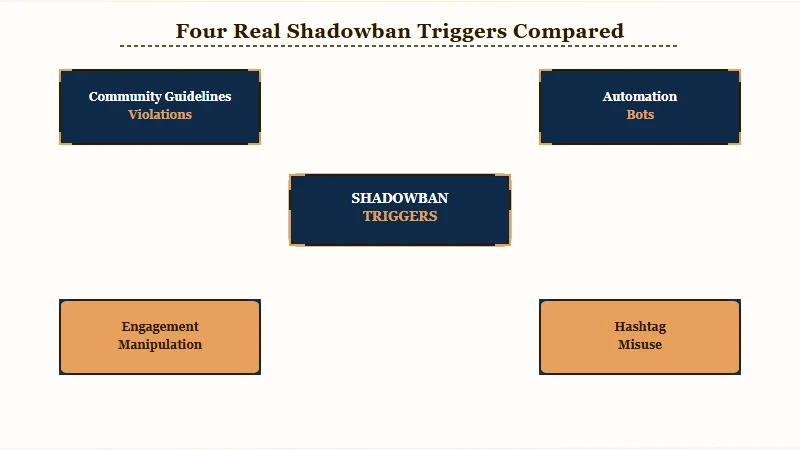
From what I have seen across platforms, the order of severity is roughly consistent. Community guideline violations are the fastest path to a hard restriction, automation is the most common trigger for soft restrictions, engagement manipulation is the easiest one to fall into without realizing, and hashtag misuse is the one creators most often try to “fix” first even though it is the least load-bearing.
Here is the worked example version of how to spot a trigger in your own posting pattern.
Vague: “I think one of my posts violated guidelines.”
Specific: “Three weeks ago I posted a clip with copyrighted background music, two weeks ago I used a third-party scheduling app I had not connected before, last week I joined an engagement-pod Telegram group, and this week my non-follower reach collapsed on both Instagram and TikTok.”
The specific version gives you an actionable timeline. The vague version sends you in circles deleting random content.
The trigger most creators underestimate is bot followers. Platforms read inflated follower counts as evidence of manipulation, and accounts that gain thousands of followers in a short window without proportional engagement get flagged faster than accounts that grow slowly.
If you bought followers in the last six months, or even if you accepted a “free follower trial” from a growth service, that history is the most likely culprit.
The trigger most creators overestimate is hashtag misuse. Yes, using banned or repetitive hashtag blocks can soft-restrict an Instagram post, but it almost never causes account-level restriction.
If your reach problem started after a single hashtag change, the hashtags probably are not the cause.
The Cleanup Sequence That Works
The recovery order is: diagnose first, clean up second, rebuild third. Skipping the diagnose step is the most common mistake creators make.
Mass-deleting old content before knowing what triggered the restriction is more likely to add a new flag than remove the original one.
The way I would approach a confirmed shadowban is in three phases. Each phase needs to finish before the next one starts, and rushing through them is how creators end up in a worse position three weeks later.
Phase 1: Diagnose. Run every test in the relevant platform section above. Write down the specific triggers you found.
If you cannot identify a trigger, do not invent one, and do not delete anything yet. An undiagnosed cleanup is a coin flip.
Phase 2: Cleanup. Disconnect every third-party app from the platform’s authorized-apps list. Change your password.
Delete the two or three pieces of content most likely to be the trigger, not your entire feed. If the trigger was bot followers, remove them gradually over two weeks rather than in a single sweep.
Mass actions look like more bot behavior.
Phase 3: Rebuild. Pause posting for three to seven days on TikTok, or just reduce frequency to two or three posts per week on Instagram and Facebook. Resume with original, on-niche, high-signal content.
No reposts, no recycled audio, no engagement bait. Most platforms restore normal distribution within two weeks of consistent clean signal.
Here is the rebuild table I would keep next to the keyboard during recovery.
| Platform | Pause length | Rebuild cadence | Expected recovery |
|---|---|---|---|
| 3 to 5 days | 2 to 3 posts per week, original only | 7 to 21 days | |
| TikTok | 3 to 7 days | 1 post per day, original audio | 7 to 14 days |
| YouTube | No pause needed | Appeal flagged videos, upload as normal | Per-video, 24 to 72 hours |
| No pause needed | 30 days of clean content per Page Quality | 30 to 90 days |
Common Myths That Make Things Worse
Three myths cost creators more time than the shadowbans themselves: the Instagram hashtag test, the account-type-switch reset, and mass-deletion as cleanup.
None of these work in 2026 the way they used to, and acting on them often makes the diagnosis or recovery harder.
The hashtag test on Instagram is the most cited and the most outdated. Meta’s 2026 hashtag-indexing changes mean a post can fail to appear under a hashtag for half a dozen reasons that have nothing to do with restriction.
What I would recommend instead is the Account Status screen plus the non-follower reach trend, both of which I covered above. The hashtag test as a primary diagnostic now produces a false positive often enough that it should not be the first thing you reach for.
The account-type-switch reset is the second myth. Toggling between Creator and Business on TikTok, or Personal and Professional on Instagram, does not clear a restriction.
It refreshes your profile metadata, which is occasionally useful for syncing analytics, but it does not address whatever trigger caused the restriction in the first place. From what I have seen, creators who try this and see “recovery” usually recovered because of the time gap during the experiment, not the switch itself.
Mass-deletion is the third and most damaging myth. Deleting fifty or a hundred posts at once looks like cleanup if you do not know how the algorithm reads it, but the same volume of activity is also a strong fingerprint of compromised or bot-controlled accounts.
Platforms flag mass-deletion as a risk pattern more often than they treat it as cleanup. The fix is to delete the two or three pieces of content most likely to be the trigger, then stop.
There is a fourth myth I keep seeing that does not have a tidy fix. A common belief is that using a VPN occasionally is a shadowban trigger.
The honest version is that frequent IP changes can raise flags, but a once-a-week VPN session for privacy does not put you at meaningful risk. Worry about IP changes only if you are switching IPs constantly or sharing a creator-house network.
Frequently Asked Questions
How do I know if I am truly shadowbanned or just having a bad week?
A shadowban shows up as a non-follower-reach collapse across three to five consecutive posts, not a single bad post. Check the reach-from-non-followers number in your platform’s native analytics first. If it is within sixty percent of your 30-day average, you are inside normal variance.
Does the hashtag test still work for diagnosing an Instagram shadowban?
Not reliably in 2026. Meta changed how hashtags are indexed, and the test now produces frequent false positives. Use the Account Status screen plus the non-follower reach trend in Insights instead.
How long does a shadowban last across platforms?
TikTok typically lifts a soft shadowban within 7 to 14 days of clean signal. Instagram ranges from a few days to several weeks for automation-related restrictions. YouTube limited-status resolves in 24 to 72 hours per video, and Facebook Page reach throttling takes 30 to 90 days.
Will switching from a Business to a Creator account remove a shadowban?
No. The account-type switch is one of the most common pieces of bad advice. It refreshes profile metadata but does not address the underlying trigger.
Can I use third-party tools to check if I am shadowbanned?
Some are useful for pattern analysis, like Spikerz and IG Hero, but no third-party tool can access the official restriction signal the platforms themselves use. Never use any tool that asks for your password.
What is the single most common trigger creators miss?
Bot followers. Buying followers, even cheaply or “as a test,” is the most common trigger I see for creators who cannot identify what they did wrong. The fix is to remove them gradually over two weeks, not in a single sweep.
What to Do Right Now
The next step depends on which test result you got, but the order is the same: stop guessing, run the diagnostic, then act on what it shows. Acting on a hunch instead of the test result is how creators end up making the problem worse.
If you ran this test and the non-follower reach number was inside normal variance, the answer is straightforward. You are not shadowbanned.
Stop refreshing the post and go work on a stronger hook for the next one.
If the reach number confirmed a real collapse on one platform, run the platform-specific recovery playbook linked in that section. Diagnose the trigger first, clean up second, rebuild third.
Most shadowbans resolve within two to three weeks of consistent clean signal.
If the reach number confirmed a collapse on every platform at once, that is a different problem. A cross-platform reach drop usually points to an IP-level issue, a device flag, or a content pattern that violates guidelines everywhere.
Start with the IP and device check, then audit your last thirty pieces of content for the four real triggers covered above.
The one mistake I would not make is acting on a hunch. The whole point of running this diagnostic is to spend three minutes on a clean answer instead of three weeks “fixing” something that was never broken in the first place.