
How to Clear Instagram Cache Without Deleting Your Drafts
How to Clear Instagram Cache Without Deleting Your Drafts
Clearing your Instagram cache can speed up the app, but the wrong method wipes your drafts. Here is how to do it safely on Android and iPhone.
- 1What Clearing the Instagram Cache Really Removes
- 2How Do I Clear the Instagram Cache on Android?
- 3Why Is There No Clear Cache Button on iPhone?
- 4Does Clearing the Cache Delete My Instagram Drafts?
- 5What Clearing the Cache Will Not Fix
- 6The Safe Order to Clean Up Instagram on iPhone
- 7Frequently Asked Questions
- Does clearing the Instagram cache delete my photos and messages?
- Will clearing the cache log me out of Instagram?
- How do I clear the Instagram cache on iPhone if there is no button?
- Does offloading the app really clear the cache?
- How often should I clear my Instagram cache?
- Does clearing the cache remove my search history?
- 8Quick Takeaways
TL;DR: On Android you clear the Instagram cache in Settings under Storage and cache, and it keeps you logged in. On iPhone there is no cache button, so you either offload the app or delete and reinstall it. The catch is that the aggressive methods also erase your local drafts, so the order you do this in matters.
If you searched how to clear the Instagram cache, you probably have a phone that is either running low on storage or an app that has started freezing on Reels and stalling on the feed. Clearing the cache is the standard fix, and most of the time it works.
What almost no guide warns you about is that one wrong tap can take your unpublished drafts with it.
Here is the part that surprised me about how the app stores data under the hood. On iPhone, the trick everyone recommends, offloading the app, often frees almost nothing, because it deliberately keeps the folder where the bloat lives.
Apple’s own rule for auto clearing that folder only kicks in when your phone is nearly full, and never while Instagram is open.
So think of this as the safe sequence, split by phone, with a clear map of what each method deletes and what it protects. You will finish knowing exactly which method to use, in what order, without gambling your saved content.

What Clearing the Instagram Cache Really Removes
Clearing the Instagram cache deletes temporary files the app saved to load faster, like preloaded images, video thumbnails, and web previews.
It does not touch your account, your posts, your messages, or your followers, because all of that lives on Instagram’s servers, not your phone.
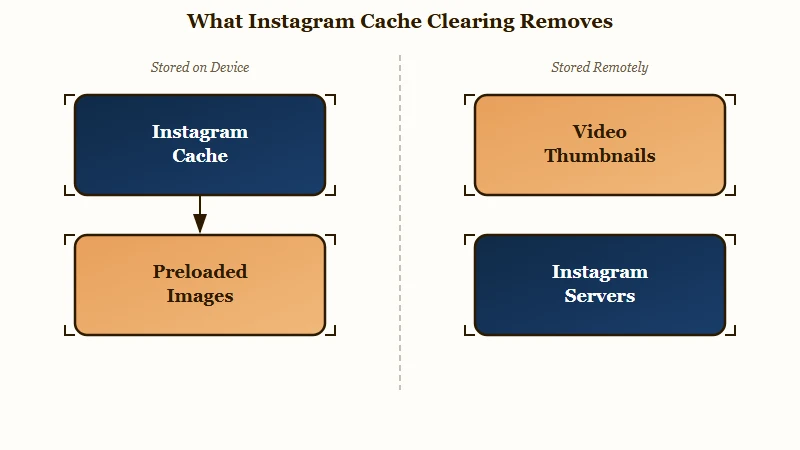
What is app cache: Temporary files an app stores locally so it can reload content quickly instead of downloading it again every time you open it.
The reason the cache balloons so fast is that Instagram is a media firehose. One preloaded 10 second Reel can exceed 200 MB, and high resolution photos run 10 to 15 MB each, so a heavy scrolling habit stacks up quickly.
On a busy Android phone, social apps routinely pass 1 GB of cache, and on iPhone the figure reported for a bloated Instagram install climbs past 10 GB.
What I would keep straight from the start is the difference between cache and data. Cache is the disposable stuff. Data is your login, your settings, and your local drafts.
Every method below sits somewhere on that spectrum, and the safe ones only clear cache while the aggressive ones wipe data too. If your feed is also showing stale content or the app keeps stalling on upload, our guide on Instagram stories not uploading covers the loading side of this.
How Do I Clear the Instagram Cache on Android?
On Android, open Settings, go to Apps, select Instagram, tap Storage and cache, then tap Clear cache.
This clears the disposable files and, importantly, keeps you logged in and keeps your drafts intact.
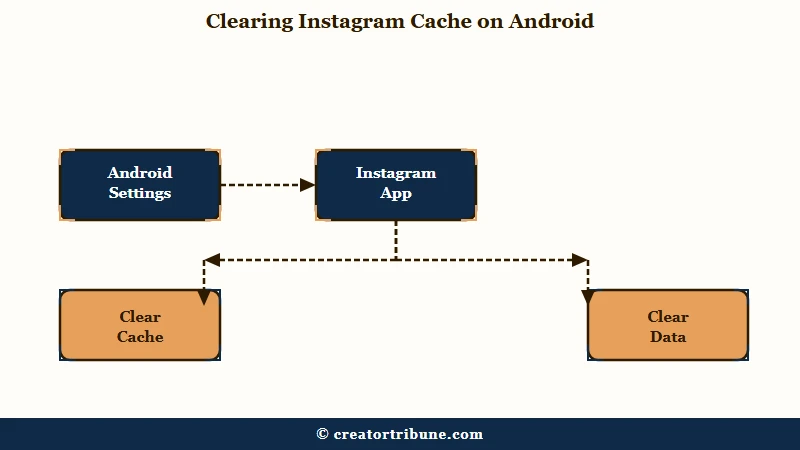
Most people panic here because the same screen has a second button sitting right next to the first, and the two do very different things. Clear cache is safe. Clear storage, sometimes labeled Clear data, resets the app to factory state and signs you out.
Here is the sequence I would walk through, in order, so you never hit the wrong one:
- Long press the Instagram icon on your home screen and tap the “i” App info shortcut, or open Settings, then Apps, then Instagram.
- Tap Storage and cache.
- Tap Clear cache. Stop here. This is the safe action.
- Only tap Clear storage or Clear data if you are prepared to log back in and lose local drafts.
If clearing the cache alone does not settle a crash, do not immediately jump to Clear data. On Samsung Galaxy phones there was a bug that closed the app instantly no matter how many times users cleared the cache, and the real fix was a system update, not a data wipe. More on that below in the section on what clearing will not fix.
Before: you tap Clear storage hoping to fix a glitch, and Instagram signs you out and your half finished Reel draft is gone.
After: you tap Clear cache instead, the glitch clears, you stay logged in, and your draft is still sitting in the Reels drafts folder.
Why Is There No Clear Cache Button on iPhone?
iPhone has no clear cache button because Apple designed iOS to manage app caches automatically instead of handing that control to the user.
The system is built to purge temporary files on its own, so Apple leaves it to each app to add its own button, and Instagram has never added one.
The problem is that “automatic” is doing a lot of work in that sentence. Per Apple’s developer documentation, iOS only clears an app’s Caches folder on rare occasions when storage is critically low, and that cleanup will never run while the app is open.
So if your phone still has a few gigabytes free, iOS is not clearing anything, which is exactly why your storage keeps creeping up while Apple insists it has this handled.
That leaves iPhone users with two real options, and this is where the biggest myth lives. Offload App removes the app itself but keeps its documents and data, so your login and local drafts survive. Delete App removes everything, including the cached bloat and your local drafts.
What is Offload App: An iOS feature that deletes an app’s program files to free space while preserving its saved data, so reinstalling restores it as you left it.
The myth I would most want to kill is this one. Guides constantly recommend offloading as the way to clear your iPhone cache, but offloading preserves the exact folder where much of the cache sits.
Sources flatly contradict each other on this, with some security blogs claiming offload clears the cache and others stating plainly that it keeps stored files. The honest answer is that offloading frees only the size of the app program, often under a couple hundred megabytes, and leaves the heavy cached media behind.
To truly wipe an Instagram cache on iPhone, you have to delete and reinstall.
Does Clearing the Cache Delete My Instagram Drafts?
Yes, the aggressive methods delete your drafts, because Instagram stores unpublished drafts locally on your phone, not in your account.
A draft is saved as the media file plus a small metadata file that holds your caption, audio, and edits, and all of it sits in the app’s private storage.
This is the single most expensive mistake people make, and the guides do not agree on it. One popular security blog reassures readers that clearing the cache will not remove drafts.
Developer focused sources and social tools say the opposite in plain terms. Log out, uninstall, or clear the app’s data, and those drafts are gone for good. When sources contradict each other this directly, I trust the one that matches how local storage works, and drafts are local.
There is a second trap on top of that. Story drafts are treated as temporary and are automatically deleted after seven days whether or not you ever touch your cache. So a Story draft you meant to post next week can vanish on its own.
The practical rule I would follow: if you have drafts you care about, post them, or screen record and re export the media before you clear data on Android or delete the app on iPhone.
If your uploads have also been coming out soft or pixelated, that is a separate issue covered in our breakdown of Instagram photo quality after upload, and clearing the cache will not fix it.
What Clearing the Cache Will Not Fix
Clearing the cache will not fix backend outages, server side bugs, or compression on your uploads, because none of those are caused by local files.
Cache clearing only helps when the problem is bloated or corrupted temporary data on your own device.
The clearest example, and the one I see people waste the most time on, is app crashing. When Instagram closes the moment it opens, users try clearing cache, clearing data, and reinstalling, and none of it works, because the cause is a software conflict outside the app.
On some Galaxy devices the instant crash bug only cleared after installing a specific One UI feature update and security patch. If the whole platform is misbehaving at once, check whether Instagram is down before you start deleting anything. Our guide on why Instagram keeps crashing walks through the device level fixes.
Blurry uploads are the other thing people wrongly blame on cache. That is usually the Data Saver setting compressing your media, combined with the low quality placeholder Instagram shows for a second while the full resolution version loads over the network. Clearing the cache does nothing for either.
Here is a quick map of which problem each method solves:
| Symptom | Likely cause | Does clearing cache help |
|---|---|---|
| App lag and slow scrolling | Bloated or corrupt cache | Yes, this is the main use |
| Storage nearly full | Cache plus stored data | Partly, full reinstall frees more |
| App crashes on open | System or software bug | No, needs an OS or app update |
| Blurry uploads | Data Saver compression | No, change the setting instead |
| Feed or profile will not load | Server outage | No, wait for the outage to pass |
The Safe Order to Clean Up Instagram on iPhone
The safe cleanup order goes from least destructive to most, so you free space without gambling your drafts.
Start with the in app cleanups that touch nothing important, and treat the full delete as a last resort you prepare for.
The way I see it, most people skip straight to the nuclear option and lose content they did not need to. A tiered sequence gets you almost all the storage back with almost none of the risk. Here is the order I would use on an iPhone:
- Clear your in app search history under Settings and activity, then Your activity, then Recent searches, then Clear all. This is separate from the cache and the app never clears it for you.
- Turn off automatic saving of your posts and Stories to your camera roll so the app stops duplicating media.
- Offload the app from Settings, General, iPhone Storage. This is the low risk step that keeps drafts and login.
- Only if storage is still critical, back up any drafts you care about, then delete and reinstall to wipe the cache completely.
Compare that to Android, where step three is just tapping Clear cache, and you only reach the destructive Clear data step if a bug forces it. The point on either phone is the same: exhaust the safe options first.
The platform controls where your content and audience live, and it can reshuffle that under you at any time. That is why I would not keep anything you cannot afford to lose trapped only inside the app. If you want a durable home base that the platform cannot wipe with a cache clear, your own links page is worth setting up once.
Instagram serves more than two billion monthly users worldwide, according to Statista, so a storage habit that eats gigabytes is a problem at real scale, not just an edge case on your phone.
Here is the full reference for what each method deletes and what it protects:
| What happens to it | Android Clear cache | Android Clear data | iPhone Offload | iPhone Delete and reinstall |
|---|---|---|---|---|
| Temporary cache | Cleared | Cleared | Mostly kept | Cleared |
| Login session | Kept | Signed out | Kept | Signed out |
| Local drafts | Kept | Deleted | Kept | Deleted |
| Posts and messages | Safe on server | Safe on server | Safe on server | Safe on server |
| Storage freed | Moderate | High | Low | High |
Frequently Asked Questions
Does clearing the Instagram cache delete my photos and messages?
No. Your posts, Reels, and direct messages are stored on Instagram’s servers, so clearing the cache only removes temporary local files. Everything reappears the next time you open the app and it reloads from the server.
Will clearing the cache log me out of Instagram?
On Android, tapping Clear cache keeps you logged in, but Clear data signs you out. On iPhone, offloading keeps you logged in, while deleting and reinstalling the app signs you out and you will need your password.
How do I clear the Instagram cache on iPhone if there is no button?
Use Offload App under Settings, General, iPhone Storage to free space while keeping your data. To fully clear the cache, back up any drafts first, then delete the app and reinstall it from the App Store.
Does offloading the app really clear the cache?
Mostly no. Offloading removes the app program but keeps the documents and data folder where much of the cache lives, so it frees only a small amount. A full delete and reinstall is the only way to truly clear it on iPhone.
How often should I clear my Instagram cache?
There is no fixed schedule. Every few months is plenty for most people, or whenever the app starts lagging, Reels stop loading, or your storage runs low. Heavy daily creators might do it monthly.
Does clearing the cache remove my search history?
No. Search history is stored separately, so you have to clear it yourself under Settings and activity, then Your activity, then Recent searches, then Clear all.
Quick Takeaways
- On Android, Clear cache is safe and keeps you logged in, while Clear data wipes your login and local drafts.
- On iPhone there is no cache button, and offloading frees little because it keeps the folder where the cache sits.
- Instagram drafts are stored on your phone, not your account, so a full delete or Clear data destroys them permanently.
- Clearing the cache fixes lag and bloat, but it will not fix crashes, outages, or blurry uploads.
- Post or back up any drafts you care about before you use the destructive methods, and clean up in order from safest to most drastic.