Recover From Creator Burnout Without Losing Your Audience
Recover From Creator Burnout Without Losing Your Audience
Creator burnout hits 62% of full-time creators. Get the 30-day recovery plan with a scorecard, batch math, and cadence ceilings inside.
- 1Are You Burnt Out Or Just Tired
- 2Why Posting More Makes Creator Burnout Worse
- 3What Does A 30-Day Content Creator Burnout Recovery Plan Look Like
- 4How Many Videos Should You Batch Per Session
- 5How Many Posts Per Week Stays Safe On Each Platform
- 6How Do You Take A Break Without Losing Your Audience
- 7Frequently Asked Questions
- Am I burnt out or just tired?
- How long does it take to recover from creator burnout?
- Will the algorithm punish me if I stop posting for 30 days?
- How do I announce a break without losing followers?
- Can content batching cause burnout too?
- How many posts per week stays safe long-term?
- Should I quit content creation if I am burnt out?
TL;DR: Creator burnout is structural, not personal. In a 2026 survey of 2,400 full-time creators, 62 percent reported severe burnout symptoms, and 47 percent had considered quitting in the past six months. The 30-day recovery plan below has worked across every major platform without the algorithm penalty most creators are afraid of.
Content creator burnout recovery is the kind of thing most guides treat as a vibe rather than a plan. You read “take a break” and “be kinder to yourself” and you nod, then you open TikTok at 11 pm and start filming another video because the algorithm waits for no one.
The honest version is that 62 percent of full-time creators report severe burnout symptoms in 2026, and the rates climb to 68 percent on TikTok specifically. The platform you picked is doing more of the damage than you are. None of this is a personal failure, and the recovery is more structured than most advice admits.
What follows is a 30-day plan with a diagnostic scorecard at the front, real batch-filming math in the middle, and a platform-by-platform cadence ceiling at the end. You will finish this with a clear answer on whether you are burnt out or just tired, exactly what to do for the next four weeks, and how to return to posting without watching your reach collapse.
Are You Burnt Out Or Just Tired
Creator burnout is a five-domain exhaustion pattern across sleep, dread, engagement avoidance, body symptoms, and identity slip that a single weekend of rest will not fix.
Burnout is a state of physical, mental, and emotional exhaustion that one good night of sleep will not fix. The shorthand I use: tiredness ends when the work ends. Burnout does not.
From what I have seen across solo creators in the visual short-form space, the strongest diagnostic is not a single feeling. It is a pattern across five domains that all degrade at once. Tiredness shows up in one or two. Burnout shows up in four or five.
Score yourself across each row in the scorecard below. Add up the points. Anything 8 or higher is structural burnout, not regular fatigue, and the rest of this article is written for you.
| Signal | 0 points | 1 point | 2 points |
|---|---|---|---|
| Sleep quality | Mostly fine | Restless 2-3 nights a week | Wake up tired most days |
| Excitement before filming | Looking forward to it | Neutral, just doing the job | Dread, procrastinate, push it back |
| Engagement with comments | Reply quickly, enjoy it | Slow to reply, mixed feelings | Avoid the comments entirely |
| Body symptoms | None | Occasional headaches or tight shoulders | Daily headaches, gut issues, jaw clenching |
| Identity slip | I create because I love it | I create because it is my job | I am the thing I make, and I want out |
A 2-3 score is just tiredness, take a real weekend off. A 4-7 score is early-stage burnout, the 30-day plan will reset you. An 8-10 score is severe burnout, you may need the plan twice back to back, plus a check-in with a doctor about the physical symptoms.
A longer dead-account recovery walkthrough covers the engagement side of this in more depth if your numbers are also collapsing.
Why Posting More Makes Creator Burnout Worse
Posting more makes creator burnout worse because it deepens content debt without addressing the structural cause, the cadence ceiling the platform demands.
The instinct when reach drops is to post more, because the algorithm rewards frequency. This is the single biggest trap in the creator economy, and the data is brutal on it.
The 2026 creator economy survey found that platforms requiring daily posting have the highest burnout rates: TikTok at 68 percent, Instagram at 61 percent, YouTube at 59 percent, podcasting at 52 percent, newsletters at 48 percent.
The format determines the burnout risk more than the niche does, more than the audience size does, more than the income does. Newsletter creators making the same money as TikTok creators burn out 20 points less often.
What is content debt: The accumulating obligation a creator feels to produce daily content forever, where rest feels like a crisis rather than a normal part of work.
Content debt is the engine of this. Every video you post creates an implicit promise that another video is coming tomorrow. The audience does not consciously demand it, the algorithm does, and you are caught in the middle paying the bill.
The way I see it, the way out is not to post more efficiently, it is to post less and more deliberately. The 30-day plan below pulls your average cadence down to something a human can sustain for three years instead of three months.
What Does A 30-Day Content Creator Burnout Recovery Plan Look Like
A 30-day content creator burnout recovery plan splits into four 7-day phases plus two transition days: hard disconnect, creative rest, low-stakes experimentation, and controlled return.
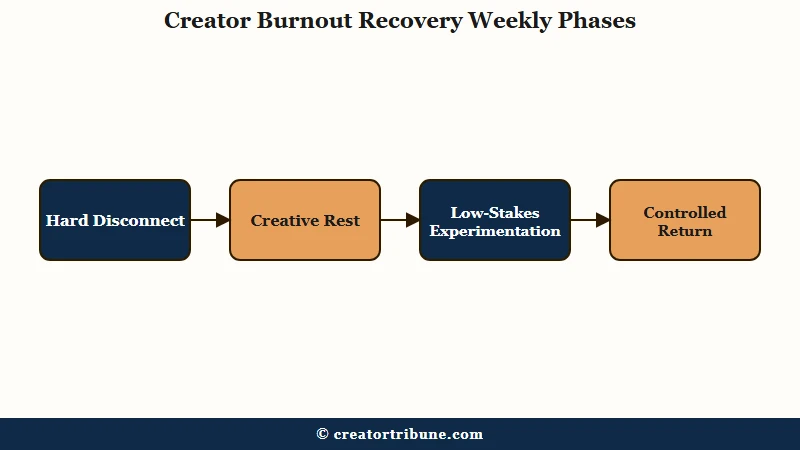
The plan splits into four 7-day phases plus two transition days. You are not posting nothing for 30 days, you are stepping down then stepping back up with intent.
Each phase has a clear job. The first week is hard disconnect, the second is creative rest, the third is low-stakes experimentation, the fourth is controlled return. The two transition days are where most plans fall apart, so I have built them in explicitly.
Here is the day-by-day:
- Day 1 (Friday, transition day): Schedule 4 evergreen posts using a tool like Buffer or your platform’s native scheduler. Announce a break to your audience using the template in the section below. Log out of every creator app on your phone.
- Day 2-8 (Hard disconnect week): Zero new content, zero scrolling on your own platforms. Replace the time with anything analog, walking, reading, cooking, gym. The 20 to 60 minutes of physical movement per day is the part that closes the stress response cycle, do not skip it.
- Day 9-15 (Creative rest week): Consume content again, but only as a viewer. Watch in your niche and adjacent niches. Take notes on what makes you genuinely curious, not what you “should” make.
- Day 16-22 (Low-stakes experimentation week): Film 3 to 5 videos with no plan to publish them. Use them to test new formats, new framings, new tones. The point is to remember that filming can be fun, not to produce.
- Day 23 (Sunday, transition day): Pick your 2 strongest experimental videos. Schedule them for Tuesday and Thursday of week 4. Set a one-time cap: no more than 3 posts in the next 7 days, no exceptions.
- Day 24-30 (Controlled return week): Publish the 2 scheduled videos. Reply to comments only during one fixed 30-minute window per day. Track how you feel before, during, and after each post on a 1 to 5 scale.
The last column matters more than the posting schedule. If your “before filming” score is still below 3 by Day 30, you are not ready to return to normal cadence yet. Do the plan a second time, this is not a failure, it is a longer recovery curve, and 8-10 scorecard creators usually need it.
What cadence to come back to covers the post-recovery side of this in detail, including the data on diminishing returns above 4 posts a week.
How Many Videos Should You Batch Per Session
The safe batching ceiling is 4 videos per 90-minute session, with one filming session per week, the 4:1 rule that keeps on-camera energy consistent.
Batching is the most-recommended burnout fix and the most-misapplied one. The intent is good, the math is usually wrong.
Most creators batch by trying to film an entire week in one Sunday afternoon. That is 7 to 14 videos in a 4-hour session, and what happens by video 8 is your face gets flat, your delivery gets robotic, the algorithm sees the energy drop, and the back half of the week underperforms. From my testing, this kind of mega-batching causes a different flavor of burnout, performance fatigue, where the work is done but the output quality has slid.
The framework I would recommend instead is the 4:1 rule.
Vague: “Batch a week of content on Sunday.”
Specific: Film no more than 4 videos per session. Schedule 1 dedicated film day per week. Keep each video to a single take with one or two retakes maximum. Sessions over 90 minutes are where the on-camera energy collapses.
If your cadence target is 3 posts a week, one 4-video session covers the week with a backup. If your cadence target is 5 posts a week, you need two 90-minute sessions, not one 3-hour session. The math is non-linear because energy is non-linear.
Here is the comparison across session structures:
| Session structure | Time | Videos produced | Energy curve |
|---|---|---|---|
| Mega-batch | 4 hours, one day | 10 to 14 | First 4 strong, rest visibly flat |
| 4:1 rule | 90 minutes, one day | 3 to 4 | Consistent across all takes |
| Split-batch | 90 minutes, two days | 6 to 8 | Consistent both sessions |
| Daily ad-hoc | 20 to 30 min, every day | 7 per week | Burnout-grade, never resets |
The 4:1 rule is the recovery-friendly baseline. The split-batch is the steady-state target once you are out of burnout and your cadence target is 5 to 6 posts a week. The daily ad-hoc row is what most creators are doing now, and it is where the 62 percent burnout figure comes from.
How Many Posts Per Week Stays Safe On Each Platform
The safe weekly ceiling is 3 to 4 short-form posts on TikTok, Reels, and Shorts, with 5 as the absolute upper limit before burnout risk grows faster than reach gains.
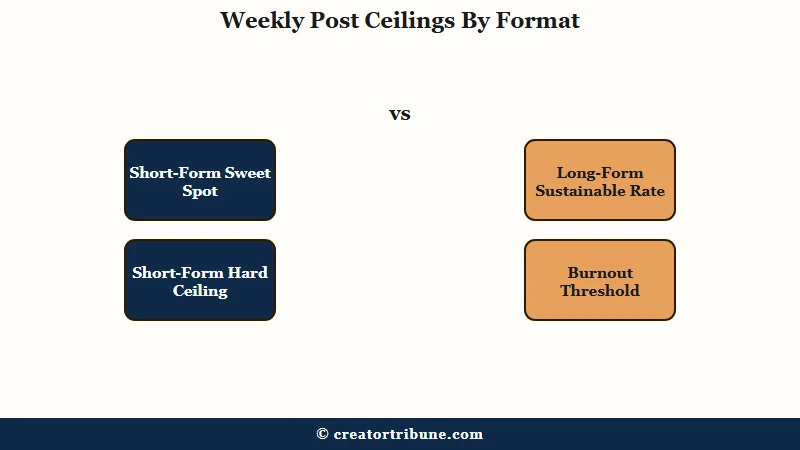
The reason TikTok creators burn out at 68 percent and newsletter creators at 48 is the cadence ceiling, the point above which the algorithm starts demanding more than a human can give. From what I have seen comparing the 2026 cadence data across platforms, the ceilings are surprisingly precise.
These are the numbers I would recommend treating as upper limits for sustainability over a 12-month horizon, not just a sprint quarter:
| Platform | Burnout-safe ceiling per week | Algorithm minimum to grow | Realistic sweet spot |
|---|---|---|---|
| TikTok | 5 | 3 | 4 |
| Instagram Reels | 5 | 3 | 4 |
| YouTube Shorts | 5 | 3 | 4 |
| YouTube long-form | 1 to 2 | 1 | 1 |
| Newsletter | 1 to 2 | 1 | 1 |
| Podcast (weekly) | 1 | 1 | 1 |
Three to four posts a week on short-form is the sweet spot. Five is the ceiling, not the recommendation. Above five, every post you add increases your burnout risk faster than it increases your reach, and the data on diminishing returns supports this.
The optimal posting frequency breakdown covers the Buffer 52M-post study that backs these numbers up, plus the platform-specific math on follower growth versus per-post reach.
If you are running multiple platforms, multiply the burnout risk, do not add it. Two platforms at 4 posts a week each is not 8 posts of effort, it is roughly 12 posts of effort once you factor in the format adaptation, caption rewrites, and platform-specific audience response.
The TikTok posting cadence math is the load-bearing one for most short-form creators because TikTok has the steepest ceiling.
How Do You Take A Break Without Losing Your Audience
You keep your audience during a break by announcing a specific return date, previewing the value coming back next, and offering a low-effort channel to stay close while you rest.
The number one fear creators express when I describe the 30-day plan is that the algorithm will punish them for going dark. The fear is reasonable and partly outdated.
TikTok introduced “Creator Sabbaticals” in 2026 that allow verified creators to take 30-day breaks without algorithmic penalty. YouTube has been adjusting its system to reduce penalties for temporary inactivity, particularly for channels with consistent watch-time histories. Instagram is the slowest to adapt and still penalizes inactivity meaningfully, but the penalty is recoverable within 7 to 14 days of resuming.
The bigger problem is not the algorithm, it is the audience perception, and that one is fully in your control. The script that works best for retaining audience during a break looks like this:
Before (vague, abandoning): “Hey guys, taking a quick break, see you soon!”
After (specific, retaining): “I am taking 4 weeks off to reset. New content drops on [exact date]. The 3 most-asked-for tutorials are getting filmed during week 4 of the break. If you want to catch the first one when it lands, the newsletter link in bio gets you the early heads up.”
The difference is the second version gives the audience a return date, a preview of value, and a way to stay close to you without you needing to be on the platform. That is what protects retention.
A simple announcement schedule for the break itself:
- Day 0: Single static post or short video announcing the break, with the exact return date.
- Day 7: One brief “still resting, here is something I learned this week” post if you want to maintain low-effort presence. Optional, the data on retention shows it makes a small positive difference.
- Day 21: Tease the first piece of returning content. Build anticipation, not pressure on yourself.
- Day 30: Return post. Reference the break briefly, then deliver real value in the post itself.
You can also use a scheduling tool comparison during the break to keep evergreen content ticking, which gives you cover without you needing to be online. For creators worried about engagement collapsing on return, the low-engagement recovery sprint is the next read after this one.
One last point on identity. The reason burnout feels so heavy in this work is that the line between you and the brand has been deliberately blurred by every piece of advice you have read.
A 30-day plan does not undo that, but it does prove to yourself that you can step back and the work, the audience, and the business all survive without you posting for a month. That proof is the durable part of recovery, more than any single technique in this article.
For context on how widespread the “always-on” workload pattern is across all professions, Pew’s 2024 job satisfaction study found declining satisfaction across multiple metrics and rising stress, with creators tracking even worse than the general workforce. None of what you are feeling is unique to you, and almost all of it is structural.
The action this article asks of you is short: pick a Friday in the next two weeks, schedule the 4 evergreen posts, write the announcement using the script in section 6, and log out. Day 1 is a single transition step. Everything after that is the recovery itself running on its own schedule.
Frequently Asked Questions
Am I burnt out or just tired?
Burnout is exhaustion that a single weekend cannot fix. Score yourself on the 5-row scorecard in this article: anything 4 or higher across sleep, dread, comment avoidance, body symptoms, and identity slip is early-stage burnout, not regular tiredness.
How long does it take to recover from creator burnout?
A focused 30-day plan resets most early-stage cases (scorecard 4 to 7). Severe burnout (scorecard 8 to 10) usually needs the plan twice back to back, plus addressing physical symptoms with a doctor. Recovery is weeks to months, not days.
Will the algorithm punish me if I stop posting for 30 days?
TikTok’s 2026 Creator Sabbatical feature removes the penalty entirely for verified accounts. YouTube’s penalty is small and recoverable within 7 to 14 days. Instagram is the harshest but still recovers within two weeks of resuming normal cadence.
How do I announce a break without losing followers?
Give a specific return date, preview the value coming next, and offer a low-effort way to stay close (newsletter, follow notification). Vague “see you soon” announcements lose followers, specific dated ones with a value teaser retain them.
Can content batching cause burnout too?
Yes. Mega-batching 10 to 14 videos in a single 4-hour session burns out your on-camera energy and the back half of the week underperforms. The 4:1 rule (4 videos per 90-minute session, one session per week) avoids this.
How many posts per week stays safe long-term?
Three to four short-form posts per week is sustainable for 12 months and up. Five is the ceiling. Above five, burnout risk grows faster than reach, and the diminishing-returns math turns negative.
Should I quit content creation if I am burnt out?
Almost never as a first move. The 30-day plan resolves 4-to-7 scorecard cases, and most 8-to-10 cases resolve in 60 days. Quitting after a single rough quarter usually means leaving money on the table. Run the plan first, decide after.