What TikTok’s New Privacy Terms Mean for Creators
What TikTok’s New Privacy Terms Mean for Creators
TikTok new terms and privacy policy changed what data the app collects. Here is what creators need to know and how to lock your account down.
- 1What Changed in TikTok’s New Terms
- 2Why the New Owners Made Your Data Less Private
- 3What the AI Training License Means for Your Videos
- 4How to Lock Down Your TikTok Data in a Few Minutes
- 5Should You Leave TikTok or Hedge Your Bets
- 6Frequently Asked Questions
- Does TikTok own my videos under the new terms?
- Is TikTok tracking my exact location now?
- Did the new terms start collecting my immigration status and health data?
- Can TikTok use my content to train AI?
- Should I delete TikTok over the new privacy policy?
- Where is my TikTok data stored now?
- 7Quick Takeaways
The Short Version: TikTok’s new US ownership rewrote the terms of service and privacy policy, and the headline surprise is that the American-run app collects more precise location data than it did under ByteDance. You still own your videos, but you grant a broad license to train AI on them. This guide covers what changed, what it means for your content, and the exact settings to tighten in a few minutes.
TikTok’s new terms and privacy policy took effect on January 22, 2026, the day American users started legally contracting with a US company instead of ByteDance. Most coverage focused on the politics of the ownership deal. The part that matters for creators got buried.
Here is the twist almost nobody expected. The move to American ownership did not make the app more private for creators. It made it less private in at least one concrete way, and that change sits in a clause most people scrolled past when they tapped “agree.”
This guide is the version written for people who post for a living. It covers what the app now collects, what the AI training license does to your videos, and the settings I would change today before filming anything else at home.
What Changed in TikTok’s New Terms
The biggest change is who you contract with and what location data the app can pull.
US users now agree to terms with TikTok USDS Joint Venture LLC, an American entity, and the new privacy policy explicitly permits collection of precise GPS location where the old ByteDance policy did not.
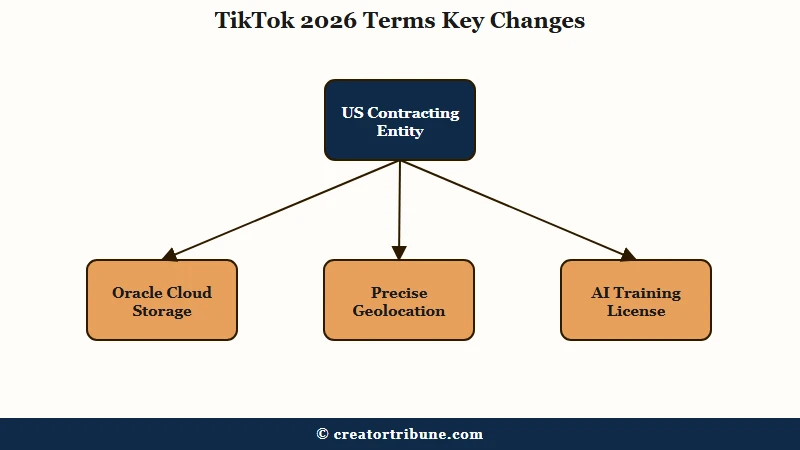
The ownership structure is worth knowing because it shapes who can see your data. Oracle, Silver Lake, and the Abu Dhabi investment firm MGX each hold a 15 percent stake, ByteDance keeps 19.9 percent, and US user data now lives inside Oracle’s cloud. The new venture is run by CEO Adam Presser, who previously led TikTok’s trust and safety operation.
Three things changed that touch creators directly. The app can now collect precise geolocation if your phone allows it. The policy spells out an AI training license over your content in plainer language. And the terms now mirror California Consumer Privacy Act wording, which is a compliance signal rather than a privacy upgrade.
Here is the side-by-side I wish someone had handed me on day one.
| What it covers | Old ByteDance policy | New 2026 US policy |
|---|---|---|
| Location data | Approximate location only, no precise GPS from US users | Precise GPS allowed if device settings permit, accurate to a street address |
| Who holds your data | ByteDance infrastructure | Oracle US cloud, ByteDance retains 19.9 percent stake |
| Content license | Broad license to operate the platform | Same broad license, now naming machine learning model training |
| Sensitive data | Collected since at least 2024 | Same collection, now framed under CCPA language |
Why the New Owners Made Your Data Less Private
The American app reads your location more precisely than the Chinese-owned one did. Under ByteDance, the US policy stated it did not gather precise GPS from American users.
The 2026 policy removed that limit and now allows location accurate enough to identify your street, and according to CBS News reporting, even the floor of a building.
This is the detail I keep coming back to, because it runs against what everyone assumed. The whole premise of the forced sale was that American ownership would protect Americans. For raw location tracking, the opposite happened.
There is a real safety angle here for anyone who films at home. If precise location rides along in your metadata, the platform holds a record of where your content was made. That is a bigger deal for a creator posting daily from one apartment than for a casual scroller.
What is precise geolocation: GPS-level location data accurate to a few meters, enough to pin your exact address, versus approximate location that only narrows you to a city or region.
One thing worth keeping in perspective. Snopes checked the viral claim that the new terms suddenly began harvesting immigration status, health, and sexual orientation, and found that collection language had existed since at least 2024. The 2026 rewrite made it more explicit and tied it to California privacy law, but it was not a brand-new grab. I would file the location change as the genuinely new risk and the sensitive-data panic as mostly recycled.
What the AI Training License Means for Your Videos
You keep ownership of your videos, but you grant TikTok a license to train AI models on them.
The terms state users retain ownership of content and AI inputs and outputs, while giving the platform a worldwide, irrevocable, royalty-free, sublicensable license that now names developing machine learning models as a permitted use.
Read that license clause slowly if you make money from your face or voice. “Sublicensable” means the platform can extend that permission to others. “Developing machine learning models” means your clips can feed systems that generate new content.
The gap the news coverage skipped is what this does to brand deals. If you sign an exclusivity clause with a sponsor, a broad sublicense sitting on top of your content is a tension worth raising with your own contracts. I would ask any brand lawyer to account for platform sublicensing before signing an exclusive.
The terms also added rules for AI-generated content itself. You cannot pass AI output off as human-made, and you cannot strip watermarks or authenticity markers. If you lean on AI tools in your workflow, that disclosure expectation is now written into the agreement you accepted.
How to Lock Down Your TikTok Data in a Few Minutes
The fastest privacy win is killing precise location and disconnecting off-app ad tracking. Two settings changes block the most invasive parts of the new policy, and they take about three minutes total.
Location is the setting most creators never touched, because the old app did not use it this way. That makes it the highest-value fix today, and it is where I would start. Here is the sequence I would run, in order.
- Set location to off. On iOS, open Settings, tap TikTok, choose Location, and set it to Never. On Android, open the Permission Manager and deny TikTok location access.
- Disconnect advertisers. Inside TikTok, go to Settings and Privacy, then Ads, then Disconnect Advertisers to stop the app from stitching together your activity on other websites.
- Clear your tracked activity. Use the Clear Activity option to wipe data the app collected through tracking pixels across the web.
- Download a copy of your data. Go to Settings and Privacy, then Account, then Download your data, so you have your own backup of profile info, watch history, and messages.
Here is the concrete before and after for the single most important step.
Before: TikTok location access set to While Using the App, with precise location enabled, so the app can log street-level GPS every time you film.
After: TikTok location access set to Never on iOS or denied in the Android Permission Manager, which cuts off precise GPS collection while leaving the rest of the app working normally.
Here is the quick-reference version of the four settings worth changing today.
| Setting | What it stops | Where to change it |
|---|---|---|
| Location set to Never | Street-level GPS logging | Phone settings, then TikTok, then Location |
| Disconnect Advertisers | Off-app tracking across the web | TikTok, then Settings and Privacy, then Ads |
| Clear Activity | Data already gathered by tracking pixels | TikTok, then Settings and Privacy |
| Download your data | Nothing, it gives you a backup copy | TikTok, then Settings and Privacy, then Account |
One caveat on the data download. TikTok notes the export excludes the most recent 24 to 48 hours, so if you are gathering evidence of a recent reach drop, wait two days for those records to show up. For diagnosing a sudden views collapse, our walkthrough on why TikTok reach suddenly drops covers the difference between a data issue and an algorithm one.
Should You Leave TikTok or Hedge Your Bets
The smarter move for most creators is hedging across platforms rather than quitting outright. TikTok still drives faster viral reach than anywhere else, so the realistic play is keeping your audience there while building a backup elsewhere, not torching the account in protest.
A lot of the “I am leaving” energy came from creators who saw zero views and assumed political censorship after the ownership change. The Guardian traced that outage to Winter Storm Fern knocking out Oracle data centers, not a moderation crackdown. I would not make a platform decision based on a weather-driven glitch that got mistaken for suppression.
If you do want a second home, a Mark Cuban-backed app called Skylight Social drew a wave of migrating creators after the deal, and YouTube Shorts remains the strongest pick for search-driven discovery and steadier monetization. The practical risk with leaving is that your followers do not come with you automatically, so move content before you move audience.
The cleanest hedge is publishing the same clips everywhere without the watermark penalty. Our guide on cross-posting without a watermark walks through the workflow, and the scheduling tool comparison covers tools that push one video to several platforms at once.
If you also use CapCut for editing, remember it shares ByteDance roots, so the CapCut alternatives roundup is worth a look for anyone trying to reduce that footprint. And if your account suddenly stops getting reach during all this, the TikTok shadowban recovery steps help you tell a real restriction from a panic.
Frequently Asked Questions
Does TikTok own my videos under the new terms?
No, you keep ownership of your content, including AI inputs and outputs. You grant TikTok a broad, royalty-free, sublicensable license to use and adapt your videos, which now explicitly includes training machine learning models.
Is TikTok tracking my exact location now?
Yes, if your phone allows it. The 2026 US policy permits precise GPS collection accurate to a street address, a change from the old ByteDance policy that only used approximate location for US users. Setting location to Never blocks it.
Did the new terms start collecting my immigration status and health data?
Not as a new change. Snopes confirmed that sensitive-data collection language existed since at least 2024. The 2026 rewrite made it more explicit and tied it to California privacy law, but it was not a fresh data grab.
Can TikTok use my content to train AI?
Yes. The license you grant now names developing machine learning models as a permitted use. Your clips can feed AI systems, and the license is sublicensable, meaning the platform can extend that permission to others.
Should I delete TikTok over the new privacy policy?
For most creators, no. Hedge instead by tightening your settings, backing up your data, and building a presence on a second platform like YouTube Shorts before moving your audience. TikTok still offers the fastest viral reach.
Where is my TikTok data stored now?
US user data is stored in Oracle’s US cloud environment under the new TikTok USDS Joint Venture. ByteDance still retains a 19.9 percent stake in the venture, and the recommendation algorithm is licensed rather than rebuilt.
Quick Takeaways
- The new US-owned TikTok collects precise street-level location where the ByteDance version did not, so turning location off is the top privacy fix.
- You still own your videos, but the license now names AI model training and is sublicensable, which matters for brand exclusivity deals.
- The sensitive-data panic was mostly recycled from 2024 language, and the early “censorship” outage traced back to Winter Storm Fern hitting Oracle servers.
- Hedge your audience onto a second platform like YouTube Shorts rather than quitting, and back up your data before you make any move.