Fix Instagram Views That Crashed After a Viral Reel
Fix Instagram Views That Crashed After a Viral Reel
Your Instagram Reel went viral and then no views on the next ones. Here is why the slump happens and the exact playbook to recover your reach.
- 1Why Your Views Crashed After Going Viral
- 2Is It a Shadowban or an Audience Mismatch
- 3How Long Until Instagram Reach Recovers
- 4The Recovery Playbook to Rebuild Your Reach
- 5What to Post After a One-Hit-Wonder Reel
- 6Frequently Asked Questions
- Why did my Instagram views drop after going viral?
- Did I get shadowbanned or is it the algorithm?
- Should I delete the videos that flopped?
- How long until my reach recovers?
- What are Trial Reels and do they help?
- Do ghost followers hurt my reach?
- 7Quick Takeaways
The Short Version: A viral Reel brings in thousands of followers who wanted that one video and nothing else. Instagram says it judges every post on its own merits, so the slump comes from those new followers dragging down the engagement rate your next posts are measured by. This guide shows how to diagnose the cause and the playbook to climb back.
You posted a Reel, it went viral, and then every video since has gotten almost no views. Going from millions of views to a few hundred is one of the most disorienting things that happens on Instagram, and it makes you feel like you broke something.
Instagram has addressed this one directly. On the platform’s own @creators account, Instagram’s Chiru Weinstein said it primarily evaluates each post on its own merits, and that a post underperforming does not mean future posts see reduced reach or distribution.
What changes after a viral hit is the audience your posts get measured against. Reels distribution runs on ratios, so when tens of thousands of people follow you for one video and then scroll past everything else, your numbers fall even when the work is just as good.
This guide walks through how to tell which version of the problem you have, how long recovery takes, and the sequence to rebuild reach.
Why Your Views Crashed After Going Viral
A viral spike fills your follower list with people who wanted one video, which drags down the engagement rate your next posts are judged by. Instagram pushed your hit to millions of non-followers, and the ones who followed without caring about your niche now sit in the denominator of every ratio that decides your reach.
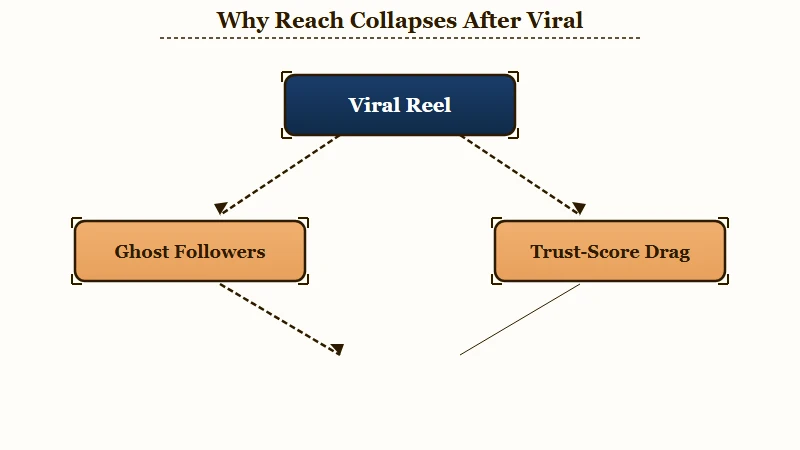
Two things break at once after a viral Reel. The first is the ghost-follower problem: a huge clip attracts people who liked that one video but have zero interest in your niche. When they ignore your next post, its engagement rate lands lower than the same post would have managed before the spike.
The second is the ratio problem. Adam Mosseri has pointed to watch time, sends per reach and likes per reach as the signals that carry the most weight on Reels, and each one is measured against how many people saw the post instead of counted raw.
A larger and less interested follower base pushes all three down at once. That is why the dip lasts weeks instead of a single post, without Instagram applying anything that works like a punishment.
With more than 2 billion monthly users on Instagram, the algorithm has no shortage of other content to show instead of yours, so it drops you the moment the signals turn negative.
What is sends per reach: The share of people who saw your Reel and forwarded it to someone in a DM. Instagram treats it as the strongest indicator that a post deserves pushing to people who do not follow you.
The way I see it, the cruel irony is that going viral is what set up the fall. The bigger the mismatch between who saw your viral clip and who you make content for, the harder the next few posts land.
Is It a Shadowban or an Audience Mismatch
A sudden 70 to 95 percent drop across all formats points to an account-level issue, while a gradual slide points to content drift. The fastest way to tell them apart is your Account Status and whether your engagement rate rose or fell as views dropped.
Start with the one screen that gives a definitive answer. Open Settings, then Account, then Account Status, which shows whether Instagram has flagged or restricted anything you posted. If it flags a violation, you are looking at graded suppression, not a mismatch.
If Account Status is clean, check your engagement rate. Counterintuitively, if your views dropped but your engagement rate went up, the algorithm is working correctly and matching you to a smaller, more targeted audience after the viral noise cleared.
Here is the quick diagnostic I run before doing anything else.
| What you see | Likely cause | First move |
|---|---|---|
| 70 to 95 percent drop across every format overnight | Account-level penalty or platform update | Check Account Status, stop any flagged behavior |
| Gradual decline over several weeks | Content quality drift | Audit your last 90 days, return to your core topic |
| Views down but engagement rate up | Healthy audience correction | Keep posting, the spike was just passive viewers |
| Reach fine on feed, dead on Reels | Format or originality flag | Check for recycled audio or template reuse |
One more trigger worth ruling out. Instagram’s originality system demotes content that substantially reuses another creator’s visuals or audio, so leaning hard on recycled templates can hold back the whole account. If you have been reposting trending formats, that alone can explain a sudden reach drop.
How Long Until Instagram Reach Recovers
Algorithm-driven drops stabilize in 7 to 14 days, while quality-drift declines take 3 to 4 weeks of consistent posting. The timeline depends entirely on the cause, and the worst thing you can do is panic-post low-effort content that digs the hole deeper.
If the cause was a flagged behavior or a platform update, reach usually returns within one to two weeks once you stop the trigger. The accounts that bounce back fastest are the ones that change nothing except removing the flagged hashtags or automation, and I would resist the urge to overhaul everything at once.
If the cause was content drift, plan for three to four weeks of steady, on-niche posting to rebuild trust. There is no shortcut here, and stopping for more than two weeks mid-recovery makes it worse because the algorithm starts to forget your distribution pattern and needs another week or two to relearn it.
What I would not do is delete the flopped videos. Deleting does not reset the algorithm or restore reach, and frequent deleting can trip spam detection, so leave them up and treat the lull as cover to experiment.
The Recovery Playbook to Rebuild Your Reach
The fix is a staged sequence that rebuilds trust with your existing audience first, then tests new content on non-followers. Rushing straight back to big swings after a collapse just feeds the algorithm more weak signals, so the order matters more than the effort.
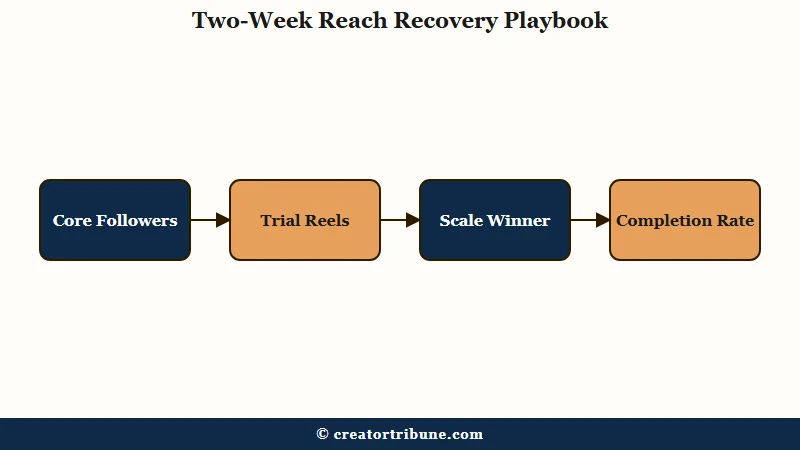
Here is the sequence I would run over about two weeks, in order.
- Days 1 to 3, post only for your core followers. Make one high-value Reel or carousel squarely on your main topic and engineer it for saves and DM shares, because sends are what carry a post beyond the people who already follow you.
- Days 4 to 7, use Trial Reels. If you have 1,000 or more followers, post experimental content as Trial Reels so it reaches non-followers only and cannot damage your main feed if it underperforms.
- Day 8 to 10, double down on whatever the Trial Reels surfaced as a winner, and share that format to your main profile.
- Day 10 onward, hold a steady cadence and judge each post by completion rate, not raw views.
The completion benchmark is your real scoreboard during recovery. A Reel above a 50 percent completion rate is performing well, while anything under 30 percent signals a weak hook or a video that runs too long for the payoff.
Before: You react to the slump by posting a longer, more produced 60-second Reel to “prove” your quality, and it dies because non-followers never finish it.
After: You post a tight 14-second Reel built to be rewatched, because a short clip watched twice sends a stronger signal than a long one watched once.
This staged approach is the same backbone as broader reach recovery after a drop, just compressed for the post-viral case. If your Account Status did flag something, run the full shadowban check and recovery first before any of this.
What to Post After a One-Hit-Wonder Reel
Post bridge content that carries the viral topic toward your actual niche, built short and forwardable. The goal is to convert borrowed attention into the right audience, not to chase another fluke with more of the same viral clip.
The mistake most creators make is either abandoning the viral topic entirely or trying to clone the exact hit. Neither works. What I would do instead is make a few posts that start from the viral subject and bridge toward what you offer, so the new followers who stay are the ones who care.
Engineer every one of these for DM shares. Content people forward to a friend earns the strongest non-follower signal Instagram has. Instagram reported that 40 percent of creators who tried Trial Reels went on to post Reels more often, and of those who did, 80 percent saw their reach from non-followers grow.
Here is what the 2026 algorithm rewards most, ranked by how much each signal moves your reach.
| Signal | What Instagram has said | What it tells the algorithm |
|---|---|---|
| Sends per reach | Named a top Reels signal, and slightly more important than likes for reaching non-followers | Worth forwarding, which is what carries a post beyond your followers |
| Saves | Treated as a strong intent signal, though Instagram has never published a weighting | Useful enough to come back to |
| Watch time | Mosseri has called it the signal that matters most on Reels | The hook held and the length fit |
| Likes per reach | Also a top signal, and slightly more important for people who already follow you | Approval from the audience you already have |
Keep the format short and rewatch-friendly. Instagram raised the maximum Reel length to 20 minutes in 2026, but it stops recommending Reels past roughly three minutes to people who do not follow you, so a long upload quietly limits itself to the audience you already have.
During a recovery that gap costs you the only audience that can rebuild your reach. If engagement still feels dead across the board, the broader fix for no engagement covers the account-wide version of this problem.
Frequently Asked Questions
Why did my Instagram views drop after going viral?
A viral Reel brings in followers who wanted that one video, and they dilute the audience your next posts are measured against. Instagram says it evaluates each post on its own merits, so this is a ratio problem rather than a penalty carried forward from the flop.
Did I get shadowbanned or is it the algorithm?
Check Settings, then Account, then Account Status for any flags. A sudden 70 to 95 percent drop across all formats suggests an account-level penalty or update, while a gradual decline points to content drift rather than a shadowban.
Should I delete the videos that flopped?
No. Deleting does not reset the algorithm or restore reach, and frequent deleting can trigger spam detection. The only exception is a post that caused a formal violation in your Account Status.
How long until my reach recovers?
Algorithm-related drops usually stabilize in 7 to 14 days once you stop any flagged behavior. Declines from content quality drift take 3 to 4 weeks of consistent, on-niche posting to rebuild algorithmic trust.
What are Trial Reels and do they help?
Trial Reels let accounts with 1,000 or more followers show a video to non-followers only. They let you test experimental content without risking your main feed’s engagement, which makes them the safest way to recover discovery after a slump.
Do ghost followers hurt my reach?
Yes. A viral clip can attract followers with no interest in your niche, and when they ignore your posts, the algorithm reads low engagement and slows your reach. Niche-specific content gradually filters them out.
Quick Takeaways
- Instagram says each post is judged on its own merits, so the slump is a diluted audience lowering your engagement rates, not a penalty for the flop.
- Diagnose first: a 70 to 95 percent drop across all formats is account-level, a gradual slide is content drift, and views-down-engagement-up is a healthy correction.
- Recover in stages over about two weeks, post for core followers first, then test with Trial Reels, and judge by completion rate above 50 percent.
- Do not delete flops or panic-post long videos, make short rewatch-friendly bridge content engineered for DM shares.