How Instagram Trial Reels Work and Who Sees Them
How Instagram Trial Reels Work and Who Sees Them
Trial reels need 200 followers on a professional account or 1,000 on a personal one. Here is how to get them, who can still see them, and why some sit at zero views.
- 1How Instagram Trial Reels Work
- 2Who Can See Your Trial Reels
- 3How to Set Up a Trial Reel Step by Step
- 4How to Read Trial Results and When to Share
- 5Frequently Asked Questions
- What are Instagram Trial Reels?
- Who is eligible for Instagram Trial Reels?
- Why can’t I see the Trial option on Instagram?
- Can my followers see my Trial Reels?
- How long do Instagram Trial Reel results take?
- Do Trial Reels hurt your reach?
- 6Quick Takeaways
TL;DR: Instagram trial reels let you show a reel from a public account to people who don’t follow you first, then share it with everyone if it works. You need 200 followers on a professional account or 1,000 on a personal one, and the account must be eligible for recommendations. Followers can still run into a trial through a direct message, the reel’s audio page or search engine results, according to Instagram’s current help page.
Instagram trial reels are the closest thing the app has to a private testing lab, and creators have been told one simple thing about them: only non-followers see them. That is the headline feature, and it is mostly true.
Instagram’s own help page says some followers may still see a trial in other places, and it rewrote that list in 2026. Between the May 21 and September 4, 2026 archived copies of the page, location and filter pages dropped off it and search engine results were added.
This guide covers who can get trial reels, how to post one, exactly who can see it, why some sit at zero views, and how to read the results before you share a winner.
What is a Trial Reel: An Instagram reel you share with people who don’t follow you first, as a test. It stays off your profile grid and out of your followers’ feed and Reels tab until you share it to everyone.
How Instagram Trial Reels Work
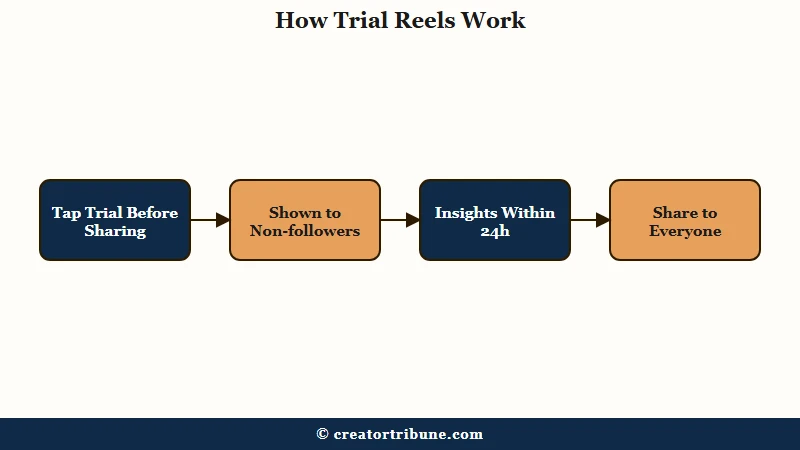
Instagram trial reels work by showing a reel to people who don’t follow you first, while keeping it out of your followers’ feed and Reels tab and off your profile until you share it to everyone.
You create the reel as normal, tap Trial before sharing, and the reel goes to strangers so you can gauge raw performance.
The way I see it, this is the feature creators wanted for years: test a hook, a format or a niche on a cold audience without spending the goodwill of the followers who already trust you. Instagram pitches it as a way to “experiment with new ideas and get early feedback.”
Insights arrive within 24 hours of sharing: views, likes, comments and shares. Instagram also warns that trials “may take longer to get views” because strangers are the audience, and says they are “evaluated independently” in ranking, so a flop does not drag down your standard reels.
The optional “Share to everyone automatically” setting shares a trial “if it’s performing well soon after you publish it, based on signals like views and engagement,” and it stays on for future trials until you change it. The often-quoted 72-hour window comes from the December 10, 2024 launch post and was gone from the help page by May 21, 2026.
Who Can See Your Trial Reels
Trial reels are hidden from your followers’ feed and Reels tab, but Instagram says some followers may still see one through a direct message, a page of reels using the same audio, or search engine results.
The “only non-followers” promise has real exceptions, and Instagram lists them itself.
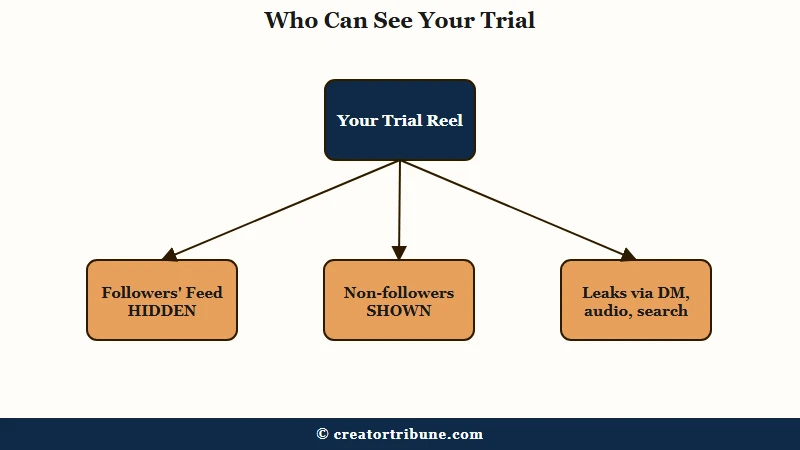
That list differs from the one Instagram gave at launch. The December 2024 launch post and every archived copy of the help page I checked, from April 2025 to May 21, 2026, said someone might share your reel “in a direct message or on a page that shows reels with the same audio, location or filter.”
By the September 4, 2026 copy the sentence read “in a direct message, on a page that shows reels with the same audio, or in the results of search engines,” and the live page still said so on September 15. Instagram frames the list as examples, so treat location tags and popular filters as possible leaks still, and add search engines to your checklist.
Here is how Instagram’s wording changed, from the launch post through the help page copies I compared:
| Version | What Instagram said |
|---|---|
| Dec 10, 2024 launch post | Auto-share judged on views “within the first 72 hours”; leaks via DM, audio, location or filter pages |
| Apr 2025 to Feb 2026 copies | Professional accounts only, with select creators testing; 72-hour auto-share still stated; a repeat-content warning first appears in the Nov 2025 copy |
| May 21, 2026 copy | 200 followers (professional) or 1,000 (personal); auto-share “soon after you publish”; ranking note reworded to “evaluated independently” |
| Sep 4, 2026 copy onward | Recommendation-eligibility rule added; leak list now DM, audio page and search engines |
Instagram lets search engines index public reels from accounts that are public, professional and run by someone over 18, and you can turn that off in your privacy settings (Instagram’s indexing page), so a trial from a creator account can surface on Google.
Creators report one more route that Instagram’s list leaves out. Followers who turned on post notifications for your account can be alerted to a trial and open it from the notification, according to replies in two September 2026 Reddit threads, including one titled Why do my parents and in-laws keep seeing my Trial Reels.
For the cleanest test, use original audio and skip the location tag and popular filters, and assume followers with post notifications on may still be alerted. Our guide on why Reels reach is low covers how much that audio choice moves distribution in the first place.
How to Set Up a Trial Reel Step by Step
Set up a trial reel by creating a new reel and tapping Trial before you share it. The option only appears on public accounts with at least 200 followers on a professional account or 1,000 on a personal one, and only while the account is eligible to appear in recommendations.
Those rules come from Instagram’s trial reels help page as it read on September 15, 2026. A personal account sitting at 950 followers clears the follower bar once it switches to a creator or business account, since the professional bar is 200.
Instagram also cuts off accounts it will not recommend: “If your public account is ineligible to appear in recommendations, you will also lose access to trial reels.” Access returns once the account is eligible again, which you can check in Account Status under More info and support in your profile menu. If it shows a recommendation limit, the guide on how to test whether you are shadowbanned covers what to check next.
Expect conflicting advice. Instagram’s own creators site still says “You must have a professional account to use trial reels,” the rule its help page replaced by May 2026, and the circulating unlock trick of tapping Create a Reel on Instagram’s creators blog is not something Instagram documents. A UK creator who pressed that button before reaching 200 followers got a pop-up saying trial reels were active, yet could not use them until the account hit 200, according to a reply in r/InstagramMarketing.
- Check eligibility. Public account, 200 or more followers on a professional account or 1,000 on a personal one, and no recommendation limits in Account Status.
- Create a new reel. Instagram warns that a trial “may get limited reach” if it detects content you have shared before, so a re-upload of an old reel is a weak test.
- Tap Trial before you share. Trial settings sits just below it.
- Decide on auto-share, then share. In Trial settings, Share to everyone automatically shares a well-performing trial with everyone, and the choice carries over to future trials. Then tap Next and Share.
- Wait for insights. They arrive within 24 hours, and checking at hour three tells you little because strangers take longer to reach.
- Share or leave it. To share by hand, open the reel from your profile, tap View insights, then Share to everyone.
Scheduling arrived in April 2026, when Adam Mosseri said “someone asked why can’t you schedule a Trial Reel. And so we built it,” per Social Media Today. Since September 11, 2026, creators have reported the option greyed out with “You can’t schedule a trial reel” while regular reels still schedule, so do not build a posting plan on it yet.
Here is the difference a trial makes in practice.
Before: I post an experimental hook straight to my feed, it flops, my followers see a weak video, and my profile grid is stuck with a dud.
After: I post the same hook as a Trial Reel, non-followers see it first, the data comes back weak after 24 hours, and I leave it unshared with my audience none the wiser.
How to Read Trial Results and When to Share
Judge a trial against your own recent reels once insights arrive within 24 hours, and share it to everyone when it beats them. Instagram’s help page gives two reasons a trial can lag (strangers take longer to reach, and repeated content may get limited reach) and says an account that is ineligible for recommendations loses trial reels altogether.
In Account Status, the Community Standards section shows removed content, while professional accounts also get a Recommendations Guidelines section showing whether something is affecting recommendation eligibility, so a clean first section does not prove your account is being recommended.
Zero-view trials are a common complaint on r/InstagramMarketing in September 2026, often from creators whose Account Status shows no strikes. Deleting a dead trial and reposting the same clip mirrored or re-captioned risks the repeat-content limit the help page describes, so record a fresh take or test a different video.
Instagram publishes no benchmark for a trial that lands. What I would watch most is views and shares together, since shares show a reel travelling beyond the test pool.
Auto-share is the hands-off route: Instagram shares a strong trial soon after publishing, based on views and engagement. Manual sharing, where you tap Share to everyone yourself, is the route I prefer, because it lets you time the post for your audience’s peak window, and our breakdown of the best time to post is worth lining up with it.
Instagram gives no deadline for sharing: it says you can share a trial reel with your followers “at any time.” Once shared, the reel moves onto your main grid and Reels tab and may reach followers in their feed, and there is no documented way to turn it back into a trial, so share deliberately.
Anyone building a business can run several trials at once, each a fresh recording with a different hook, treat the whole thing as rapid A/B testing, and then funnel the new non-followers who engaged into an audience you own.
If turning borrowed reach into owned reach is the goal, the free Creator Money Page template walks through how to capture those new viewers before the algorithm moves on.
When your standard reels are dropping at the same time, our guide to an overnight Instagram reach drop is the place to start, since Instagram says trials are ranked separately from them.
Frequently Asked Questions
What are Instagram Trial Reels?
Instagram trial reels are reels you share with people who don’t follow you, as a test. They stay off your profile grid and out of your followers’ feed and Reels tab until you choose to share them with everyone.
Who is eligible for Instagram Trial Reels?
Public accounts with at least 200 followers on a professional account or 1,000 on a personal account, according to Instagram’s help page. The account must also be eligible to appear in recommendations, or it loses access to trial reels until it is eligible again.
Why can’t I see the Trial option on Instagram?
Check the three rules: a public account, enough followers for your account type, and recommendation eligibility in Account Status. If you are a personal account between 200 and 1,000 followers, switching to a creator account lowers your bar to 200. Access can also lag: in a Reddit thread about a 200-follower account with no trial option, a reply said the feature took 3 to 4 days to appear.
Can my followers see my Trial Reels?
Not in their feed or Reels tab, and not on your profile, unless you share the trial with everyone. Instagram says some followers may still see one if it is shared with them in a direct message, on a page showing reels with the same audio, or in search engine results. Creators also report that followers with post notifications turned on for your account get alerted to trials.
How long do Instagram Trial Reel results take?
Insights appear within 24 hours of sharing. If you turned on Share to everyone automatically, Instagram shares a well-performing trial soon after you publish it, based on signals like views and engagement, and the current help page gives no hour figure.
Do Trial Reels hurt your reach?
Instagram says trial reels are “evaluated independently” and “don’t impact the performance or ranking of your standard reels content.” The documented risk is repetition: a trial may get limited reach if Instagram detects content you have already shared.
Quick Takeaways
- Trial reels need a public account with 200 or more followers (professional) or 1,000 (personal), plus recommendation eligibility.
- Followers can still find a trial through a DM, the same-audio page or search engine results, and Instagram dropped location and filter pages from that list between May and September 2026.
- Insights land within 24 hours, and auto-share now works “soon after you publish” with no hour figure.
- Trials are ranked separately from your standard reels, but repeated content may get limited reach.
- Manual sharing beats auto-share when you want to time the post and funnel new viewers into an owned audience.