Instagram Account Locked and What Really Gets You Back In
Instagram Account Locked and What Really Gets You Back In
Instagram account locked? Here is what each lockout screen really means, the fix that matches it, and the one case Meta says it cannot undo.
- 1What Does It Mean When Your Instagram Account Is Locked?
- 2Why Did Instagram Suddenly Lock My Account?
- 3How Do You Get a Locked Instagram Account Back?
- 4What If the Security Code Never Arrives?
- 5What Happens If You Lost the Email and the Phone Number?
- 6Is That Lockout Warning Even Real?
- 7Which Popular Fixes Should You Avoid?
- 8How Long Does an Instagram Lockout Last?
- 9Frequently Asked Questions
- How do I get my locked Instagram account back?
- Why did Instagram suddenly lock my account?
- How long is an Instagram account locked?
- Is it possible to unlock an Instagram account?
- Will I lose my followers and posts while my account is locked?
- Why are my Instagram settings greyed out but the app still works?
- 10Quick Takeaways
TL;DR: An Instagram account locked for suspicious activity is usually a security checkpoint, not a ban, and most clear in minutes once you complete the code or identity step on a device you already use. The screens look almost identical but need different fixes, so match the fix to the screen before you touch anything. One case is genuinely unrecoverable, and Meta says so in writing.
Your Instagram account is locked, the app is showing a screen you have never seen before, and the advice you can find splits between “just tap Continue” and “your account is gone forever”.
Neither is much use when you are staring at a code field that keeps rejecting you.
The reason most guides fail here is that they treat “locked” as one problem. It is at least four different states wearing the same word, and each one has a different exit. Send the wrong fix at the wrong screen and you burn attempts, trigger a cooldown, and make the next try harder.
This piece sorts the screens first, then gives the fix that matches each one. The first thing I check is which screen someone is looking at, because that single question decides everything that follows.
I have also flagged the two most-repeated fixes on the internet that the sources themselves disagree about, and the one dead end Meta documents plainly and almost nobody quotes.
What Does It Mean When Your Instagram Account Is Locked?
An Instagram account locked by the security system is a temporary checkpoint holding your login until you prove the attempt is yours. It is different from a disabled or suspended account, which is a policy decision about your content and follows a separate appeal path.
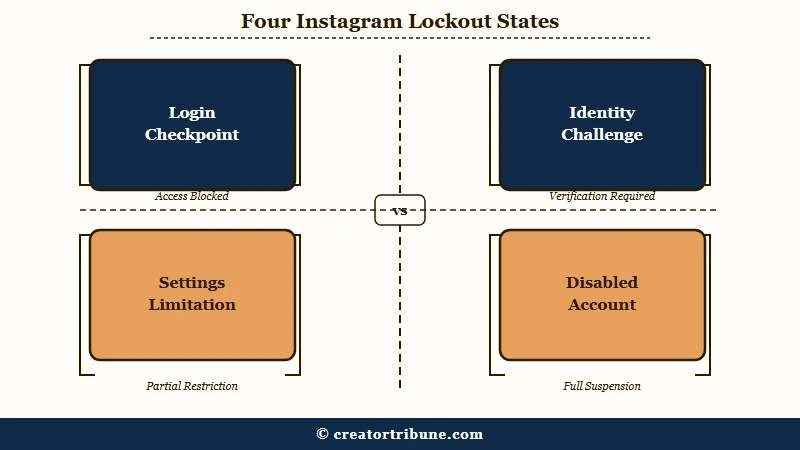
The word “locked” gets applied to at least four states, and the distinction that matters most to me is checkpoint versus policy. A checkpoint is automated, reversible, and often clears the same day. A policy action is a human or automated judgement about rule-breaking, and no amount of code-entering will move it.
There is also a fifth state that gets mistaken for a lockout constantly. Instagram documents a mode where you can still use the app normally and only the settings are restricted.
| State | What you see | Is it a ban? | Where it ends |
|---|---|---|---|
| Login checkpoint | “Suspicious login attempt” with a code prompt | No | Enter the code, often minutes |
| Identity challenge | Request for a video selfie or an ID | No | Review, then a password reset email |
| Settings limitation | App works, security settings greyed out | No | A few days, or a recognised device |
| Disabled or suspended | A policy notice with an appeal button | Yes | Appeal only, different process |
If the notice you are looking at names a policy or Community Guidelines, you are in the fourth row and this is the wrong article. The recovery path for a disabled Instagram account runs through appeals, not codes.
Why Did Instagram Suddenly Lock My Account?
Instagram locks accounts when its automated systems see a login or a behaviour pattern that does not match your history. The most common triggers are a login from an unrecognised device or location, a burst of rapid follows or likes, and a third-party app connected to your account.
Nothing has to go wrong on your side for this to fire. Travel, a new phone, a VPN, or a public network can all register as an unfamiliar login. That is the version I keep coming back to, because a lot of people assume a lock means they were hacked when the trigger was moving country.
The state that surprises people most is the mildest one. Instagram’s documentation on limited settings access describes what happens after an unrecognised login: “Whenever there’s a login to your account from a device or web browser we don’t recognize, we’ll limit access to certain security and account settings for a few days to help keep your account safe.”
That is a restriction on settings, not on the account. Feed, posting and messages keep working, and Meta gives a direct route around it, which is to log in from a device or browser you normally use. Anyone treating that screen as a full lockout is solving a problem they do not have.
If the pattern is that you get thrown out over and over rather than held at a checkpoint, that is a separate fault with its own causes, covered in the guide on repeated Instagram logouts.
How Do You Get a Locked Instagram Account Back?
Start at the login screen with the account’s own recovery flow, complete the code step on a device you have used before, and reset the password once you are in. Escalate to identity verification only when the code path is unavailable.
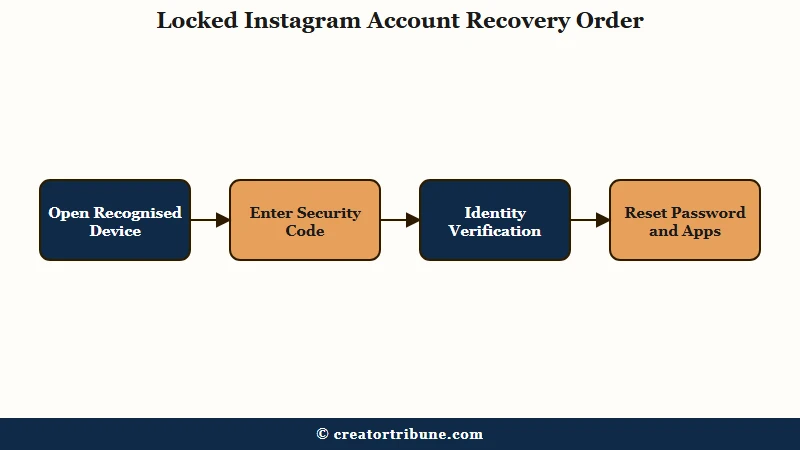
Order matters more than people expect, and this is the sequence I walk through rather than tapping whatever is brightest on screen.
- Open the app on a phone that has logged into this account before. A recognised device clears more checkpoints than any other single factor.
- Enter your username and tap the recovery prompt, then choose the code delivery you can definitely receive right now.
- Enter the code once, carefully. Repeated requests are what trigger a cooldown and slow everything down.
- If neither the email nor the phone reaches you, choose the “Need more help” style option to move to identity verification.
- Once you are back in, reset the password and check which devices and third-party apps still have access.
Step one carries more weight than the rest combined. A recognised device is the difference between a checkpoint that clears in a minute and a multi-day identity review.
Before: phone dies on holiday, you borrow a laptop, request a code four times in five minutes, hit a cooldown, then start a selfie verification you did not need.
After: you wait until you are back on your usual phone, request one code, and the checkpoint clears without any identity step at all.
If the identity route is where you have landed and the selfie keeps failing, the specific failure modes for that step are covered in the walkthrough on Instagram selfie verification.
What If the Security Code Never Arrives?
A missing security code is usually blocked before it reaches you, not unsent. The three common blockers are a filtered email folder, a blocked SMS shortcode on your handset, and a rate limit you triggered by requesting codes repeatedly.
The shortcode one catches people out because nobody remembers doing it. Android Authority notes the number Instagram sends from “used to be 32665, but apparently, it has changed to 32099”, so check your blocked-numbers list for both rather than assuming one is current.
Requesting the code again and again is the trap I would most want to talk someone out of. Each extra request pushes you further into a cooldown, and the fix people reach for is the thing making it worse.
There is a stranger failure worth knowing about if you use Google’s higher-security settings. Instagram’s verification emails can go undelivered while every other Instagram email, including new-login alerts, still arrives at the same address, which is reported in Google’s own Gmail support community.
Nothing on the Instagram side looks broken, so it is easy to spend an hour on the wrong problem.
| Symptom | Likely cause | Fix |
|---|---|---|
| No SMS after several tries | Shortcode blocked on the handset | Check blocked numbers for 32665 and 32099 |
| Email code never lands | Spam, promotions or a filter rule | Search all folders for the sender, not the subject |
| Code arrives but is rejected | Expired, or you requested a newer one | Use only the most recent code, then stop requesting |
| Nothing at all, on either channel | Rate-limited after repeat attempts | Wait several hours before the next attempt |
| Some Instagram mail arrives, codes do not | Provider-side filtering of that message type | Try a different recovery channel or address |
What Happens If You Lost the Email and the Phone Number?
This is the one case Meta documents as unrecoverable. If you cannot reach the email address the account was registered with and you never linked the account to Facebook, Instagram states plainly that it cannot restore access.
The line that stopped me is on Meta’s own help page about losing access to your contact details: “If you can’t access the email account you registered with and didn’t link your Instagram and Facebook accounts, we’re unable to give you access to the account.” Meta adds that “Instagram can’t provide any assistance with helping you get back into your email account.”
Almost every guide ranking for this problem presents recovery as a question of persistence. Meta’s documentation says there is a floor, and I have not seen a single top-ranking page quote that sentence.
There is a second trap on the same page. The standard advice is to change the email or phone number on your profile, and Meta’s own precondition kills it for locked-out users: “Before you begin, make sure you can already access Instagram… If you can’t access Instagram and reach your Instagram profile settings, you won’t be able to continue.”
That advice is real, and it is preventive rather than curative. Doing it now, while you can still log in, is what keeps you out of the dead end later. Linking the account to Facebook does the same job, because that link is the exact condition Meta names as the difference between recoverable and not.
For anyone building a following, this is the argument for not renting your entire audience from one company. A simple owned landing page for creators with an email list behind it means a lockout costs you a channel, not the relationship.
Is That Lockout Warning Even Real?
Not always. The exact language Instagram uses for genuine security alerts is now being copied by scammers, and a recent wave uses AI to make the fake version far more convincing than the old generic phishing text.
I do not buy the old advice that you can spot these by their bad spelling any more. Research from McAfee, reported in The Guardian and PetaPixel in August 2026, found that freely available AI models could work out where a holiday photo was taken from background cues alone, with one model reaching 87% accuracy and another 91%, without any location data attached.
That gets turned into a message naming the place you genuinely just visited. The example given in the reporting reads “We detected unusual activity while you were traveling in Costa Rica”, followed by a prompt to verify immediately.
The defence is boring and it works. Never action a security alert from the link inside it, and open the app yourself instead. A real checkpoint will be waiting for you in the app; a fake one only exists in the message.
The same rule kills the paid-recovery scams that circle this problem. Meta has fired staff over misuse of an internal account-restoration tool, reported by CNET in 2022, and the market that grew around it is exactly what anyone selling you an “inside contact” is pretending to have.
If your account was genuinely taken over rather than checkpointed, the hacked account recovery route is the real path.
Which Popular Fixes Should You Avoid?
Two of the most-repeated fixes for a locked account are contested by the sources recommending them. Turning on a VPN and using a private browsing window both appear as advice and as warnings, and during an active verification neither is worth the risk.
The VPN split is the clearest. One set of guides suggests changing your IP to get around a block, while others warn the opposite, with wikiHow cautioning that “if you’re using a VPN or proxy, try turning it off” because flagged IP addresses can stop codes arriving.
My rule is to sit on the plainest possible connection until you are back in. Home wifi, no VPN, the usual phone. Every layer you add is another thing the risk system has to forgive.
Private and incognito windows carry the same disagreement, recommended in some guides as a way to dodge cached-session errors and warned against elsewhere on the grounds that the session token cannot persist the way the verification flow expects. That mechanism is the more convincing of the two to me, since a verification loop that never completes is the exact symptom described.
Reinstalling the app is the other one to leave alone mid-checkpoint. It clears the local session without touching the server-side hold, so the checkpoint is still there and you have added a fresh unrecognised install on top of it.
How Long Does an Instagram Lockout Last?
A code-based checkpoint ends the moment you enter a valid code. A settings limitation after an unrecognised login runs a few days by Meta’s own description. An identity review is the slow one, because it depends on a queue rather than on anything you do.
Nobody outside Meta can give you a reliable number for the identity review, and I would treat any page quoting a precise success rate for appeals with real suspicion, because Meta does not publish those figures.
What Meta does describe for the identity path is the shape of the outcome rather than the timing. You lose access while the review runs, and a successful review comes back as an email containing a password reset link, not as an instant unlock. Waiting for the app to start working again is how people miss the email that ends the lockout.
If you deactivated the account yourself at some point and the confusion is about whether it is coming back at all, that is a different question answered in the guide to reactivating an Instagram account.
Frequently Asked Questions
How do I get my locked Instagram account back?
Open the app on a device you have used before, enter your username, and choose the recovery option that sends a code to an email or phone you can reach right now. Enter it once. If neither reaches you, switch to the identity verification route instead.
Why did Instagram suddenly lock my account?
Automated systems flagged something that did not match your normal pattern. Logging in from a new device, country or network is the most common trigger, followed by rapid follows and likes, and by third-party apps connected to your account. It usually does not mean you were hacked.
How long is an Instagram account locked?
A code checkpoint clears as soon as you enter a valid code. A settings limitation after an unrecognised login lasts a few days, per Instagram’s documentation. Identity reviews depend on a queue, so no fixed timeframe is reliable, and any page quoting exact odds is guessing.
Is it possible to unlock an Instagram account?
Usually yes, through a code or identity verification. One case is not. Meta states that if you cannot access the registration email and never linked the account to Facebook, it cannot give you access. Link the accounts now to avoid that outcome.
Will I lose my followers and posts while my account is locked?
No. A security checkpoint holds access, it does not delete anything. Followers, posts, stories and messages are intact and return exactly as they were once verification completes. Deletion is a separate process with its own warning screens.
Why are my Instagram settings greyed out but the app still works?
That is a settings limitation rather than a lockout. Instagram restricts security and account settings for a few days after a login from a device it does not recognise, while posting and messages keep working. Signing in from your usual device clears it.
Quick Takeaways
- Match the fix to the screen, because a code checkpoint, an identity review and a policy suspension look similar and end in completely different places.
- A recognised device clears more checkpoints than anything else you can do, so wait for your usual phone rather than borrowing one.
- Requesting the code repeatedly is the single most common way people make a short lockout into a long one.
- Link your Instagram to Facebook today, since Meta names that link as the difference between a recoverable account and one it says it cannot restore.
- Treat any security alert that arrives as a message with suspicion and open the app yourself, because the current scam wave copies Instagram’s exact wording.