Why YouTube Views Suddenly Drop to Zero and How to Fix It
Why YouTube Views Suddenly Drop to Zero and How to Fix It
YouTube Studio's view counter dropped to zero across hundreds of channels on May 24-25 2026 while likes kept climbing. What really happened.
- 1What Actually Happened With YouTube Views on May 24-25 2026
- 2Why YouTube Views Suddenly Drop: The Five Real Causes in 2026
- Why YouTube Shorts Views Drop Suddenly
- 3Why Studio Views and AdSense Earnings Do Not Match
- 4What This Means For You During a YouTube Views Glitch
- 5Was the May 2026 YouTube Views Glitch Ever Fixed?
- 6Frequently Asked Questions
- Why did my YouTube views suddenly drop in 2026?
- Why did my YouTube Shorts views drop suddenly?
- Do views come back after a YouTube Studio glitch?
- Was the May 2026 YouTube views outage confirmed by YouTube?
- Should I delete or reupload a video while views show zero?
- How can I tell a YouTube outage from a problem with my channel?
What Happened: A YouTube Studio reporting glitch on May 24-25, 2026 wiped the real-time view counter to zero across hundreds of monetized channels for 60 to 180 minutes. Likes kept incrementing normally, which is the signature of a reporting-layer failure rather than actual view loss. Revenue and watch time accrued in the backend; only the display went dark, and YouTube marked the issue fixed on May 24, 2026.
The YouTube views glitch in May 2026 lit up r/PartneredYouTube on the night of the 24th and the morning of the 25th, with monetized creators watching their real-time graphs flatline while like counts kept ticking up. One Partner-flair creator wrote “in the past 60 minutes my views have dropped to zero.”
Another, normally pulling 500 to 700 views per hour on long-form, reported “currently 7 now.” A third was watching a stranger’s video with 300 likes and only 110 views and could not square the math.
This is not the first time YouTube Studio has done this, and it will not be the last. The piece of the pipeline that failed is the same one that failed in March 2024, in November 2022, and twice earlier this year on March 30 and May 13.
It also failed on May 24 and 25, 2025, the same calendar dates one year before this outage. TeamYouTube posted then that views were showing as “0” for recent uploads and confirmed a fix the following day, which makes this the second late-May zero-views incident in consecutive years.
Each time the pattern looked identical from the creator side: views frozen near zero, likes climbing normally, real-time graph flat, official @TeamYouTube account silent for hours. Each time the panic was the same too, and each time the underlying watch time and revenue were fine.
What the next few paragraphs will give you is the technical reason this keeps happening, the diagnostic questions that separate a harmless reporting glitch from the four other reasons views suddenly fall, and the short list of things you should not do while the counter is blank.
The wrong move during a glitch can turn a reporting blackout into a real ranking problem, and that is the part most creators get wrong.
What Actually Happened With YouTube Views on May 24-25 2026
The YouTube views glitch in May 2026 was a Studio real-time analytics outage, not actual view loss.
The speed layer of YouTube’s analytics pipeline stopped materialising new view events while the batch layer kept accumulating them in the background, producing the classic “likes-climb-but-views-stay-zero” signature. Engagement was real; only the display layer broke.
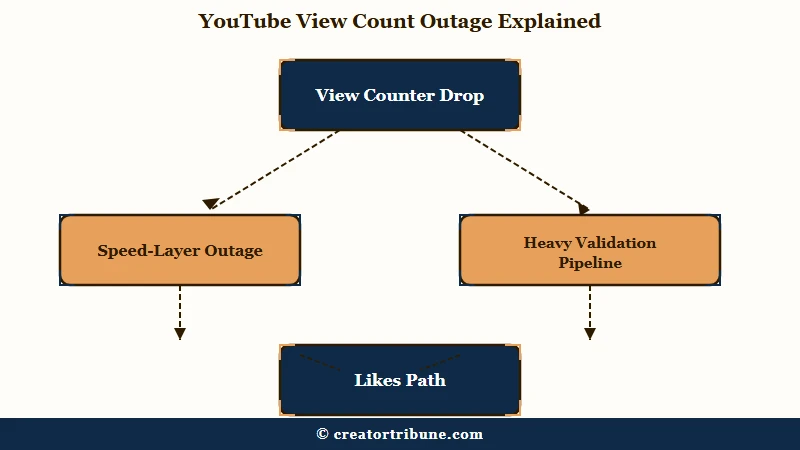
The way I see it, the giveaway was always the like counter. YouTube counts likes through a much simpler path than views, with fewer fraud checks and a much shorter audit tail, so they show up almost immediately.
Views go through a heavier validation pipeline because every view is a potential ad impression, and ad impressions cost real money to advertisers if YouTube gets the count wrong. When likes increment and views do not, you are looking at the heavy-validation pipeline stalling, not the audience disappearing.
YouTube has used the same internal communication template for this kind of incident at least since the March 24-25, 2024 outage, which ran with the exact phrasing “we are experiencing issues with the systems for realtime data. This may cause inaccurate view counts and reports of video performance.” If you ever see that line on a status page or in a TeamYouTube tweet, the events you cared about already happened. The system just has not finished telling Studio about them.
For the wider context on how this same pipeline glitch can look like a separate problem on the impression side, the zero-impressions diagnostic walks through the version of this where browse and external traffic both flatline at the same time.
Why YouTube Views Suddenly Drop: The Five Real Causes in 2026
YouTube views suddenly drop for one of five reasons, and only one of them is an emergency. A Studio reporting glitch, an invalid-view audit, an algorithm distribution cut, a Shorts-feed reset, or a spam and AI-content purge each leave a different fingerprint, so the fix always starts with naming which one you are looking at.
The May 24-25 Studio outage is the first cause. The other four are what most creators mean when they search for why views suddenly dropped in 2026, and they are easy to confuse. The differences line up like this:
| Cause | Telltale signal | Does it come back? |
|---|---|---|
| Studio reporting glitch | Views flatline near zero while likes keep climbing; third-party trackers still show normal numbers | Yes, auto-backfills within 48 hours |
| Invalid-view audit | Count drops or freezes, often near a round threshold; YouTube has audited around the 301-view mark for years, and large videos can shed millions (BTS “ON” fell from 83 million to 48 million in a single audit) | No, the removed plays were bot or spam traffic |
| Algorithm distribution cut | Real-time views and likes taper together over hours while impressions fall; the 2026 click-through test window shrank from 72 hours to about 24, so weak openers lose reach fast | Only with stronger retention on later uploads |
| Shorts-feed reset | A Short that pulled thousands per hour falls to dozens while long-form is untouched; matches the late-June-to-July 2026 Shorts wave | Yes, once a Short clears the feed satisfaction test |
| Spam and AI-content purge | Whole videos or channels lose views overnight during enforcement sweeps; YouTube wiped about 4.7 billion lifetime views across 16 channels in January 2026 | No, if the content tripped a spam or deceptive-practices policy |
Why YouTube Shorts Views Drop Suddenly
Shorts views collapse on their own schedule because the Shorts feed re-tests every upload against live audience satisfaction, separate from your long-form numbers. When a Short that was pulling thousands of views an hour falls to dozens overnight, the feed has stopped surfacing it, usually after the 2026 overhaul’s completion and satisfaction checks scored it under the bar.
The run of “my Shorts get almost no views since July 1 2026” reports on YouTube’s own community forum traces to that overhaul, which added a visual-uniqueness filter that flags reused stock footage as low value and tightened the first-three-seconds retention test. A Short that misses either check is quietly capped rather than removed, so the channel looks healthy while one format stalls.
Why Studio Views and AdSense Earnings Do Not Match
The May 2026 glitch matters because it sits inside the same Lambda architecture that handles every monetized view on YouTube.
That architecture splits every view event into a real-time speed layer for the dashboard and a batch layer for the canonical 24 to 48 hour reconciliation.

The speed layer is what creators see; the batch layer is what AdSense pays on. When the speed layer stalls, the dashboard lies, but the batch layer keeps writing.
What I would want every monetized creator to internalise is this split. The view counter in Studio is a lossy summary of an event stream, not the event stream itself.
Google’s own Dataflow research paper documents the underlying mechanism in detail. A “watermark” tracks how far the system thinks event-time has progressed, and when that watermark stalls or jumps, the visible counter goes with it. Phantom zeros happen when the watermark falls behind real-time while events keep arriving in the background.
There is also a quieter mechanism in the same paper called “retractions,” where the pipeline is allowed to emit a value and then later cancel it with a negative correction when better data arrives. That is the technical reason view counts sometimes jump or drop suddenly rather than updating smoothly. You can watch a video lose 80 views in a single tick because the pipeline retracted a batch of plays it later flagged as low-quality.
The November 16, 2022 underreporting incident gave the precedent most relevant to monetized creators. On that day, several r/PartneredYouTube reports surfaced where the finalized AdSense earnings came in higher than the live Studio estimate had shown during the glitch window.
The reporting layer had been understating the truth. AdSense reconciled the gap during the 48-hour batch run and paid on the real numbers.
This is a one-data-point precedent, not a guarantee, but it is the cleanest signal you can find that the monetization layer treats Studio’s display as advisory.
What This Means For You During a YouTube Views Glitch
During a YouTube Studio glitch the right move is to do nothing, and the wrong moves are the ones most creators reach for first.
Edits, reuploads, panic deletes, thumbnail swaps, and title changes during the blackout window will all backfire because the same speed layer that is not showing your views is the one that detects metadata changes and triggers reindexing. You do not want to trigger reindexing on a video that is, in reality, doing fine.
Here is the diagnostic I would walk through before touching anything in Studio:
- Check your like counter on the same video. If likes are still incrementing, this is a reporting glitch and not algorithmic suppression. Stop here.
- Cross-reference with VidIQ, TubeBuddy, or Social Blade. Third-party tools read different endpoints than Studio and tend to lag rather than fail outright. If they show numbers Studio does not, you have proof the views are real.
- Look at the public view counter on the watch page in an incognito window. The public counter and the Studio counter pull from the same speed layer at peak but freeze at different cadences, so a non-zero public counter on a Studio-zero video is another glitch tell.
- Wait 48 hours. The batch layer reconciles inside this window. If your finalized 7-day view chart still shows the dip after 48 hours, then and only then start looking at limited-distribution causes.
Use the table below to keep the two scenarios apart in the moment. Reading it wrong is what turns a one-night reporting blackout into a real reindex hit.
| Signal | Studio reporting glitch | Real algorithmic suppression |
|---|---|---|
| Likes during the dip | Increment normally | Stop alongside views |
| Public watch-page counter | Often non-zero | Matches Studio at zero |
| Third-party trackers (VidIQ, Social Blade) | Show normal numbers, with lag | Match Studio at zero |
| Duration | 60 to 180 minutes typically | Days to weeks |
| Recovery pattern | Numbers jump back via retraction | No backfill |
| Other channels in your niche | Also affected | Yours only |
If your symptoms match the right column, this is not the article you need. The percentage-stuck processing puzzle and the Shorts views stopping playbooks each go deeper on the real-suppression diagnostic with steps to take.
For channel-level signals that get aggregated into your standing with the algorithm over time, the channel-level trust score signals breakdown covers what compounds beyond any single video.
Here is the exact “do not touch” rule, stated as a worked example so it sticks:
Before: Real-time graph shows 0 views, panic kicks in, you open the video editor, trim two seconds off the intro, save. The metadata change triggers reindexing. When the speed layer recovers six hours later, your video is treated as a fresh upload with no audience history, and the algorithm restarts it from scratch.
After: Real-time graph shows 0 views, you check likes, see them climbing, close the tab, walk away for two hours. The speed layer recovers, retractions backfill the numbers, the algorithm continues from where it left off. No reset, no momentum loss, no income hit.
Was the May 2026 YouTube Views Glitch Ever Fixed?
Yes. YouTube marked the issue fixed on May 24, 2026, the same day the outage hit.
TeamYouTube confirmed on May 24, 2026 that “this issue with YouTube Studio Analytics is now fixed”. The tracking thread for the incident now carries a FIXED tag in its title.
The incident was logged on YouTube’s “Views dropping on YouTube Studio Analytics” thread, which is the thread that later gained the FIXED prefix. A separate long-running thread on unexplained zero views in real-time analytics collects the recurring version of the same complaint and is worth watching for the next one.
That is the pattern to expect during the next one: a numbered tracking thread on the help forum, then a FIXED prefix on that thread once the backfill completes. If a future outage runs past 72 hours with no acknowledgement, escalate through the in-product help link rather than reuploading.
One thing the fix notice did not settle is money. YouTube confirmed the reporting problem was resolved but published nothing about revenue for the affected window, so the November 2022 precedent above remains the only real evidence on that question, and it is still a single data point.
What I would not do is assume this is the last one. YouTube has shipped at least five Studio analytics incidents in the past 18 months.
The Lambda architecture trades dashboard reliability for cheaper compute, and that trade is not going away. The right posture for monetized creators in 2026 is to treat Studio’s real-time numbers as a soft signal and AdSense’s finalized statement as the only one that matters for revenue decisions.
What I am watching next is whether YouTube ships an in-Studio incident banner the way Google Ads already does for delivery delays. The current setup, where creators find out about a global outage by reading Reddit, is not sustainable as the platform pushes more revenue features into Studio.
Frequently Asked Questions
Why did my YouTube views suddenly drop in 2026?
Check the like counter first. If likes are still climbing while views sit near zero, it is a Studio reporting glitch and the numbers backfill within 48 hours. If likes and views fell together over several hours, you are looking at one of the other four causes, most often an algorithm distribution cut or, for Shorts, a feed reset.
Why did my YouTube Shorts views drop suddenly?
Shorts are re-tested against live audience satisfaction independently of your long-form videos, so a Short can fall from thousands of views an hour to dozens while the rest of the channel is untouched. The 2026 overhaul added a visual-uniqueness filter that flags reused stock footage and tightened the first-three-seconds retention test. A Short that misses either check is capped quietly rather than removed.
Do views come back after a YouTube Studio glitch?
Yes, when the cause is a reporting glitch. The batch layer keeps recording view events while the real-time display is stalled, and the counter jumps back once the pipeline reconciles, normally inside 48 hours. Views removed by an invalid-view audit do not come back, because those plays were judged to be bot or spam traffic.
Was the May 2026 YouTube views outage confirmed by YouTube?
Yes. TeamYouTube confirmed on May 24, 2026 that the YouTube Studio Analytics issue was fixed, and the help forum thread tracking the incident now carries a FIXED tag. YouTube published nothing about revenue for the affected window.
Should I delete or reupload a video while views show zero?
No. Editing, reuploading, or changing the title or thumbnail during a reporting blackout triggers reindexing on a video that is actually performing normally, which restarts its distribution from scratch. Waiting costs nothing and the counter repairs itself.
How can I tell a YouTube outage from a problem with my channel?
An outage hits other channels in your niche at the same time, leaves likes incrementing, and usually leaves third-party trackers such as VidIQ or Social Blade showing normal numbers. A channel-level problem affects only you, stops likes and views together, and shows the same zero everywhere including the public watch page.