Eight Ways To Build Your YouTube Channel Trust Score
Eight Ways To Build Your YouTube Channel Trust Score
YouTube channel trust score decides how much distribution your videos get. Here are the eight signals that build it the fastest.
- 1What Is YouTube Channel Trust Score?
- 2How Does YouTube Measure Trust In 2026?
- 3What Are The Eight Signals That Build Trust Fastest?
- 4What Are The Biggest Trust Score Destroyers?
- 5How Long Does It Take To Recover Trust Score?
- 6How Do You Set Up A New Channel For Maximum Trust?
- 7Frequently Asked Questions
- Does YouTube confirm a “trust score” exists?
- How long does it take a new channel to build trust score?
- Can I check my YouTube trust score directly?
- What is the single fastest way to destroy YouTube trust score?
- Does deleting old underperforming videos help trust score?
- Will using AI tools for scripts or thumbnails hurt my trust score?
TL;DR: YouTube’s “channel trust score” is a composite of 30+ signals that work like a credit score for distribution. Eight signals carry most of the weight: viewer satisfaction, session contribution, return-viewer rate, channel-relative click-through, retention, on-camera presence, upload cadence, and account-setup hygiene. Build them and the algorithm starts pushing your videos.
Most creators talk about the YouTube algorithm as if it is one thing. It is not. It is a stack of engines (Browse, Suggested, Shorts, Search, Notifications) that each weigh signals differently, and underneath all of them sits a channel-level rating that decides whether your work gets shown at all.
That rating is what the creator community has started calling a “trust score.” It is the closest analog to a credit score for distribution: invisible to you, weighted on 30+ inputs, and the single biggest reason two channels with identical content can get wildly different reach.
This guide breaks the trust score down into eight signals you can move, the four things that destroy it the fastest, and the realistic recovery timeline if your channel is already in the red.

What Is YouTube Channel Trust Score?
YouTube channel trust score is an internal composite of 30+ signals that determines how aggressively the algorithm distributes your content.
It is not a public metric. The closest thing to it that YouTube has confirmed publicly is the move from raw watch time to viewer satisfaction as the primary distribution lever.
The way I see it, trust score lives on a continuum. At the top, the algorithm pushes new uploads to Browse, Suggested, and Notifications quickly.
At the bottom, the same upload sits in “zero view jail,” shown to nobody for hours. Most channels live in the messy middle, where small signal shifts produce outsized reach changes.
The major shift in 2026 is that the score is now evaluated at the channel level, not the video level. A single weak upload no longer drags the whole channel; consistent patterns do. That cuts both ways: a single great video does not save a channel with a poor pattern either.
With more than 113 million active YouTube channels globally and a creator base that keeps growing, the algorithm has every reason to lean harder on channel-level reputation rather than judging each upload in isolation.
How Does YouTube Measure Trust In 2026?
Viewer satisfaction, session contribution, channel-relative click-through, and percentage retention are the four heaviest-weighted signals in 2026.
The algorithm cares less about how long a video is watched and more about whether the viewer stays in the app afterwards.
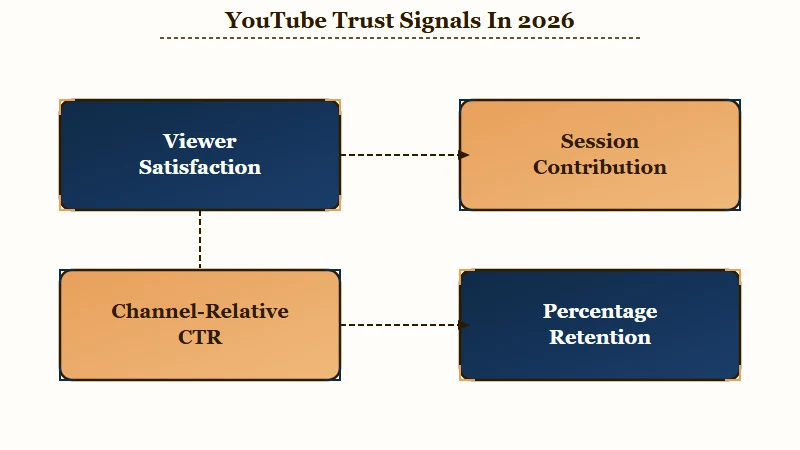
From what I have noticed, the four signals worth understanding before any other optimisation:
- Viewer satisfaction. Measured through post-watch surveys, likes, dislikes, and whether viewers return to the channel. This is the strongest signal in 2026 and has displaced raw watch time as the primary driver.
- Session contribution. Whether your video leads viewers to watch more on YouTube (positive) or causes them to close the app (negative). Session-ending videos are penalized in Suggested and Browse.
- Click-through rate, evaluated against your channel’s own average. A 6% CTR is great for a 100-subscriber channel and weak for a 1-million-subscriber channel. The algorithm reads it relative to your channel’s baseline, not absolute numbers.
- Percentage retention, not absolute minutes. An 8-minute video watched to 88% outranks a 30-minute video watched for 8 minutes. Length is no longer the moat it once was.
A new channel hits a strong signal when its return-viewer rate clears 10%, meaning more than one in ten viewers from a video comes back to watch another within a short window. This is the cheapest leading indicator that the algorithm has started recognising your audience.
What Are The Eight Signals That Build Trust Fastest?
Eight signals carry most of the trust-score weight: viewer satisfaction, session contribution, return-viewer rate above 10%, channel-relative CTR, percentage retention, on-camera presence, sustainable upload cadence, and clean account setup. Hit any six of the eight and reach climbs.
These are the signals I would prioritize in the order most channels can move them realistically:
- Add at least one second of on-camera presence per video. Face, hands, or voice. Even a 3-second cutaway shifts the “human creative fingerprint” score and helps escape zero-view jail.
- Publish 3 to 5 uploads per week, not 12 a day. The algorithm reads bot-paced cadence as a manipulation attempt. Steady human-paced cadence is a positive signal.
- Engineer the first 30 seconds for viewer satisfaction. A clear promise in the first 15 seconds and a visible payoff before the 30-second mark drives the survey-based satisfaction score.
- Build for session contribution, not just video time. Add an end-card to a related video on your channel. Mention “watch this next” with a concrete reason. Session-positive videos get pushed harder.
- Title and thumbnail for click-through against your own baseline. Treat your previous month’s average CTR as the floor, not the industry average. Improving channel-relative CTR is what the algorithm rewards.
- Hit 50%+ percentage retention on at least half your uploads. Aim for retention curves with at most one steep drop, not a slow constant bleed.
- Reply meaningfully to the first 10 comments on every upload. Comment quality and creator-response speed are both weighted; mass-blocking or mass-deleting drops the score sharply.
- Set up the channel as a real person from day one. Aged Gmail (6+ months), phone verification, ID verification for Feature Eligibility, a personal photo, and a first-person bio. This is the cheapest trust signal available and the one new channels skip most often.
Vague: “Improve my channel.”
Specific: “Add a 3-second on-camera intro to every video this month, hit 3 weekly uploads, and reply to the first 10 comments on each within 6 hours. Track return-viewer rate weekly and watch it climb.”
The vague version produces nothing. The specific version moves four of the eight signals simultaneously, which is usually enough to push a stuck channel into measurable reach growth within 30 days.
What Are The Biggest Trust Score Destroyers?
The fastest destroyers are bot-paced uploads, undisclosed AI content, engagement manipulation, and mass-deletion of comments.
Each of these reads as “this channel is not run by a human” and triggers distribution suppression.
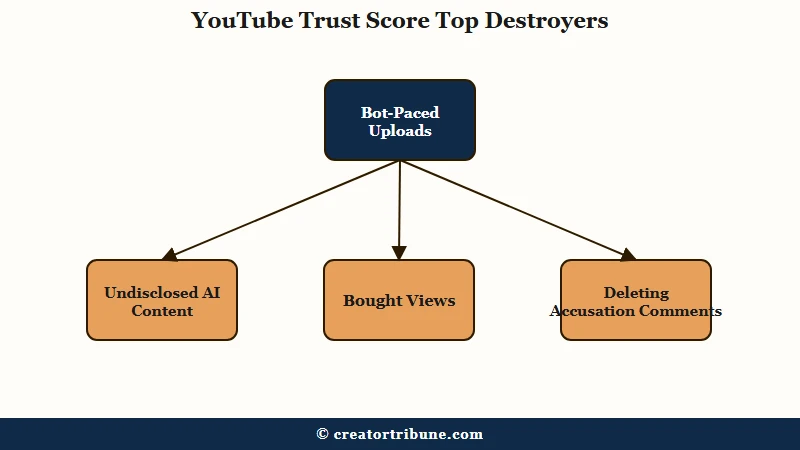
In my experience these are the four patterns that nuke trust score fastest:
| Destroyer | What it looks like | Distribution impact |
|---|---|---|
| Bot-paced uploads | More than 6 uploads per day, identical thumbnails, no on-camera presence | Zero-view jail on next upload |
| Undisclosed AI content | Realistic AI of real people without the disclosure label | Immediate suppression, escalates with repeats |
| Engagement manipulation | Bought views, comment pods, sub-for-sub schemes | Manual review, possible Partner Program removal |
| Mass-deleting accusations | Removing every “is this AI” or critical comment in bulk | Engagement quality score drops, channel pushed less |
The platform’s community guidelines page lists the specific behaviours that trigger manual review, but the score-level damage usually shows up before any visible enforcement. A channel that loses 30% of reach over two weeks without a strike has almost always tripped one of these four destroyers.
The AI disclosure rule is the one that catches honest creators most often. Composited reality (greenscreen meme videos, deepfake-adjacent edits) needs the “altered or synthetic content” label even when no AI was used, and missing it reads to the algorithm as deception.
How Long Does It Take To Recover Trust Score?
A standard trust-score recovery from a performance drop takes 2 to 4 weeks of consistent, high-retention uploads.
Zero-view jail caused by a missing “humanity signal” can lift on the very next upload if that upload is a visibly human piece of content.
The split that matters:
- Slow burn drop (gradual 20-40% reach decline over 2-3 weeks): Usually a cumulative pattern issue. Recovery takes 2 to 4 weeks of consistent uploads that hit 50%+ retention. There is no shortcut.
- Sudden drop (50%+ reach loss in one upload): Usually a specific event. Check for a missed AI disclosure, a copyright strike, a community-guideline warning, or a manual review. Recovery depends on resolving the trigger first, then 2 weeks of steady recovery uploads.
- Zero-view jail (new channel stuck at 0-10 views per upload): Add a visibly human video (a talking-head vlog or a face-on-camera Q&A). One upload with on-camera presence is often enough to break the loop on the next post.
- Strike or manual action: 3 to 6 weeks for review, sometimes longer. Submit a complete appeal package (screen recording of workflow, raw project files, written statement). The same approach that works for false AI demonetization applies here.
The mistake I see most often: panic-uploading more during a reach drop. Bot-paced cadence is one of the destroyers. The right move during a drop is fewer uploads, each with higher production care, until the signal stabilises.
How Do You Set Up A New Channel For Maximum Trust?
A new channel built right can clear zero-view jail in the first 5 uploads. Aged Gmail, full verification, a personal photo, a first-person bio, and one on-camera video out of the gate are the five highest-impact setup moves.
Skipping any of them is the most common reason new channels stall.
The full setup checklist for a new channel:
- Use a Gmail account at least 6 months old. New email addresses created the same day as the channel correlate strongly with bot accounts and trigger conservative initial distribution.
- Verify phone number AND government ID for Feature Eligibility. Phone alone is the minimum; ID-verified channels get higher upload limits and faster initial reach.
- Channel photo: your face or a real personal mark. A logo is acceptable for established brands. A generic stock image or AI-generated avatar reads as low-trust.
- Bio in first person. “I make videos about [niche]” beats “This channel features content about [niche].” The first-person voice is a small but real signal.
- Make the first upload a talking-head intro or face-visible piece. Pure voice-over slideshow as a first upload almost always lands in zero-view jail. Even a 90-second handheld intro saves weeks of recovery time later.
- Link your channel to one external profile. A personal site, LinkedIn, or X profile that has been active for a while. The cross-platform identity link is a confirmed trust-positive signal.
- Don’t bulk-upload back catalogue. Upload one video, wait 48 hours, watch the initial distribution. Bulk uploads on day one read as automation.
A clean setup is the cheapest trust insurance available. It costs an hour. The same kind of pre-launch hygiene matters when Instagram reach drops because of weak account signals; YouTube is no different.
Frequently Asked Questions
Does YouTube confirm a “trust score” exists?
YouTube has not used the term “trust score” in any public statement, but they have publicly confirmed the shift from watch time to viewer satisfaction as the primary distribution signal, and the creator community uses “trust score” as shorthand for the composite of 30+ channel-level signals.
How long does it take a new channel to build trust score?
A clean setup with one on-camera video, 3 weekly uploads, and 50%+ retention typically exits zero-view jail within 5 to 10 uploads. Full algorithmic recognition (consistent Browse and Suggested impressions) usually takes 30 to 60 days.
Can I check my YouTube trust score directly?
No, the score is not exposed in YouTube Studio. The closest proxies are your channel-relative CTR, average percentage view duration, and return-viewer rate. If all three are climbing month over month, your trust score is climbing.
What is the single fastest way to destroy YouTube trust score?
Bulk-uploading AI-generated content without the required disclosure label. The combination of bot-paced cadence and undisclosed AI is the highest-risk trigger and frequently lands channels in the suppressed-distribution category within a week.
Does deleting old underperforming videos help trust score?
Rarely. Setting weak videos to private removes them from your channel’s engagement signal but also removes the watch-time history. Hide-don’t-delete is usually safer; the algorithm now weights channel-level patterns more than individual video failures.
Will using AI tools for scripts or thumbnails hurt my trust score?
No. YouTube’s official policy explicitly excludes AI used for production assistance (scripts, outlines, captions, thumbnails). The only AI use that requires disclosure is realistic alteration or synthesis of real people, places, or events.