Why YouTube Just Wiped 4.7 Billion AI Slop Views in 2026
Why YouTube Just Wiped 4.7 Billion AI Slop Views in 2026
YouTube just wiped 4.7 billion AI slop views and pulled monetization from channels earning 30K a month. Here is what creators should change this week.
What Happened: YouTube has wiped 4.7 billion lifetime views and stripped roughly $10 million in annual creator revenue from channels it now classifies as AI slop. The largest purge so far hit 16 channels and 35 million subscribers, and the criteria caught educational and narrative channels alongside obvious spam.
If you build on YouTube, the safe assumption this week is that the platform now reads your channel as a single pattern, not as a stack of individual videos. That is a real shift, and it has already cost a few hundred channels their entire revenue stream.
The part most people are missing is the size of the collateral damage. Channels with real audiences, real watch time, and real value are getting caught in the net, not just the obvious slop farms.
This piece walks through what YouTube did, why the language CEO Neal Mohan used matters more than the takedown numbers, and the concrete moves I would make this week if I had any AI in my workflow at all.
What Actually Happened
The YouTube AI slop crackdown is a channel-level demonetization wave that has wiped 4.7 billion views and stripped about $10 million in annual revenue across 16 major channels, with a broader 278-channel target list documented behind it.
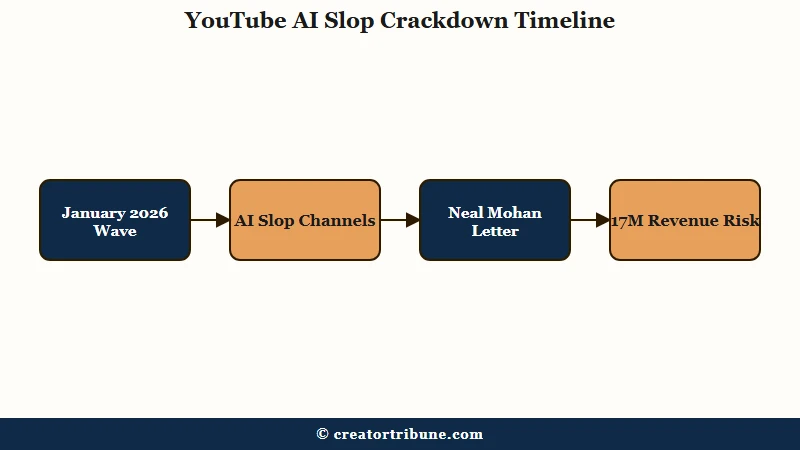
The biggest single number to anchor on comes from OutlierKit’s January report. It reports that 16 channels representing 35 million subscribers had their content either terminated outright or completely wiped. Of those 16, 11 were terminated and 6 had their entire libraries pulled.
The combined damage across just those channels is the 4.7 billion view figure that is now circulating everywhere. What I find most telling here is that the wipe ratio was higher than even the harshest creator forecasts from late 2025 predicted.
Behind that headline is a much larger investigation. The same source documents 278 AI slop channels with 63 billion cumulative views and an estimated $117 million in annual ad revenue at risk. YouTube has not committed to taking down all 278, but the policy framework is now in place to do it.
Mohan’s January 2026 annual letter was the first time the company used the literal phrase “AI slop” in an official capacity. That language shift matters more than the dollar number.
Rene Ritchie, YouTube’s Head of Creator Liaison, followed up to clarify that AI tools are not banned and over a million channels use YouTube’s built-in AI tools daily. What the platform is targeting is content where AI acts as the entire creator, not as one tool in a human’s workflow.
Why This Is a Bigger Deal Than It Sounds
YouTube is now evaluating channels as whole production pipelines, not as individual videos, and that is what makes this crackdown different from every previous monetization wave.
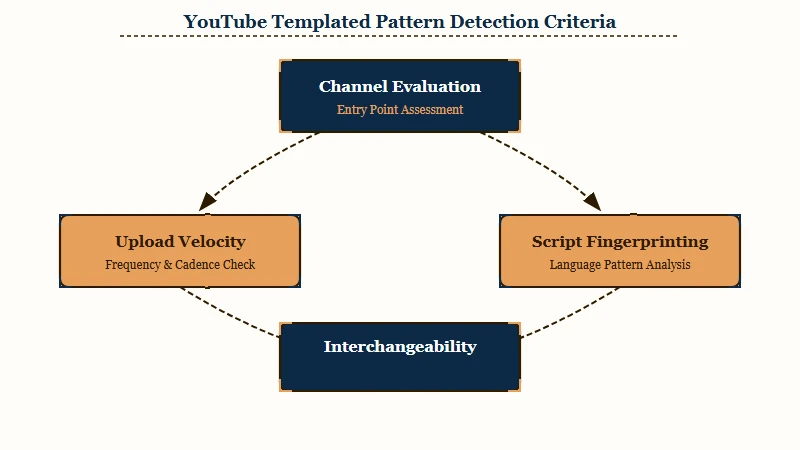
The way I read this, the old monetization fights were about individual videos. A specific upload would get demonetized for a copyright claim, a content violation, or a thumbnail issue, and you would fix it and move on. The 2026 version evaluates the channel as a single pattern.
Two specific cases make the point hard. A Bible story channel with 588,000 subscribers, earning roughly $30,000 per month, was stripped overnight.
An exam prep channel earning $7,500 per month aimed at real estate students was demonetized despite providing real educational value. Both got hit because the production pipeline looked too automated, not because the individual videos were bad.
That is the part most creators have not internalized yet. The detection criteria are not about a single bad video. They are about upload velocity (publishing more long-form content than a human reasonably could), script fingerprinting (recycled or AI-spun transcripts across the library), and “interchangeability” (a channel that could be swapped with hundreds of others without a viewer noticing).
There is also a deeper economic story underneath the takedowns. Fliki’s breakdown frames it as YouTube choosing advertiser trust over creator revenue.
The platform was willing to erase $10 million in annual creator earnings across 16 channels to prevent the broader ad market from souring on the platform. That ratio tells you which side YouTube is going to default to in every borderline call from here.
What This Means for You
If your workflow uses any AI for scripting, voicing, or visuals, the next 30 days are the window to add visible human fingerprints before the algorithm decides for you.
The honest framing is that “I do not use AI” is not a defense if your production pattern looks templated. Channels that hand-write scripts but use the same intro hook, the same five-shot structure, and the same voice rhythm across every video are also at risk. The signal is pattern, not provenance.
Here is the diagnostic I would run this week, in order:
- Open your last 10 uploads in YouTube Studio. Look at them as a stranger would. Are the thumbnails template clones? Do the first 8 seconds of audio sound interchangeable? Could you swap one video’s intro into another’s slot and nothing would feel off? If yes on any of these, you have a fingerprint problem.
- Check your upload velocity against your stated workflow. If you tell viewers you film and edit your own content but you publish two 15-minute videos every day, the math does not work, and YouTube’s detection system runs the same math.
- Audit your voiceover. Default ElevenLabs voices, default Murf voices, the same TikTok TTS that thousands of channels use, all of these are now correlated with the slop signal. Voice cloning your own voice, or paying a human voice actor, is the fastest way to break the pattern.
- Find your distinctive element. Mohan’s framing was that an AI-heavy channel needs to feel “like Mickey Mouse,” meaning a recognizable, branded identity that could not be swapped with anyone else. Find the one element only your channel has, and lean into it across every upload.
- Add visible commentary or analysis. Even a faceless channel can include written-on-screen author commentary, opinions, or callouts that reference the creator’s specific perspective. That is what the policy calls “creative fingerprints.”
Here is the worked split between content that survives and content that gets flagged:
Vague: “Use AI tools responsibly to add human input.”
Specific: Record a 20-second voiceover intro in your own voice on top of an AI-generated body. Add 3 to 5 on-screen commentary cards that reference a specific opinion or anecdote. Vary the video structure (some videos lead with the conclusion, others with a story) so the channel does not have one detectable shape.
| Risk pattern | Why it gets flagged | What to change |
|---|---|---|
| Same TTS voice across every upload | Voice fingerprinting matches thousands of slop channels | Clone your own voice or rotate paid human VO |
| Daily long-form uploads on a solo channel | Upload velocity is mathematically impossible for one creator | Drop to 3 per week and document the workflow on-camera |
| Identical thumbnail template every video | Visual template fingerprinting | Break the template once per week, even slightly |
| AI script with no on-screen commentary | No creative fingerprint detected | Add 3 to 5 opinion cards per video |
| Stock footage or default Midjourney aesthetic | Visual interchangeability | Mix in original B-roll, even phone footage |
This is the kind of work that pairs cleanly with the diagnostic playbook in the broader monetization-denied breakdown and the channel termination recovery guide on this site.
If you have already seen reach throttling before any of this lands, the YouTube shadowban diagnostic is the right read first, because reach collapse usually shows up weeks before a formal action.
What Comes Next
The 278-channel investigation is still open, and the next enforcement wave will almost certainly include Shorts as a primary target, not just long-form.
The Shorts angle is the one most people are sleeping on. According to the OutlierKit data, 21% of YouTube Shorts shown to new users are now classified as AI slop or low-quality junk. That is roughly one in five recommendations, and it is by far the most damaging number in this whole story from the platform’s perspective.
When the next wave lands, my guess is that it hits the Shorts ecosystem first. The Shorts side has lower per-video stakes for creators, which made it the dumping ground for AI-generated content over the last 18 months.
YouTube can take action there with less individual blowback than wiping a 588,000-subscriber long-form channel. The Shorts monetization rules are also more flexible, which means the platform has more enforcement room.
The 72-hour upload freeze that creators are recommending after a warning is real. If you get any flag from YouTube in the next month, the strongest move is to stop posting for three days, do the audit, and come back with visibly different content. Continuing to upload after a warning compounds the signal that the channel runs on autopilot.
The other thing to watch is what advertisers do. If brand-safety teams at the agency level start adding “AI-generated” as a filter, the demonetization wave gets a permanent floor, not just a one-time spike. That has not happened yet at scale, but the conditions are in place for it to land in the second half of 2026.
The clean read from all this: the platforms are no longer treating “AI in the workflow” and “AI as the workflow” as the same thing, and the burden is now on the creator to show the difference. Run the 5-step audit this week. The cost of getting it wrong, as the Bible story channel discovered overnight, is the entire monetization stream in a single afternoon.