YouTube Channel Terminated and Every Recovery Path Left
YouTube Channel Terminated and Every Recovery Path Left
YouTube channel terminated? Your recovery path depends on the termination type. Walk through the appeal process and the Second Chances alternative.
- 1Why YouTube Terminates Channels and Which Type You Have
- 2How to Appeal a YouTube Channel Termination Step by Step
- 3What Is the YouTube Second Chances Program and Who Qualifies
- 4What Happens When a YouTube Appeal Fails
- 5How to Prevent YouTube Channel Termination
- 6Frequently Asked Questions
- Can I get my terminated YouTube channel back?
- How long does the YouTube termination appeal take?
- Can I create a new YouTube channel after termination?
- What happens to my other YouTube channels when one is terminated?
- What is YouTube Second Chances?
- Does a failed YouTube appeal make things worse?
- Does a YouTube channel termination ever expire?
- How many copyright strikes cause YouTube termination?
TL;DR: You can appeal a Community Guidelines termination from YouTube Studio for up to one year, though YouTube says most appealed termination decisions are upheld. If the appeal fails, the Second Chances pilot announced on October 9, 2025 lets some creators request a brand new channel a year after the termination, excluding copyright and Creator Responsibility cases. Copyright terminations go through a counter notification or a claimant’s retraction instead.
Your YouTube channel got terminated and the notification told you almost nothing useful. A reference to a policy violation, maybe a vague category label, and a link to an appeal form that feels like it leads nowhere.
A YouTube channel terminated for a Community Guidelines violation is not in the same situation as one terminated for copyright strikes. The recovery path, the timeline, and the realistic odds of getting your channel back all depend on which category YouTube placed you in.
If your channel is still live but your content is being suppressed, the shadowban diagnostic covers the separate problem of limited distribution without termination.
Why YouTube Terminates Channels and Which Type You Have
YouTube terminates a channel for repeated Community Guidelines violations, a single case of severe abuse, dedication to breaking a policy, or three copyright strikes inside 90 days, and the reason named in your termination email decides which recovery path is open to you.
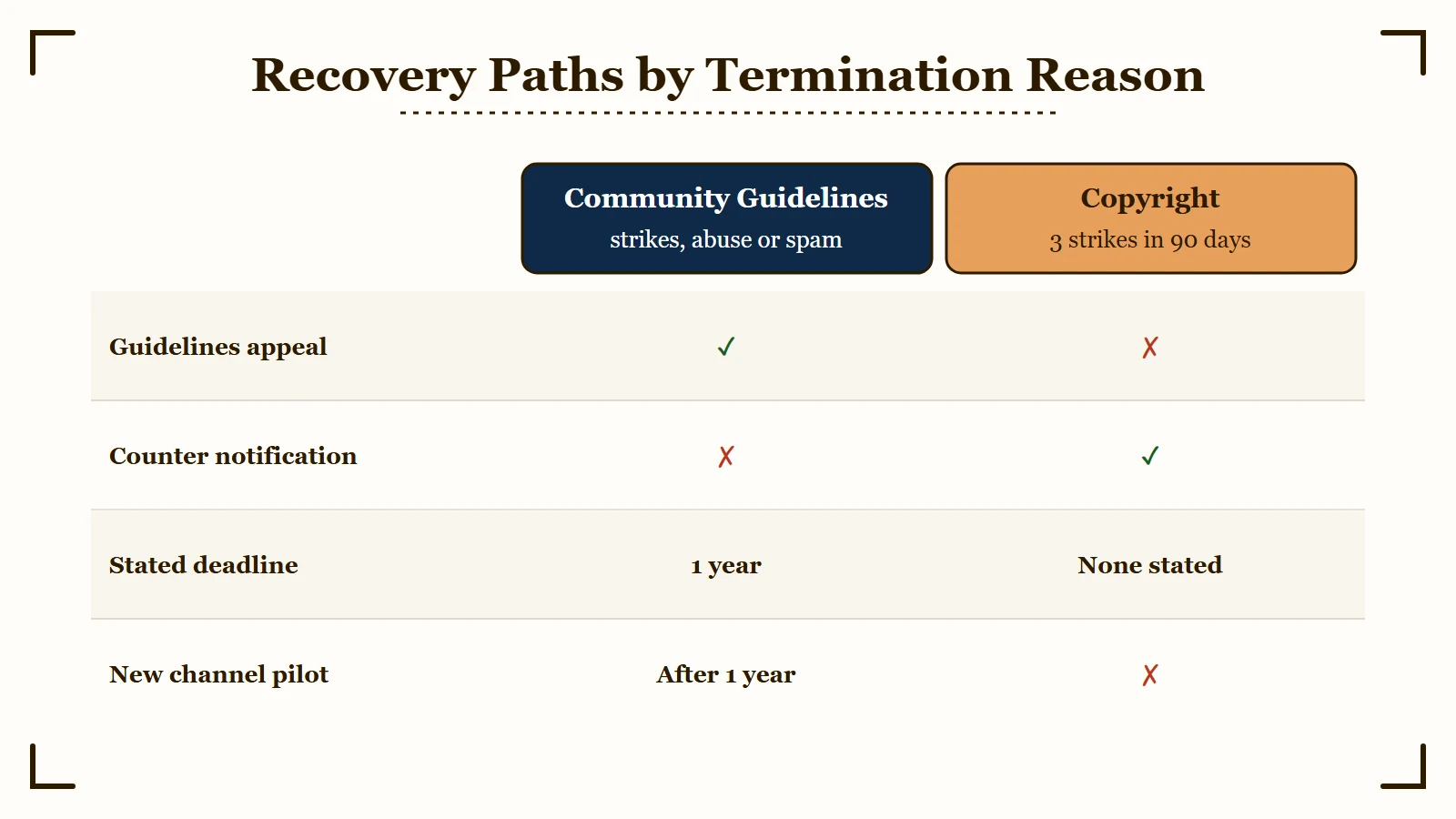
The confusion starts because YouTube uses the same “terminated” label for situations with very different ways back. YouTube’s channel termination page lists three Community Guidelines routes, and copyright runs on a separate strike system with its own rules.
| Termination route | What YouTube says triggers it | Way back | Second Chances pilot |
|---|---|---|---|
| Three Community Guidelines strikes | 3 strikes in the same 90-day period may remove the channel permanently | Appeal in YouTube Studio within 1 year | Can request after 1 year |
| Single case of severe abuse | Examples include predatory behavior or spam, and it can come without a warning | Appeal in YouTube Studio within 1 year | Can request after 1 year, but YouTube weighs particularly severe violations |
| Channel dedicated to a violation | Examples include hate speech, harassment, or impersonation, and YouTube says spam accounts often land here | Appeal in YouTube Studio within 1 year | Can request after 1 year, with the same weighing |
| Three copyright strikes | 3 copyright strikes in 90 days make the channel subject to termination | Counter notification by email, fax or post, or a retraction from the claimant | Excluded |
To see why your channel was terminated, check YouTube’s termination email or sign in to YouTube Studio, which still shows the termination info even though the dashboard and other features are gone. That reason decides everything below, so screenshot it before you do anything else.
Three-strike accumulation starts with a warning, because YouTube says the first violation is typically only a warning, and that warning can expire after 90 days if you take the optional policy training. A first strike then freezes uploads, live streams and other posting for 1 week, and a second strike inside the same 90 days freezes posting for 2 weeks. A third strike in that window may remove the channel, and each strike lasts 90 days from the day it was issued, according to YouTube’s strike basics page.
Severe single-violation termination skips the strike ladder. YouTube says a single case of severe abuse, such as predatory behavior or spam, can end a channel without warning, and severity counts again when YouTube reviews a request for a new channel.
Copyright termination follows a separate track. YouTube’s copyright strike page says 3 copyright strikes in 90 days make a channel subject to termination, along with channels linked to it. A counter notification stays open afterwards by email, fax or post, and the YouTube copyright strike removal guide covers it in detail.
Google’s quarterly Transparency Report shows which policies drive most of these terminations. From April to June 2026 YouTube removed 2,732,395 channels for Community Guidelines violations, and 2,310,181 of them, or 84.5%, went for spam, deceptive practices and scams.
Three strikes spread across several policies are a small slice by comparison. YouTube files a channel that collected three strikes for more than one policy within 90 days under “Multiple policy violations”, and that label covered 7,741 channels in the quarter, about 0.3%, while child safety (136,252) and the nudity category (137,130) each accounted for about 5%. Three-strike terminations for a single policy are counted under that policy, so the report cannot say how many channels reached three strikes in total.
Two cases have their own walkthroughs: the spam and scams termination guide and the unlisted video termination guide.
How to Appeal a YouTube Channel Termination Step by Step
You appeal a Community Guidelines termination from YouTube Studio on a computer, and YouTube gives you up to 1 year from the termination date to submit it.
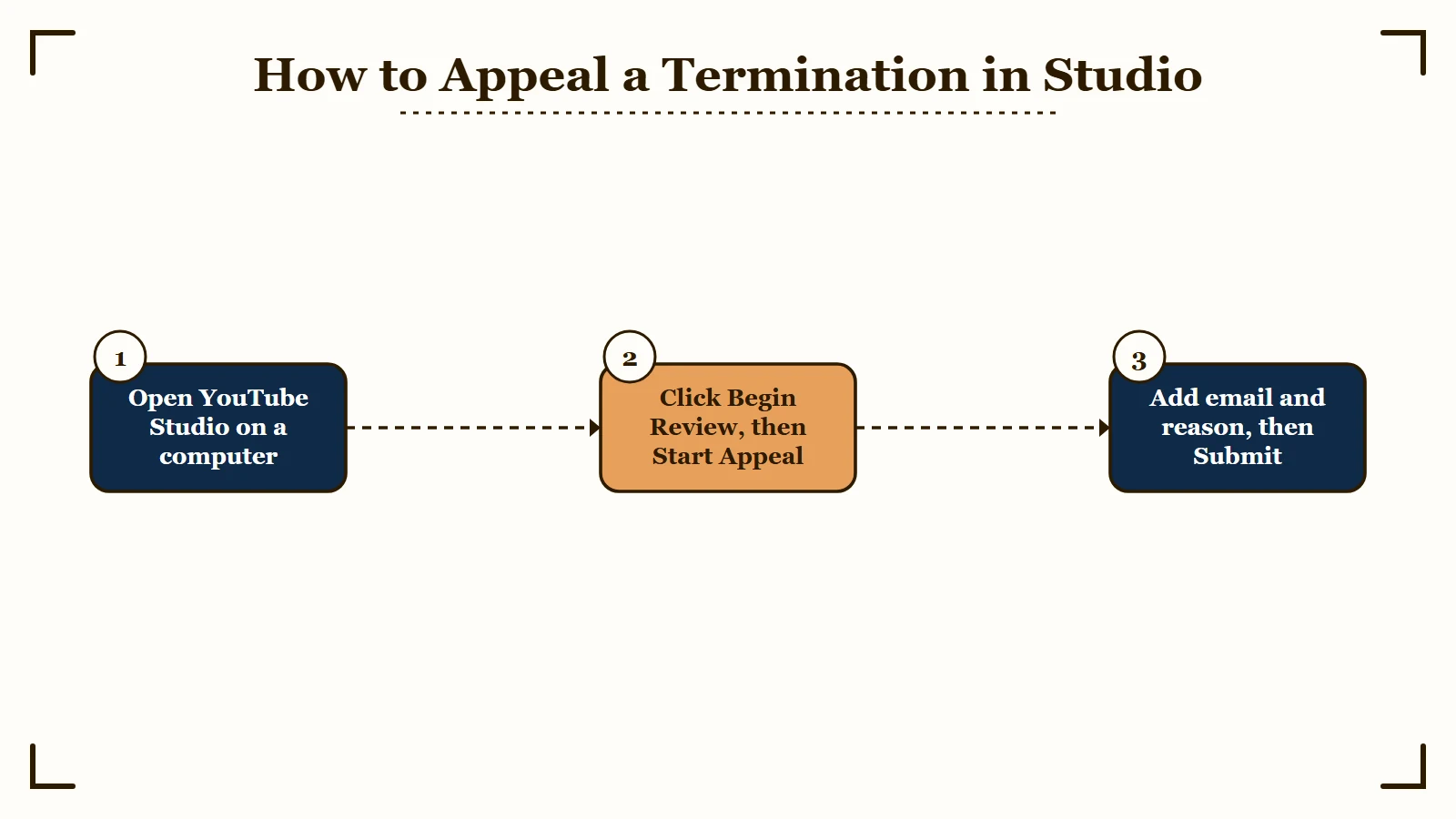
The mechanics are short, and the written reason is the one part you control. YouTube limits how many times you can appeal a single channel termination, so treat the first submission as the one that counts.
YouTube documents this sequence on its termination page.
- Open YouTube Studio on a computer and sign in with the terminated channel’s account. You may need to re-authenticate.
- Below the termination info, click Begin Review. You may need to complete a verification step.
- Review the reason for the termination, then click Next.
- Select Start Appeal and click Next.
- Enter a contact email address and explain your reason for appeal.
- Click Submit, then screenshot the confirmation for your records.
- If the Studio steps will not let you submit, use the separate appeal form YouTube links from the same termination page.
YouTube’s steps ask only for a contact email and your reason for appeal, so the written reason has to carry your evidence. Name the policy the email cited, the video or post at issue, and the context that shows why it did not break that policy.
Before: “My channel was wrongly terminated. I never violated any rules. Please restore my channel. I have been on YouTube for 5 years and this is unfair.”
After: “My channel [name] was terminated on [date] citing [specific policy]. I believe this was applied in error because [specific reason with evidence]. The flagged content at [URL if known] was [explain context: educational, satirical, licensed, etc.]. I have reviewed the current Community Guidelines and confirm my remaining content is compliant. I am requesting reinstatement of the channel.”
The first version gives the reviewer nothing to work with. The second names the policy, supplies context, and shows you have read the rules as they stand today.
Reading the current rules pays off because YouTube’s Second Chances announcement says appeals are evaluated based on how its policies apply at the time of the appeal, and that one factor is whether the policy in question has been retired from the Community Guidelines.
Automated systems find most of what gets removed. Of the 11,159,676 videos YouTube removed from April to June 2026, automated flagging made the first detection on 11,005,420, about 98.6%, and the report itself concedes that YouTube sometimes makes mistakes, which is why it allows appeals.
Set your expectations from YouTube’s own numbers. YouTube says the majority of appealed termination decisions are upheld, and for removed videos, where it does publish counts, it received 1,269,277 appeals and reinstated 87,953 videos in the same quarter, roughly 7 reinstatements for every 100 appeals counted, according to the appeals section of the report.
YouTube gives no fixed review time for termination appeals. Studio shows your submission confirmation and the appeal’s anticipated review time, the outcome arrives by email, and an accepted appeal sends you back to your Studio dashboard with the old channel reinstated.
What Is the YouTube Second Chances Program and Who Qualifies
What is YouTube Second Chances: A pilot YouTube announced on October 9, 2025 that lets some terminated creators request a brand new channel one year after their termination date. It does not restore the old channel, its videos or its subscribers.
YouTube’s Second Chances pilot lets some previously terminated creators request a new channel, never reinstatement of the old one, and nobody can apply until one year after the termination date. It sits alongside the standard appeal, and YouTube calls it a gradual pilot, so the option can be missing even for creators who meet the criteria.
Very little carries over. YouTube calls the new channel a fresh start where you build your community back, and you have to requalify for monetization on it. You can re-upload any of your prior videos that are within the Community Guidelines, which makes your own original files worth keeping.
What YouTube requires before you can request a new channel:
- One year has passed since the termination date. YouTube says terminated creators are not eligible until then.
- The termination was not for copyright infringement.
- You have not violated YouTube’s Creator Responsibility policies.
- You have not deleted the terminated YouTube channel or its Google account, because creators who did cannot see the “request a new channel” option at this time.
- The option has reached your account. YouTube is rolling it out gradually, so some eligible creators will not see it yet.
YouTube also weighs whether the creator committed particularly severe or persistent violations, and whether their on- or off-platform activity harmed or may continue to harm the YouTube community, giving channels that endanger kids’ safety as its example. That makes child safety a factor in the review, while the listed exclusions are copyright infringement and Creator Responsibility violations.
The copyright exclusion is easy to miss. If three copyright strikes ended your channel, the pilot is closed to you, and the routes left are a counter notification or asking the claimant to retract.
To request a new channel, sign in to YouTube Studio on a computer with the terminated channel’s own account and look for the “Request new channel” option. YouTube emails the outcome to the address tied to the original channel, per its Rejoining the YouTube Community help page.
An approved channel can apply for the YouTube Partner Program once it meets the program criteria, which YouTube sets at 1,000 subscribers plus either 4,000 qualified watch hours in the last 12 months or 10 million qualified Shorts views in the last 90 days.
What Happens When a YouTube Appeal Fails
When YouTube rejects a termination appeal, the channel stays terminated and YouTube signs you out once you accept the decision. For eligible creators, the next documented step is a Second Chances request one year after the original termination date.
YouTube’s termination page lists no further penalty for a rejected appeal. A disabled Google Account is a separate action. Google can stop someone signing in to every Google service when product rules such as the YouTube Community Guidelines are broken, and that has its own appeal at sign-in, with up to 2 reviewed appeals for some violations, per Google’s disabled account help.
The Second Chances clock does not restart when an appeal is rejected. YouTube counts eligibility from the termination date, so a rejection in month eight leaves about four months before you can request a new channel.
The four scenarios look like this.
| Scenario | Channel status | Account status | Next step |
|---|---|---|---|
| Terminated, no appeal yet | Removed, and partner earnings stop | You can still sign in to Studio to review the termination | Appeal within 1 year |
| Appeal accepted | Old channel reinstated | Sent back to your Studio dashboard | Resume creating |
| Appeal rejected | Stays terminated | Signed out once you accept the decision | Second Chances request 1 year after the termination date, if eligible |
| New channel made without approval | Breaks the circumvention rule | The prohibition covers every channel you own, create, acquire or keep appearing in | Stop, and use a Second Chances request if eligible |
Money and files go with the channel. YouTube says a terminated partner is no longer entitled to earn revenue and may have unpaid earnings withheld, and you can no longer download your YouTube content, although your wider Google data stays downloadable.
Creating a new channel after termination is the worst mistake you can make. YouTube prohibits a terminated creator from using, possessing or creating any other YouTube channel, and the rule reaches every existing channel, any new channel you create or acquire, and any channel in which you are repeatedly or prominently featured.
YouTube does not publish how it matches a new channel to a terminated creator, and a different laptop or email address leaves the rule untouched, because it is written around you and the channels you run or appear in. Letting a terminated creator use your channel is prohibited too.
TikTok treats a fresh account after a ban the same way. Its Community Guidelines list trying to avoid enforcement as a reason to ban an account and say TikTok may ban new accounts you create, as the TikTok ban appeal guide explains.
If your appeal fails and the pilot is closed to you, the rules leave no way to keep creating on YouTube. Moving your audience to another platform is the path that stays within them, and a channel run under a new brand or company still falls under the rule if you use it or keep appearing in it.
How to Prevent YouTube Channel Termination
The most reliable prevention starts at the first warning: take the optional policy training where it is offered so the warning expires after 90 days, and keep a second strike from landing inside the 90-day life of the first.
YouTube starts that 90-day clock from the day you complete the training, and a repeat violation of the same policy inside the window can turn the warning into a strike.
Each strike runs on its own clock, expiring 90 days after the day it was issued. A creator who gets two strikes in the same week has 90 days to stay clean before both expire, and a third strike inside that window can end the channel.
Six habits cover the prevention basics.
- Enable two-step verification on your Google account. Someone who takes over your channel can post content that earns strikes in your name, and the YouTube phishing protection guide covers the attacks that get past it.
- Re-read the Community Guidelines whenever YouTube announces a policy change, since appeals are judged on the current wording.
- Use only original content or properly licensed material. A Content ID claim typically does not become a strike, but disputing one without a valid reason lets the owner file a removal request that can.
- Complete Copyright School after your first copyright strike. A copyright strike only expires after 90 days once you have completed it, and a scheduled removal request gives you 7 days to delete the video and avoid the strike.
- Watch Studio notifications during any active strike. Each strike email names what was removed, the policy it broke and what you can do next.
- Avoid any third-party service that sells subscribers, views or engagement. Spam, deceptive practices and scams drove 84.5% of YouTube’s channel removals from April to June 2026, which makes it the single biggest reason channels disappear.
What I would recommend above all else is treating the first strike as the emergency it is. Once a third strike ends the channel, it comes back only if YouTube reverses the termination.
If your channel is still live and you are dealing with monetization being denied, that is a separate issue from termination risk, though the policy overlap means fixing one often helps with the other.
Frequently Asked Questions
Can I get my terminated YouTube channel back?
Yes, if YouTube accepts your appeal, which you can file for up to one year after the termination. If it fails, the Second Chances pilot may let eligible creators request a new channel a year after the termination, but the old channel does not come back.
How long does the YouTube termination appeal take?
YouTube publishes no fixed review time. Studio shows the appeal’s anticipated review time after you submit, and the decision arrives by email.
Can I create a new YouTube channel after termination?
No. YouTube bars a terminated creator from using, possessing or creating any other channel, and a different device or email address does not change that. The sanctioned route, if you are eligible, is a Second Chances request a year after the termination.
What happens to my other YouTube channels when one is terminated?
They fall under the same ban, because YouTube’s circumvention rule covers all of your existing channels. For copyright, a channel linked to one with 3 active copyright strikes is subject to termination too.
What is YouTube Second Chances?
A pilot YouTube announced on October 9, 2025 that lets some terminated creators request a new channel one year after the termination. It excludes copyright terminations and Creator Responsibility violations, and creators who deleted the channel or its Google account cannot currently see the option.
Does a failed YouTube appeal make things worse?
YouTube documents one consequence: once you accept the rejection, you are signed out and the channel stays terminated. A disabled Google Account is a separate Google action with its own appeal.
Does a YouTube channel termination ever expire?
No expiry date appears on YouTube’s termination page, and YouTube described its long-held approach as lifetime terminations. The documented ways back are an appeal within one year or a Second Chances request after one year.
How many copyright strikes cause YouTube termination?
Three copyright strikes within 90 days make a channel subject to termination, along with associated channels. Copyright terminations are excluded from Second Chances, so the routes back are a counter notification or a claimant’s retraction.