Fix the View Drop From YouTube Thumbnail A/B Tests
Fix the View Drop From YouTube Thumbnail A/B Tests
YouTube A/B test lowering your views? Here is why impressions drop during Test and Compare, whether it recovers, and how to run tests safely.
- 1Why Does the YouTube A/B Test Lower Your Views
- 2Is the View Drop Real Suppression or Just Perception
- 3Why Did My Highest CTR Thumbnail Lose the Test
- 4Can You A/B Test Titles and Shorts Too
- 5How Long Should a YouTube Thumbnail Test Run
- 6How To Run a Test Without Tanking Your Views
- 7How To Recover a Video That Died During a Test
- 8Frequently Asked Questions
- Does YouTube A/B testing actually lower your views?
- Is the thumbnail test view drop permanent?
- Why does my best thumbnail keep losing the test?
- Should small channels use Test and Compare?
- How long does a YouTube thumbnail test take?
- Why can I not find the A/B test option on my video?
- What happens if my test has no clear winner?
- 9Quick Takeaways
TL;DR: A YouTube A/B test lowers your views because the tool splits your traffic across every variant and the algorithm pulls back reach while it probes a broader audience. The drop is usually temporary and recovers once a winner is applied. The fix is to test only strong thumbnails on evergreen videos, never weak filler variants, and to know when to stop a test that has flatlined.
YouTube’s own documentation explains part of what you are seeing. Its help pages state that YouTube “may maintain a small percentage of traffic as a control group of viewers that are excluded from the experiment”, that this group “will only see the default thumbnail and title”, and that “the video performance from the control group is excluded from the experiment calculations”.
The numbers inside the test panel are therefore not your video’s total performance. Part of your audience is deliberately held outside the experiment, and their views are stripped out of the comparison you are staring at.
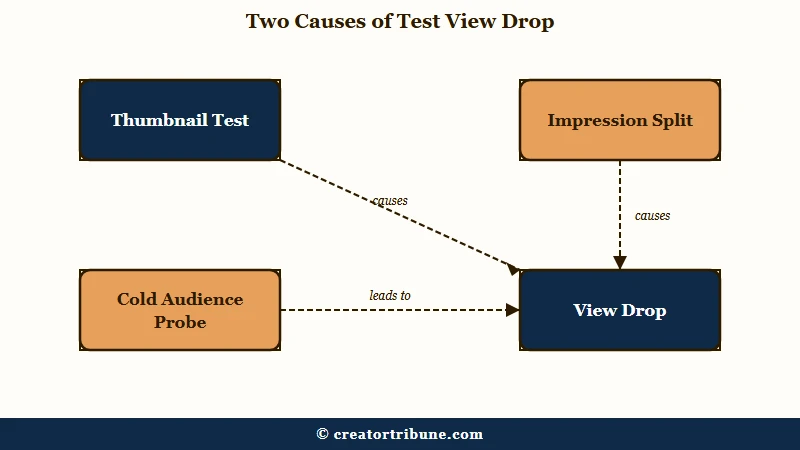
The drop you can see is mostly mechanical. Impressions divide across up to three variants, a slice of traffic is fenced off as a control, and the algorithm re-tests the video on a colder audience while it gathers data.
This guide covers why the drop happens, whether it is real suppression, why your highest click-through thumbnail can lose, and how to recover a video that died mid-test.
Why Does the YouTube A/B Test Lower Your Views
A YouTube A/B test lowers your views because Test and Compare splits your impressions evenly across every variant while the algorithm re-tests the video on a broader audience.
Your weakest thumbnail gets shown as often as your best one, which drags down the average.
What is Test and Compare: YouTube’s built-in A/B testing tool, now listed in YouTube Help as “A/B test titles & thumbnails”. It rotates up to three variants on one video and picks the winner on watch time share. Since a global rollout that began in December 2025 it tests titles as well as thumbnails, or both together.
Two things stack on top of each other during a test. First, traffic is divided, so no single strong thumbnail gets full exposure. Second, the algorithm treats a test like a fresh evaluation and pushes the video to a wider, colder audience, which naturally lowers click-through for a while.
Creator-reported drops run from a routine 30 to 50 percent dip to extreme cases where impressions fell close to nothing during the test window. YouTube publishes no figure for any of this, so treat those numbers as community reports rather than a documented range. How hard it bites depends heavily on your channel size.
Is the View Drop Real Suppression or Just Perception
The view drop is partly real and partly perception, because the test panel never shows you all of your traffic. YouTube excludes the control group’s performance from the experiment calculations, so part of the audience you think you lost is being counted somewhere you cannot see.
The evidence is genuinely split. Some experts argue the “suppression” is a myth and that sharp click-through drops happen naturally any time the algorithm tries a video on a colder audience, test or no test. Others point to creators whose small channels went from 50 views a day to 5 during a test that ended inconclusive.
Both can be true. On a large channel, a 10 to 20 percent dip is absorbed without much pain. On a small channel with thin traffic, the same mechanic can look like the video died, because there were never enough impressions to spread across three variants in the first place.
With YouTube serving more than 2.5 billion logged-in monthly users according to Statista, the test pool a big channel pulls from dwarfs what a small one can feed in two weeks. That scale gap, not creative quality, is why the same tool feels harmless to one creator and fatal to another.
| Symptom | Likely cause | What to do |
|---|---|---|
| Views drop 30 to 50 percent right after starting | Traffic split across variants plus broader-audience probe | Let it run if the channel can absorb it |
| Impressions fall close to zero on a small channel | Too little baseline traffic to feed three variants | Stop the test, pick the best thumbnail manually |
| Results keep coming back “Inconclusive” | Under 1,000 impressions per variant | Stop it, the video is too low-traffic to test |
| Views never recover after winner applied | Possible algorithmic flag from the test history | Upload a fresh thumbnail to reset, or re-upload |
Why Did My Highest CTR Thumbnail Lose the Test
Your highest click-through thumbnail can lose because YouTube decides the winner on watch time share, not raw click-through rate.
A thumbnail that pulls fewer but more committed viewers beats one that wins clicks and loses them in the first minute.
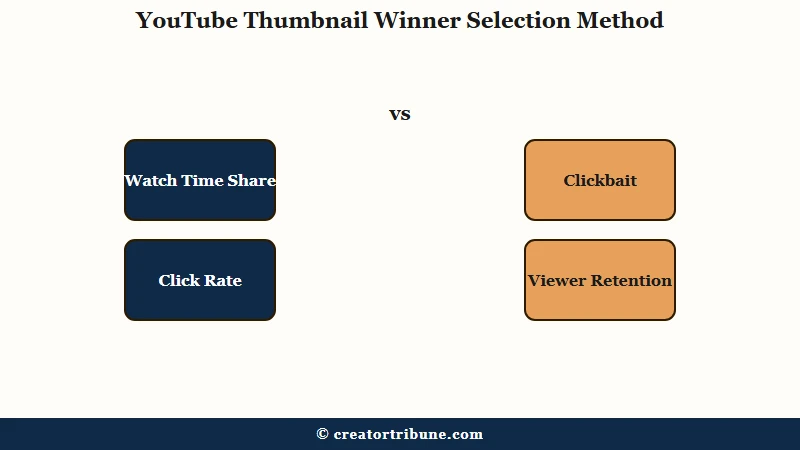
What is watch time share: The portion of total watch time a thumbnail variant earns, used by YouTube to reward thumbnails that bring viewers who actually stay.
This is the most misunderstood part of the tool, and YouTube has stated the reasoning plainly. Announcing the rollout, the company said it wanted to “ensure that your A/B test experiment gets the highest viewer engagement, so we’re optimizing for overall watch time over other metrics like CTR”, as reported by Search Engine Journal.
A thumbnail that wins the click and loses the viewer in the first minute can therefore lose to one that pulls fewer but more committed viewers. Guides reporting that a lower-CTR variant won are describing the outcome the metric is built to produce.
This is also why thumbnails that bring viewers who stay and convert into subscribers win the test even with a lower click rate. Watch time share rewards the thumbnail that sets an honest expectation.
This shift is deliberate. A thumbnail that misrepresents the video to chase clicks now costs you on the exact metric that decides the test, because viewers who feel misled leave early and pull the watch time down with them. Misleading thumbnails are one of the fastest ways to tank a video, and the watch-time metric is YouTube’s defense against them.
Can You A/B Test Titles and Shorts Too
You can test titles, thumbnails, or both together on regular videos, but you cannot A/B test Shorts at all.
YouTube states plainly that “you are not able to A/B test Shorts, Scheduled Lives, and Premiere videos at this time”.
The tool is no longer thumbnail-only. Search Engine Journal reported that YouTube announced title testing in September 2025 and began the global rollout in December 2025 to all creators with advanced features enabled, so it now covers up to three titles, three thumbnails, or combinations of the two on one video.
Two more restrictions catch people out. The feature “is currently only available on computers through YouTube Studio”, so it will not appear in the mobile app, and it is unavailable on videos set as Made for Kids, for mature audiences, or private.
Titles and thumbnails run through the same experiment mechanics, control group included, so switching to a title test does not avoid the split. Shorts are the useful exception: if a Short lost views, no A/B test caused it, because the tool cannot run on Shorts at all.
How Long Should a YouTube Thumbnail Test Run
YouTube says a test “should be completed within two weeks”, and in practice it can settle in a few days or take the full fortnight depending on how much traffic the video gets.
Low-traffic videos end “Inconclusive” because the sample never gets big enough to call.
YouTube gives two weeks as the outer limit, and leaving the test alone for the full window is simply how you avoid skewing the data. Aim for enough traffic that each variant collects a meaningful sample, in the region of 1,000 impressions or more. If your video cannot realistically get there inside a fortnight, the tool is the wrong fit and will mostly just thin out the few views the video had.
The results come back in three labels. Plenty of guides still list a “Preferred” result, but YouTube Help now names the set as Winner, Performed Same and Inconclusive, so that middle label is worth unlearning.
A non-winner result carries a consequence worth planning for. YouTube states that “if there was no clear ‘winner,’ then the first title or combination of title and thumbnail that you uploaded will be shown to all viewers”, so upload order decides your fallback. Put your strongest option in the first slot.
| Result label | What it means | What happens next |
|---|---|---|
| Winner | One thumbnail won with statistical confidence | YouTube applies it to the video automatically |
| Performed Same | The variants earned a similar watch time share | The first option you uploaded is shown to everyone |
| Inconclusive | Variants too similar or traffic too low to call | Your first uploaded option is shown, so try bigger differences |
How To Run a Test Without Tanking Your Views
Run tests only on evergreen videos with stable traffic, use strong variants only, and take big swings instead of tiny tweaks.
The fastest way to lose views is filling the three slots with weak thumbnails just to have something to test.
The safest structure is the Safe-Safe-Wildcard method: two thumbnails in your proven style plus one bold experiment. That way a single risky variant cannot sink the whole video, and you still learn something from the wildcard.
Micro-changes like font size or shirt color usually come back “Inconclusive” because viewers never notice the difference. Test completely different concepts instead, such as a face versus no face, or a different emotional hook. One small lever does move the needle: a GrowthOS split test found that adding a question mark to thumbnail text lifted click-through by 19.8 percent.
Work through this sequence before starting any test.
- Pick an evergreen video with steady traffic, not a brand-new upload still in its first 48 hours.
- Confirm the video gets enough daily impressions to plausibly hit 1,000 per variant inside two weeks.
- Build two strong on-brand thumbnails and one wildcard, never three rushed ones.
- Start the test and leave it alone for the full window so the data is not skewed.
Before: Three quick thumbnails thrown at a two-day-old upload, one of them blurry filler, while you refresh impressions every hour.
After: Two polished variants and one bold wildcard on a six-month-old evergreen video, left running for 14 days without touching it.
How To Recover a Video That Died During a Test
To recover a video that tanked during a test, stop the test, apply your best thumbnail manually, and if impressions stay suppressed, upload a fresh thumbnail or re-upload the video. Most videos climb back within a couple of days once the test ends.
Panic is the real enemy here. Several creators have reported that after stopping a test and picking a thumbnail by hand, views and impressions started returning within two days. The video was never dead, it was mid-experiment.
If the suppression genuinely sticks, the harder reset works too. Creators have reported stalled videos recovering their impressions within a day of being re-uploaded with no test running, though that is community experience rather than anything YouTube documents. Work through the following order.
- Stop the test in YouTube Studio and manually select the strongest thumbnail.
- Give it 48 to 72 hours before judging recovery, since the climb back is gradual.
- If impressions stay flat, swap in a completely fresh thumbnail to reset the video’s test history.
- As a last resort on an important video, re-upload it clean and skip the testing tool entirely.
If your views dropped without any test running, the cause is probably different, and a sudden reach collapse has its own diagnostic path worth ruling out first. It is also worth checking your channel-level trust and satisfaction signals, since those affect how aggressively the algorithm tests you.
Frequently Asked Questions
Does YouTube A/B testing actually lower your views?
Yes, temporarily. The tool splits traffic across variants and the algorithm probes a broader audience, so views commonly dip 30 to 50 percent during the test. They usually recover once a winner is applied.
Is the thumbnail test view drop permanent?
Almost never. Most creators see impressions climb back within two to three days of stopping the test or applying a winner. If suppression sticks, uploading a fresh thumbnail or re-uploading the video resets it.
Why does my best thumbnail keep losing the test?
YouTube picks winners by watch time share, not click-through rate. A lower-click thumbnail that keeps viewers watching longer beats a high-click thumbnail whose audience leaves quickly.
Should small channels use Test and Compare?
Usually not. Small channels rarely generate the impressions per variant needed for a clear result, so tests often end inconclusive while thinning out the few views the video had.
How long does a YouTube thumbnail test take?
YouTube says a test “should be completed within two weeks”. It can settle in a few days on a busy video, so two weeks is the outer limit rather than a minimum you have to sit through.
Why can I not find the A/B test option on my video?
The feature only appears on computers through YouTube Studio and needs advanced features enabled on your channel. It is also unavailable for Shorts, Scheduled Lives, Premieres, and anything marked Made for Kids, for mature audiences, or private.
What happens if my test has no clear winner?
YouTube falls back to whichever option you uploaded first, not the one that was live before the test. Upload your strongest thumbnail or title into the first slot so a Performed Same or Inconclusive result still leaves you with your best option.
Quick Takeaways
- The view drop is mostly mechanical: impressions split across variants, YouTube fences off a control group whose views are excluded from the test maths, and the algorithm re-tests the video on a colder audience.
- YouTube decides winners on watch time share, so your highest click-through thumbnail can and will lose.
- Test only evergreen videos with enough traffic to hit 1,000 impressions per variant, never small or brand-new uploads.
- Use the Safe-Safe-Wildcard method and take big swings, since tiny tweaks return “Inconclusive.”
- To recover a tanked video, stop the test and pick a thumbnail manually first, then reset with a fresh thumbnail or re-upload if needed.