File a DMCA Takedown on an AI Voice Clone of Your Script
File a DMCA Takedown on an AI Voice Clone of Your Script
How to file a DMCA takedown when someone clones your voice with AI and re-publishes your stolen YouTube script. Form fields, timelines, evidence.
- 1Why DMCA Targets the Script and Not the Voice Clone
- 2Evidence to Collect Before You File
- 3The YouTube DMCA Takedown Form Step by Step
- 4Response Times and Counter-Notice Handling
- 5The Tennessee ELVIS Act and the Federal NO FAKES Act
- 6Filing the Same Takedown on TikTok
- 7Frequently Asked Questions
- Can I DMCA an AI voice clone of my voice?
- How long does a YouTube DMCA takedown take in 2026?
- What happens if the thief files a counter-notice?
- Does the ELVIS Act apply outside Tennessee?
- Will YouTube remove a video if I only have a partial script match?
- Should I send a cease-and-desist before filing the DMCA?
- 8Quick Takeaways
TL;DR: DMCA does not protect your voice, it protects your script. When someone clones your voice and re-publishes a verbatim copy of your script on YouTube or TikTok, file the DMCA against the script copying, not the voice clone. That route has the highest success rate and lands the video down in 5 to 10 days. The voice clone itself is covered by the Tennessee ELVIS Act if the thief is in or targeting Tennessee, and the pending federal NO FAKES Act when it lands.
Someone copied your script almost word for word, ran it through ElevenLabs or a clone of your voice, and uploaded it as their own. You searched for the obvious match and there it is, sometimes with more views than your original.
The instinct is to fight the AI voice clone. That is the wrong fight.
Voice cloning sits in a legal gray zone that takes lawyers and state-level statutes to settle. The script under the voice is a different story, and it is the route that wins a takedown.
This tutorial walks through filing a YouTube DMCA against the script copying, with the exact form fields, the evidence you need before you click submit, the typical response window, and what to do when the thief files a counter-notice. The same process maps to TikTok with one tooling difference covered below.
Why DMCA Targets the Script and Not the Voice Clone
DMCA protects your script as a literary work, not your voice as a sound recording. The Copyright Act of 1976 protects original works of authorship, which includes a video script with specific sentence structures, citations, and unique phrasing.
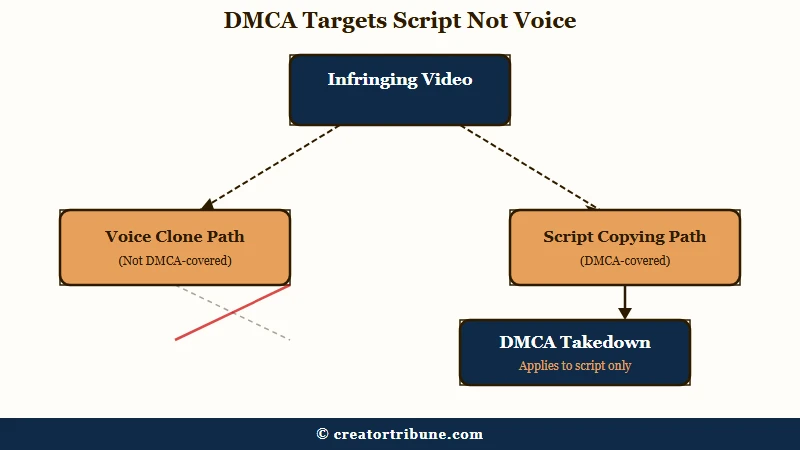
Sound-recording protection under Section 114(b) is limited to the fixation of sounds, not to a simulation of how you sound. A cloned voice that re-reads your text does not infringe your voice. The text being read infringes your script.
What this means in practice is that the strongest DMCA notice you can file is the one that does not mention voice cloning at all. The notice should describe the original work as “the script of video [title and URL]” and the infringing material as “a video that reproduces my script verbatim or near-verbatim”. You attach side-by-side transcript evidence, not voice analysis.
From what I have seen across creator takedown cases, the notices that fail are the ones that lead with “they cloned my voice” framing. YouTube’s reviewers process that as a personality-rights complaint and route it to a slower lane that often ends in rejection. Reframing the exact same case as “verbatim script copy” goes through the standard copyright lane and lands much faster.
The other piece nobody mentions is that a 10 percent rewrite of your script is generally not enough to defeat copyright. Substantial similarity tests look at sentence structure, citation choices, and unique phrasing, not just word swaps. If the thief reordered paragraphs but kept your specific claims, your specific numbers, and your specific framing, the takedown still holds.
Evidence to Collect Before You File
Before opening the takedown form, collect three categories of evidence: timestamp proof, transcript proof, and platform metadata.
Skip any of these and the notice gets thrown into the slow review lane or rejected outright on a counter-notice. Skip all three and you are filing an unwinnable case.
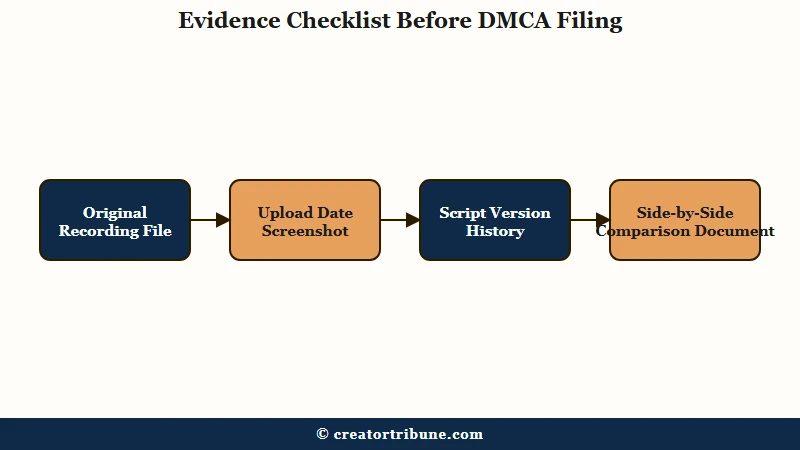
Here is the exact pre-filing checklist.
- Save your original raw recording file from your camera or recorder. The export metadata (creation date, device ID, software version) is the gold standard for proving you authored the script first.
- Pull the upload date and URL of your original video. Take a screenshot of your YouTube Studio backend showing the publish date, not the public-facing page.
- Save your script as a document with a creation date that pre-dates the upload. A Google Doc edit history or a Notion version log both work.
- Generate a side-by-side comparison document that lines up your sentences against the infringing video’s sentences. Highlight the verbatim or near-verbatim matches.
- Capture the infringing video URL, channel handle, channel URL, upload date, and view count. View count is not a legal element but it matters for damages later.
- Archive the infringing video via web.archive.org so the page survives the takedown. You will need the archived link if the thief files a counter-notice and the original disappears.
The side-by-side comparison is the load-bearing piece. YouTube reviewers spend roughly thirty seconds per case and the side-by-side is what closes the loop in those thirty seconds.
A vague claim with no side-by-side gets rejected. A claim with a clean side-by-side gets the video down.
Before: “This channel stole my script and used AI voice cloning to publish it as their own. URL is X, my channel is Y.”
After: “The video at URL [infringing] is a verbatim reproduction of the script for my video at URL [original], published on [original date] versus [infringing date]. The attached side-by-side document shows 47 sentences from my original appearing in the same order in the infringing video, with 3 sentences quoted exactly and 44 sentences differing by no more than one or two words.”
The second version is the one that lands the takedown.
If you need a written-content alternative for any tools-and-products research that lives alongside this fight, our Descript review covers the legitimate voice cloning tools, including Overdub’s invisible watermark and Live Voice ID consent script that real creators use to protect their own audio.
The YouTube DMCA Takedown Form Step by Step
YouTube routes DMCA takedowns through the Copyright Removal Request form inside YouTube Studio, with seven required fields.
The form is straightforward but the wording in each field changes your case strength. Here is what to enter, field by field.
- Contact information: your full legal name, email, phone, and mailing address. YouTube may share this with the uploader, so use a professional address rather than a home address if privacy is a concern.
- Description of the copyrighted work: name your original video, paste its URL, and add a short line like “Original video script, published [date], 8 minutes 42 seconds long, full transcript attached”.
- Identification of infringing material: paste the URL of the infringing video. If multiple videos on the same channel use your script, list every URL.
- Statement of good-faith belief: tick the box and add nothing creative. The form provides the boilerplate.
- Statement of accuracy under penalty of perjury: tick the box and add nothing creative. Same as above.
- Signature: type your full legal name. This is a legal signature under the DMCA.
- Upload supporting evidence: attach the side-by-side document, the timestamped transcript of your original, and the archive.org snapshot of the infringing video.
Submit and you should see a confirmation screen with a case ID. Save that ID. YouTube will email status updates to the address you provided and the case ID is how you reference the request if you have to escalate.
| Field | What hurts your case | What strengthens your case |
|---|---|---|
| Description of work | “My voice was cloned” framing | “Original script published [date], verbatim transcript attached” |
| Identification of infringing material | Linking only the channel | Listing every infringing video URL individually |
| Supporting evidence | “I am the original creator” claim only | Side-by-side script comparison + archive.org snapshot |
| Signature field | Initials or a screen name | Full legal name typed verbatim |
| Contact info | Home address (privacy risk) | PO box or business address |
The script and voice cloning intersect with a larger AI-content moderation shift YouTube ran through in 2025.
The YouTube AI slop demonetization policy renamed the old reused-content rule as inauthentic content on July 15, 2025. AI-cloned scripts that ride on your work are demonetised under that policy independent of any takedown you file, but the takedown still removes the video while the policy reduces the thief’s incentive to try it again.
Response Times and Counter-Notice Handling
YouTube typically removes clear-cut infringing videos within 5 to 10 days of filing.
TikTok’s standard window through its standard takedown form is also 5 to 10 days, but a verified brand running through the Intellectual Property Protection Center can see action in around 3 business days. Complex disputes or borderline cases stretch to 2 to 3 weeks on both platforms.
Once the video is removed, you may receive a counter-notice from the uploader. A counter-notice is the thief claiming the removal was a mistake or that the use was fair use. The platforms are legally required to forward the counter-notice to you within 10 business days.
Your move at that point is binary. Either you file a federal lawsuit to restrain the uploader within 10 to 14 business days, or the platform restores the video. There is no middle ground.
The $400 federal filing fee is real, the legal time is real, and most creators do not pursue this path for a single video. The decision turns on view count, monetisation impact, and pattern (a one-off thief versus a serial channel that has hit you multiple times).
The way I see it, the rational play for most creators is to file the DMCA, accept that maybe 20 percent of cases will be counter-noticed, and reserve the federal lawsuit option for a serial offender or a channel that has built real revenue on top of stolen scripts.
What you should never do is panic-respond to a counter-notice with another aggressive escalation. Counter-notices are sometimes filed reflexively by thieves who hope you will not follow through. Your weight to throw at the response is to escalate to a lawyer who will file the restraint, and that lawyer will tell you whether the case is worth the $400 plus billable hours.
The Tennessee ELVIS Act and the Federal NO FAKES Act
State-level voice cloning law currently sits with Tennessee, where the ELVIS Act made unauthorized AI voice cloning a Class A misdemeanor effective July 1, 2024.
If the thief is operating from or targeting Tennessee, the state-level remedy is available alongside the federal DMCA route. Outside Tennessee, voice cloning is still in the legal gray zone the federal NO FAKES Act is trying to close.
The federal picture moved in May 2026 when the revised NO FAKES Act was reintroduced in the Senate by Senators Blackburn, Coons, Salazar, Dean, and colleagues. The revised version proposes a federal right to control unauthorized digital replicas of voice and likeness, and explicitly contemplates platform liability if a service hosts an unauthorized replica with knowledge of the violation.
Until NO FAKES passes, your federal hammer remains DMCA on the script. If you operate or sell to Tennessee, you have an additional state-level remedy under the ELVIS Act for the voice-clone half of the crime. If you do not, your route is the DMCA, with the script as the lever.
I would not wait for federal voice-replica law to fight the takedown. Every month a stolen-script video sits up is monetised views the thief banks and the algorithm rewards. File the script DMCA today, escalate to ELVIS Act if the geography supports it, and watch the NO FAKES Act developments for when the federal piece lands.
Filing the Same Takedown on TikTok
TikTok’s process is similar to YouTube’s but routes through either its standard copyright form for one-off creators or the Intellectual Property Protection Center for verified brands.
The IPPC is faster (around 3 business days for verified brands) but requires registration with a business license or passport. Most individual creators file through the standard form, which still works.
The standard TikTok takedown form requires the same evidence as YouTube: original URL, infringing URL, signed declaration, and supporting documents. The form is at TikTok’s copyright page and the response window is similar.
For creators running a brand or running serial-protection campaigns, the IPPC is worth the registration cost. You upload your raw script files as “unregistered copyright” with timestamps, then the dashboard lets you search for infringing videos by phrase and submit batch complaints. Volume creators with multiple thieves see real ROI on the time investment.
The cross-platform piece that nobody talks about is that thieves often re-upload the same script to YouTube and TikTok and Instagram in parallel. File the YouTube takedown first, capture the case ID, then use the same evidence package on TikTok and Instagram with one line of provenance (“this case was filed and approved on YouTube under case ID [X]”). Platforms cross-reference each other lightly, and a prior approval helps your next case.
Recovery muscle for the broader platform game matters here too. The dead account recovery playbook covers the suspension side, and the YouTube copyright strike removal walkthrough covers the side where you receive a strike rather than file one.
Frequently Asked Questions
Can I DMCA an AI voice clone of my voice?
DMCA does not protect your voice, it protects your script as a literary work. If the AI voice clone is reading a verbatim copy of your script, file the DMCA against the script copying. If the clone is reading new content in your voice, your remedy is state law or the federal NO FAKES Act when it passes.
How long does a YouTube DMCA takedown take in 2026?
YouTube typically removes clear-cut infringing videos within 5 to 10 days. Borderline or complex cases can stretch to 2 to 3 weeks. Verified brands using the partner copyright tools may see faster action.
What happens if the thief files a counter-notice?
You have 10 to 14 business days to file a federal lawsuit restraining the uploader. If you do not, the platform restores the video. Most creators do not pursue lawsuits for single videos, but a serial offender or a channel with monetisation built on stolen scripts is worth the $400 filing fee plus legal time.
Does the ELVIS Act apply outside Tennessee?
The ELVIS Act is a Tennessee state law. It applies when the conduct occurs in Tennessee or targets Tennessee residents. Outside Tennessee, voice cloning sits in a legal gray zone the federal NO FAKES Act is trying to close, and DMCA on the script remains the federal hammer that works anywhere in the US.
Will YouTube remove a video if I only have a partial script match?
Yes, if the match is substantial. Courts and platform reviewers look at structure, citation choices, and unique phrasing, not just verbatim word counts. A 60 percent paraphrase that keeps your specific claims and framing usually still infringes, and attaching a side-by-side document is what makes the case.
Should I send a cease-and-desist before filing the DMCA?
No. Filing the DMCA first puts the burden on the platform to take action and removes the video while you sort out the legal pieces. A cease-and-desist tips the thief off and gives them time to file a defensive counter-strategy, so file the DMCA first and negotiate later if needed.
Quick Takeaways
- DMCA protects your script, not your voice. File against the script copy, not the AI voice clone.
- Build the side-by-side script comparison document before you open the takedown form, it is the load-bearing evidence.
- YouTube removes clear-cut cases in 5 to 10 days. A counter-notice forces you to choose a federal lawsuit or let the video return.
- Tennessee’s ELVIS Act covers the voice clone half if the thief is in or targeting Tennessee. The federal NO FAKES Act revised May 2026 is the law to watch.
- File the YouTube takedown first, then use the approved case to accelerate parallel TikTok and Instagram takedowns.