Instagram Killed Its Search Bar for Meta AI in May 2026
Instagram Killed Its Search Bar for Meta AI in May 2026
Instagram replaced its search bar with Meta AI in May 2026. Here are the five things visual creators should do this week before reach drops.
What Happened: Instagram replaced its native keyword search bar with the Meta AI assistant in late May 2026. The change kills the old hashtag-first discovery model for visual creators, ranks Saves and Shares above Likes in the new algorithm, and sets up a Google-competitor index that will read every frame, caption, and spoken word in your Reels. Here is what creators on Instagram, TikTok, Reels, and YouTube Shorts should do this week.
Discussion broke open across r/SocialMediaMarketing and r/InstagramMarketing in the last 24 hours after the change rolled out to most accounts. The story is bigger than a UI tweak. Meta did not redesign the search bar, it deleted it and replaced it with the Ask Meta AI prompt that sits on top of an independent web index Meta is building to take a swing at Google.
The instagram meta ai search bar replacement in May 2026 is the visible piece. The invisible piece, the one that matters more for creators, is that the ranking-signal hierarchy quietly flipped under the same release. Saves now outweigh Shares, Shares outweigh Watch time, and Likes sit at the bottom. The 30-hashtag growth playbook that worked for ten years is officially dead, and most of the SEO guides written before May 27 are now stale.
The way I see it, this is the most important Instagram platform change since the 2016 algorithmic feed. If you make short-form video, this rewrites what you optimize for, where you put keywords, and even how you talk on camera. The next two weeks are the window where early movers grab disproportionate reach before the rest of the field figures it out. Here is the breakdown plus a five-step playbook you can run this week.
What Actually Happened
Instagram replaced its keyword search bar with the Meta AI assistant in May 2026, ending its keyword-match search era and beginning a semantic, AI-first discovery model.
Tapping the magnifying glass in the app now opens an Ask Meta AI prompt instead of the old keyword input.
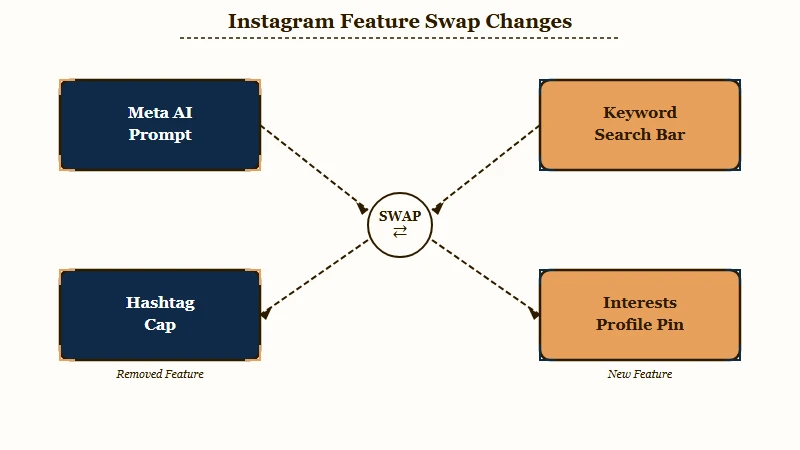
The rollout is global and applies to most accounts, including Creator and Business profiles. There is no opt-out. Users can mute Meta AI responses for 15 minutes, a few hours, or an indefinite Until I change it window, but the Meta AI icon stays in the interface and the AI continues to influence what shows up in results in the background. The classic search bar is not hiding behind a menu. It is gone.
Alongside the search swap, Instagram quietly shipped two other changes in the same release. Profiles can now pin up to five Interests directly on the bio, and the platform recommends sticking to three to five highly specific hashtags per post instead of the old 30. Meta started enforcing a five-hashtag hard cap back in December 2025, and the May update treats anything above that as noise rather than reach.
Adam Mosseri, the head of Instagram, framed the shift this way in a Pulse Advertising recap of his community calls: authenticity is becoming infinitely reproducible. Translation: AI can fake polished content at scale, so polished content is no longer a credibility signal. Mark Zuckerberg has been pitching Meta AI as the most intelligent AI assistant you can use for free, which lines up with the company’s ambition to make it the default front door for Instagram, WhatsApp, and Facebook.
The strongest direct user signal sits on Reddit, where marketers in r/SocialMediaMarketing and r/InstagramMarketing are realising the old playbook stopped working and have no documented replacement yet.
Why This Is a Bigger Deal Than It Sounds
Meta is building its own web index, and the Ask Meta AI bar is the first consumer surface for it.
Three quiet shifts inside the May 2026 release point at a much bigger play than an Instagram redesign.
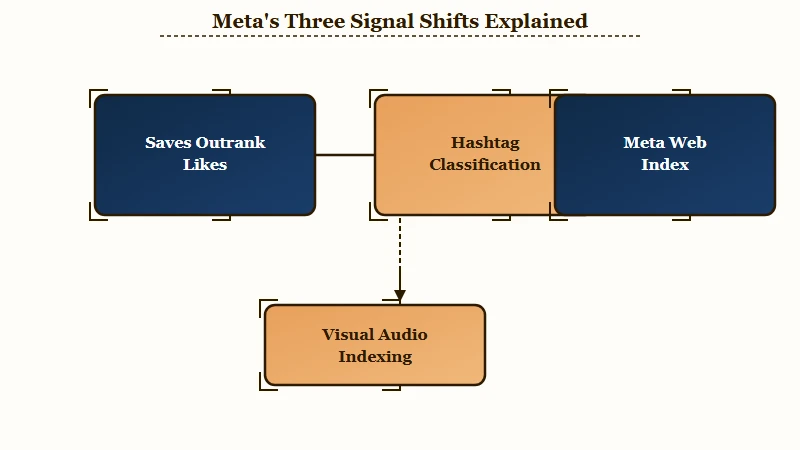
First, the ranking-signal hierarchy flipped. Saves became the heaviest-weighted popularity signal, with Shares second and Likes officially the weakest of the headline metrics. For most of the last decade, creators chased Likes because Likes were the public scoreboard.
The 2026 algorithm uses Saves as the proxy for utility, because users only save what they want to come back to. That single change rewrites what a winning Reel looks like.
Second, the hashtag system is now a classification signal, not an amplification channel. Hashtags used to push you to new audiences. In the new model, they validate what the AI already inferred from your visuals, captions, and spoken audio. Stuffing 30 tags now actively hurts you because the AI reads dilution as spam behaviour. The five-tag cap is not a UI choice, it is the algorithm telling you it does not need more than five hints to categorise you.
Third, and this is the part the trade press is mostly missing, Meta is building an independent web index for Meta AI so it does not have to depend on Google or Bing. Stack Influence flagged this in their Instagram AI Search Bar breakdown.
The Ask Meta AI bar is the first consumer touchpoint for that index. Over time, Meta wants the same prompt to surface answers across Instagram, WhatsApp, Facebook, and the open web. That is a swing at the Google query box, and creators are the test pilots.
There is one more shift worth flagging. Sprout Social’s 2025 Pulse Survey put social search ahead of Google as the number one discovery channel for Gen Z, per Statista’s Instagram tracker, with around 72 percent of US Gen Z using Instagram primarily for messaging rather than the public feed. The public feed is no longer where attention lives. Search and DMs are. That is why Meta moved search to AI first.
What This Means for You and Five Things to Do This Week
Visual creators on Instagram, TikTok, Reels, and YouTube Shorts should rework five things this week, starting with the Interests pin and ending with a Saves-driven CTA.
None of these take more than 30 minutes individually, and skipping them is the cheap way to give early-mover competitors a month-long lead.
Here is the priority order I would walk through if I were sitting down with my own profile today.
- Pin five Interests on your profile right now. Meta AI uses these labels to cluster your account into hyper-specific niches. Pick three core-niche labels and two adjacent ones so the model triangulates rather than guessing. Broad labels lose to hyper-specific labels in this system.
- Rewrite your caption template to put the primary keyword in the first two lines. The new search bar is optimised for full-sentence queries like “best lighting setup for a desk podcast”, not three-word fragments. Front-loading the keyword tells the AI what the post is about before the reader scrolls.
- Add the topic out loud in the first five seconds of every Reel. Meta transcribes spoken audio and feeds it into a three-signal indexing layer with visual recognition and OCR on overlay text. If you say the topic in the opening hook, the AI tags your video with it. If you save the topic for the middle, the AI may have already routed the video.
- Switch your CTA from like and follow to save this for later. Saves now drive distribution more than any other engagement metric. CTAs that prompt Saves directly produce a measurably stronger ranking signal than vanity-metric CTAs. Update your end-card overlays and your captions in the same pass.
- Drop hashtag counts from 30 to between three and five highly specific tags. Pick tags that match the niche you pinned in step one. The algorithm reads extra tags as dilution and demotes the post. This is the change most creators are still resisting and the one with the fastest measurable impact.
Here is the consolidated playbook for the five most-asked search queries that creators are typing right now, mapped to the right action.
| Query | What changed | What to do this week |
|---|---|---|
| instagram search bar gone | Meta AI replaced the keyword search | Pin five Interests on your profile and rewrite caption openers as full-sentence answers |
| how to rank on instagram 2026 | Saves outrank Likes and Shares outrank Watch time | Switch CTAs from like and follow to save this for later |
| are hashtags dead instagram 2026 | Five-tag hard cap, classification only | Drop to three to five hyper-specific tags per post |
| instagram reach dropped overnight | Algorithm reweight under May 2026 release | Audit recent posts against the new signal hierarchy, see our overnight reach drop diagnostic |
| meta ai instagram opt out | No full opt-out, mute only | Mute AI responses in the search panel and focus on optimisation instead |
If you have been investing time in the old Instagram hashtag strategy or chasing Likes via Reel reach tactics, the playbook for both shifts under the new model. The diagnostic in those pieces still applies, but the recommended fixes for the next 90 days lean on Saves and Interests rather than tag rotation.
Before: “Hit that like button if this helped! Drop a comment with your favorite hack and follow for more lighting tips.”
After: “Save this for later when you set up your home studio. The three light placements I showed are the ones I use in every podcast Reel.”
The After version directly prompts the highest-weighted ranking signal and the AI can lift the topic phrase straight out of the caption. The Before version optimises for the metric that now matters least.
There is one fallback for accounts that have already lost reach in the past week. Pause new posts for 48 to 72 hours, audit your last 10 Reels for keyword presence in the first five seconds, and rewrite captions to lead with the topic in plain words. Most creators who recovered did exactly that, and reach returned inside a week.
What Comes Next
Expect Meta to roll voice search into the Ask Meta AI bar within the next quarter and to push Meta-AI-driven discovery into Threads and Facebook by end of summer 2026. The Instagram surface is the test environment, not the endpoint.
What I would watch for in the next eight weeks: voice search adoption inside the Ask Meta AI bar, deeper Threads integration, and a paid AI placement tier for creators who want their content prioritised in Meta AI answers. Zepic flagged the Meta independent index angle in their OCR and semantic analysis breakdown, and that index is unlikely to stay locked inside Instagram for long.
The thing I do not expect: a rollback. The five-hashtag cap survived industry backlash in December 2025, and Meta has spent the last six months reinforcing the AI-first messaging from Zuckerberg down to Mosseri. The classic search bar is not coming back. Optimising for the new model is the only credible move.
The way I see it, this is also a real opening for creators on the smaller platforms. TikTok and YouTube Shorts still reward old-school keyword and tag tactics for now. If Meta is forcing AI-first search on Instagram, creators who have already done the work to make their content semantically rich, with strong spoken topics and OCR-friendly overlays, get a tailwind across all three platforms. Optimising for Meta AI is also optimising for TikTok’s internal SEO and YouTube’s AI-driven recommendation engine.
Quick Takeaways
- Instagram replaced its keyword search bar with the Meta AI assistant in May 2026. There is no full opt-out, only a temporary mute.
- Saves outrank Shares, Shares outrank Watch time, Likes are now the weakest popularity signal. Rewrite CTAs accordingly.
- Pin five Interests on your profile, drop hashtag counts to three to five specific tags, and say the topic out loud in the first five seconds of every Reel.
- Meta is building an independent web index for Meta AI. The Ask Meta AI bar is the first consumer surface for a Google-competitor play, not just an Instagram redesign.
- The next two weeks are the early-mover window. Audit your last 10 posts against the new signal hierarchy this week before competitors do.