Why Instagram Aggregator Accounts Lost Their Reach in 2026
Why Instagram Aggregator Accounts Lost Their Reach in 2026
Instagram aggregator accounts lost their recommendation reach in 2026, with photos and carousels now penalized. Here is what changed and what to do.
What Happened: On April 30, 2026, Instagram extended its anti-aggregator rule from Reels to photos and carousels, so accounts that mostly repost other people’s work stop being recommended to people who don’t follow them. Instagram says an account becomes eligible again once most of what it posted in a rolling 30-day window is original. Existing followers still see your posts, and Account Status shows whether you are affected and lets you appeal.
Instagram put the cause of many theme pages’ quiet reach collapse on the record on April 30, 2026. It extended its unoriginal-content rule from Reels to photos and carousels, a change Adam Mosseri described as rolling out “over the next month.”
Five months on, the notices are still landing. Creators in r/Instagram reported new unoriginal-content flags on September 2 and September 6, 2026, the second on a page of green-screen template edits that had been flagged three times.
If you run a meme page, a curation account, a brand inspiration feed, or any account that grows by surfacing other people’s work, this one matters more than it looks. Instagram now publishes the test that makes an account unrecommendable, and its definition of original is tighter than most creators expected.
Below is what changed, the threshold that decides whether your account is affected, what counts as original, and how to check and recover an account.
What Changed With the April 30 Crackdown
Instagram’s April 30, 2026 update extended its anti-aggregator rule from Reels to photos and carousels, so accounts that mostly repost content they did not create or materially edit are no longer recommended to people who don’t follow them, in Explore, Reels, feed recommendations or Discover.
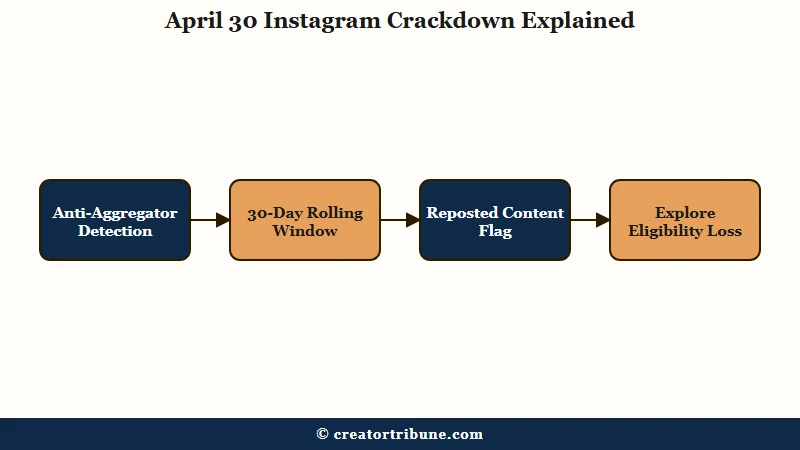
The change was reported by TechCrunch on April 30, 2026 and confirmed by Tubefilter the same day. Adam Mosseri announced it in a post on his account: “if you mostly share content from others that you didn’t make or meaningfully edit, your account won’t be recommended to people who don’t follow you.”
Instagram’s April 30 announcement says accounts that “primarily post unoriginal content” lose recommendations and can become eligible again “when most of their recently posted photos, carousels and reels are considered original in a 30-day period,” calculated on a rolling basis. The 2024 version of the rule, still on Instagram’s creators site, drew a fixed line at “10 or more times in the last 30 days,” so a page near either mark should treat itself as at risk.
The rules that applied to Reels since 2024 now cover photos and carousels as well. Theme pages did not see this coming, because the public conversation around unoriginal content had always been about Reels.
What is an aggregator account: An account that primarily builds reach by reposting or curating content other creators made, instead of producing original photos, videos, or commentary.
Instagram does tell you when the rule applies. An art-page owner reported a notice in June 2026 saying the account could not be recommended because it “shared content that may not be yours,” with 10 of its posts flagged.
Your follower feed and engagement on existing posts look normal, which is why many creators blame the algorithm before they suspect a policy hit. What falls is the audience that does not follow you, and Viewers (formerly Accounts reached) is the Insights number where that shows first.
Pages rebuilding around original posts often hand the publishing schedule to an automation tool, and SMTasker is one that runs Instagram, TikTok and Threads accounts on real Android devices, with a trial before you pay. It only handles posting, so whether a post counts as original still depends on what you put in it.
Why This Is a Bigger Deal Than It Sounds
The 2026 expansion is bigger than a Reels rule because it covers every format a repost page publishes, and once an account mainly posts other people’s work, Instagram stops recommending every post on it, the original ones included.
Theme pages, fan accounts, motivational quote feeds, recipe aggregators, design inspiration carousels and brand UGC feeds all ran on the same pattern: find content other people made, repost it with credit or a watermark, build a follower base and monetize the audience. That pattern was already penalized on Reels, and it now costs reach on every format Instagram uses to grow accounts. Instagram’s own figure shows the shift, with 75 percent of its US recommendations now coming from original posts.
Instagram carves out licensed aggregators: the rule will not affect “a set of publishers that we’ve identified” that hold licensing agreements or permission from the creators whose work they post.
Duplicate matching runs alongside the 30-day test. When Instagram finds two or more identical posts and is confident they match “based on audio and visual signals,” it recommends only the original, as long as the original is relatively new.
The original creator’s version then takes the recommendation slot your repost would have filled, and Instagram notifies that creator. Reposted content also gets a label linking back to the original creator.
Brand managers who relied on crediting the original creator are the most exposed group. Meta’s 2026 guidance, as Engadget reported it, treats watermarks and credits to the original creator as “low-effort edits” that do not make a post original.
Cross-posters should note that Instagram lists “no visible watermarks” among the conditions for recommendation, so a TikTok export with the logo still on it is ineligible on that ground alone.
A clean file of your own is a different case, because the published replacement rule compares identical content on Instagram itself. Creators still report originals being flagged, including one who wrote in May 2026 that Instagram wanted 10 videos deleted from an account posting its own work since 2019, so check Account Status rather than assuming you are safe.
TikTok and YouTube Shorts have been moving the same way. The native vs reupload breakdown covers how the three platforms treat the same problem with different detection layers and recovery paths.
What Counts as Original Content Now
Instagram counts content as original when you wholly created it or materially edited it to add your own perspective, such as humor, commentary, new text, creative edits or voiceover. Reposting someone else’s work with a credit in the caption does not qualify.
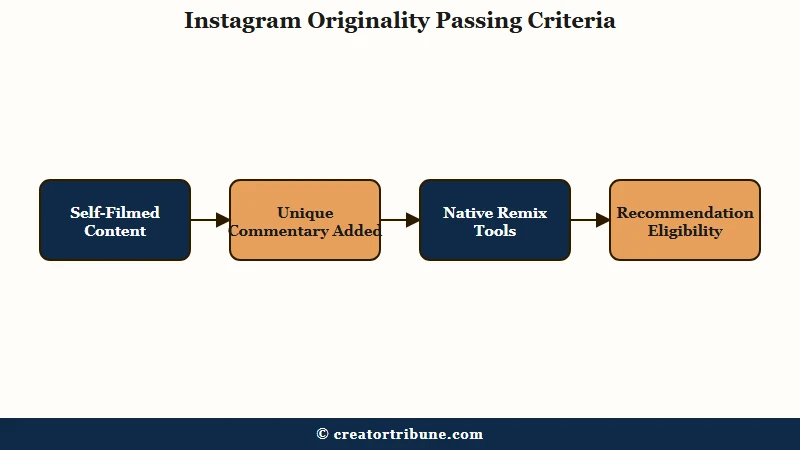
Here is what counts, from Instagram’s own guidance:
- Photos, videos and designs you took, filmed or made yourself.
- Meme templates or popular clips you transform with humor, social commentary, cultural references or a relatable take, through unique text, creative edits or voiceover.
- Clips narrated with a new voiceover, turned into a parody compilation, or remixed to express a reaction, which Instagram says it will not swap out for the original in recommendations.
- Third-party footage under your own green screen, words or commentary, the routes Mosseri named for aggregators who want to keep their reach.
And here is what does not count:
- Adding a border, watermark, logo or subtitles to someone else’s content.
- Changing the speed of a video without adding anything else.
- Minor crops of someone else’s photo or video.
- Screenshotting another creator’s post, even if their username is visible for credit.
- Crediting the original creator in the caption.
- Reposting a TikTok creator’s video to your Reels account, with or without their watermark.
For work you cannot make your own, Mosseri’s advice, quoted by PetaPixel, is to repost on Instagram with the Repost button, “which gives them credit where it’s due,” or to publish a collab post with the original creator. Both keep the credit attached instead of re-uploading the file.
Tubefilter compared the bar to fair use, and it sits well above the loose “credit means free use” standard a lot of pages ran on. A meme template is fine if you add a joke that uses it as a setup, while the same template reposted as-is with a “follow for more” sticker is not.
| What you do | Counts as original | Why |
|---|---|---|
| Film your own product unboxing | Yes | You made the visual and the commentary |
| Share a customer’s post as a collab post | Shared, not original | Mosseri recommends collab posts because credit stays with the creator |
| Take a viral Reel and add your own commentary as a green-screen overlay | Yes | Mosseri names green screen and your own commentary as ways to make content your own |
| Download a TikTok, crop the watermark, reupload to Reels | No | A minor crop leaves someone else’s work unchanged |
| Screenshot a popular tweet and post it as a carousel | No | Instagram names screenshots of other people’s posts as not original |
| Repost an inspirational quote graphic with “Credit: @x” in the caption | No | Credit does not equal originality |
| Reupload your own TikTok file to Reels | Risky | Ineligible if TikTok’s watermark shows, and creators report clean originals flagged too |
The last row surprises creators most. Upload a clean export with no other app’s logo on it, and check Account Status after a batch of cross-posts instead of assuming that a file you made yourself is safe.
What This Means for You
If your reach collapsed after April 30, check Account Status before anything else, because it says whether your account can be recommended to people who don’t follow you and lists the posts behind the decision.
A standard shadowban check looks at non-follower reach across hashtags, Reels and Explore, and the aggregator penalty hits the same slice. This one is easier to confirm, because Account Status lists the posts affecting your eligibility under Recommendations Guidelines, with options to edit or remove them or to tap Disagree with decision.
Here is the audit sequence to run this week, in this order:
- Open Account Status. On your profile, tap Menu, then Account Status below More info and support, and open Recommendations Guidelines. On a professional account it shows whether your content can be recommended to non-followers and which posts are affecting it.
- Check Insights next. Tap Insights below For professionals and compare Viewers (formerly Accounts reached) for the last 30 days with the period before. On individual posts, Instagram splits Accounts engaged into followers and non-followers.
- Count your reposts. Mark each post from the last 30 days as original, transformed or repost, where a repost means re-uploading someone else’s file. Instagram’s current test is whether most of those posts are original, and its 2024 rule drew the line at 10 reposts, so keep reposts below half of your posts and below 10.
- Clean up the flagged posts. Edit or remove the flagged posts from Account Status, starting with the ones that are someone else’s work with nothing added. If you think a post was flagged by mistake, tap Disagree with decision instead.
- Post only original or transformed work until most of your last 30 days of posts are original. No quote graphics from unknown sources, no screenshotted tweets, and no reposted Reels with watermark crops.
- Share other creators’ work through the Repost button or a collab post. Mosseri recommends both because the credit stays with the person who made it.
Recovery is uneven once the reposts come down. The green-screen creator flagged in September, who said the page had been hit three times and forced to delete more than 60 videos, later reported that the latest notice went away on its own after archiving five or six posts. A commenter in the May 2026 thread said deleting 10 flagged originals was followed by a request to delete 10 more.
If Account Status shows no recommendation flag but your non-follower reach still fell, the shadowban diagnostic guide walks through the rest of the reach check, platform by platform.
Before: A theme page posts 25 carousels in 30 days, and 15 of them are other designers’ work with a small “Credit: @originalcreator” line in the caption. With 15 of its 25 posts made by someone else, most of what it publishes is reposted, so none of its posts are recommended to non-followers.
After: The page deletes eight of those reposts from Account Status, which leaves 7 in the window, and switches to design breakdowns written in its own words, featuring partner designers through collab posts. With 10 originals against 7 reposts in the rolling 30 days, most of what it posted is original, which is the condition Instagram gives for eligibility to return.
How Instagram Compares to TikTok and YouTube Right Now
All three platforms now penalize unoriginal uploads, in different ways: Instagram takes whole accounts out of recommendations, TikTok makes unoriginal posts ineligible for the For You feed, and YouTube’s rule sits in its monetization policy.
Instagram judges the whole account over a rolling 30 days and removes it from recommendations when it primarily posts unoriginal work. Eligibility returns once most of its recent posts are original, and Account Status is where you check it and appeal.
TikTok’s Community Guidelines, in the version effective September 24, 2026, say content “is also ineligible for the FYF if it includes unoriginal or reused material without anything new.” The examples TikTok gives include clips that show someone else’s watermark or logo, and minimally edited posts such as short clips made only from GIFs.
YouTube handles reused clips through its Partner Program monetization policies, so the penalty it publishes is to earnings. It updated those policies on July 15, 2025 to spell out what “inauthentic” mass-produced and repetitive content looks like, TechCrunch reported, and YouTube’s creator liaison called it a minor update to rules that had kept such content out of monetization for years.
For creators reposting between platforms, the cross-post-without-watermark guide on staying clean across all three matters more now. A visible logo from another app makes a post ineligible for Instagram recommendations, and TikTok lists someone else’s watermark as a reason a clip is ineligible for the For You feed.
The guide to why Reels reach drops covers the ranking signals Mosseri names (watch time, likes and sends), and an account that passes the originality check is still ranked on them.
What Comes Next on Originality Enforcement
Enforcement now runs on the same terms across Reels, photos and carousels, so the changes to plan for are in measurement and monetization: skip rate in Reels insights, Viewers replacing Accounts reached, and product tags that let creators earn from a Reel.
Skip rate is already part of the standard Reels insights. Instagram announced in August 2025 that it was replacing View Rate with skip rate, “the percentage of views from people who decided to skip your reel during those first 3 seconds,” as Social Media Today reported. Meta’s API reference lists it as reels_skip_rate, an estimated metric still in development, and the Instagram skip rate guide covers what counts as high.
Meta’s API reference lists shares only as a count, with no share-rate metric, so treat any screenshot of a Share Rate card as a test until Instagram documents it.
Instagram also renamed Accounts reached to Viewers in 2026 and kept the definition, the number of unique accounts that saw your content on screen at least once, and views versus viewers explains how to read the gap between the two numbers.
In-Reels affiliate links have started rolling out. On April 7, 2026, Instagram began letting creators tag up to 30 products in a Reel, including pasted affiliate links for items listed in a brand’s Meta catalog, Net Influencer reported. It launched in the US, Brazil, India, Indonesia and Thailand.
Instagram’s push for original posts dates to 2022, as Tubefilter noted, and each change since, from the 2024 Reels rule to the April 2026 expansion, has extended it to more formats. A reversal looks unlikely.
The accounts that adapt fastest are the ones that pivot from curation to commentary. A page that used to repost the best of someone else’s work can survive by adding a narrator, a clear point of view, or a structural transformation, and by sharing the rest through the Repost button or collab posts. A page that can do none of those stays out of recommendations for as long as most of what it posts in a 30-day window is someone else’s work.