How to Recover YouTube Impressions After a Copyright Strike
How to Recover YouTube Impressions After a Copyright Strike
Long-form impressions collapsed after your YouTube copyright strike resolved? This is the real recovery timeline plus the four-step plan that pulls a channel back.
- 1What Really Happens to Your Channel When a Strike Resolves
- 2How Long the Long-Form Throttle Actually Lasts
- 3The Four-Step Plan That Pulls Impressions Back
- 4How to Tell the Algorithm Has Unfrozen You
- 5What Makes the Collapse Worse, Not Better
- 6Frequently Asked Questions
- Does deleting the video that caused the strike remove it from my channel?
- How long does the long-form impression throttle actually last after a strike?
- Will posting Shorts help recover my long-form impressions?
- Should I upload more frequently to “tell the algorithm I am back”?
- What single metric tells me the algorithm has forgiven the strike?
- Can a second strike during the 90-day window reset the recovery clock?
TL;DR: A copyright strike sits on your channel for a full 90 days even if the video is deleted, and the algorithmic chilling effect on long-form impressions usually outlasts the strike itself by two to four weeks. The fastest recovery path is three to five satisfaction-optimized uploads on your proven topic, end-screen chaining for session contribution, and a community-tab refresh, not a posting-volume sprint or a pivot to Shorts.
Long-form YouTube impressions collapsing after a copyright strike resolves is one of the most demoralizing patterns a small channel can hit, because the strike notification reads as if removing the video makes the problem go away. It does not. The strike sits on your channel record for 90 days regardless of whether you delete the video, and the algorithmic chill that comes with it routinely lingers two to four weeks after the strike itself expires.
I have watched this exact pattern play out on a handful of channels in the past month, and the part most creators get wrong is the response. The instinct is to flood the channel with uploads, switch to Shorts to “get views back,” or rewrite every title hoping to outrun the throttle. None of those work because the recovery signal YouTube is actually waiting for is satisfaction, not volume.
This guide walks through the real recovery window, the four-step plan that pulls long-form impressions back, the specific signals to watch in YouTube Studio so you know the algorithm has unfrozen you, and the moves that prolong the collapse if you make them.
What Really Happens to Your Channel When a Strike Resolves
A copyright strike resolves in one of three ways and only one of them fully clears the channel-level penalty.
The strike expires 90 days from issue date after you complete Copyright School, the claimant retracts it, or you win a counter-notification. Deleting the offending video does nothing to the strike itself.
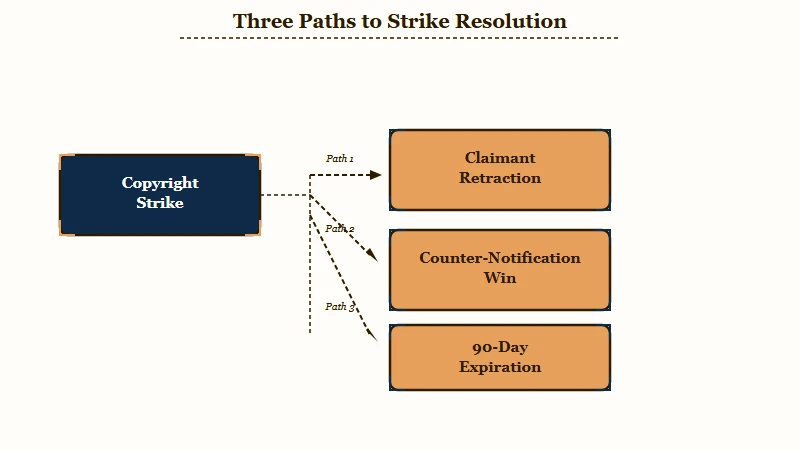
From what I have seen, this is where most creators lose two extra weeks of recovery time. They watch the video disappear from the upload list and assume the channel is clean, then upload normally and watch the new videos underperform. The strike record is still there in YouTube Studio under Copyright > Strikes, and the algorithm reads it.
Three concrete things happen to your channel during the 90-day window:
- Live streaming and monetization features can be restricted. Even a single active strike can pause monetization eligibility and disable live, custom thumbnails, and uploads longer than 15 minutes on smaller channels.
- Recommendation reach drops across the catalog, not just the struck video. Channel-level reach drops show up in the Suggested feed first, then Browse, then Search. New uploads inherit the throttle.
- The algorithm caps trust signals. Even high-CTR, high-retention uploads during the strike window get lower impression ceilings than the same channel would have hit pre-strike.
The 90-day timer starts on the day the strike is issued, not the day you respond. For context on related YouTube algorithm penalties that look similar but have different recovery paths, our YouTube shadowban diagnostic covers the non-strike version of impression collapse.
How Long the Long-Form Throttle Actually Lasts
The throttle on long-form impressions usually outlasts the strike itself by two to four weeks of consistent, strong-performing uploads.
The strike expires at day 90, but the algorithm needs new high-satisfaction signals before it lifts the impression cap on future uploads.
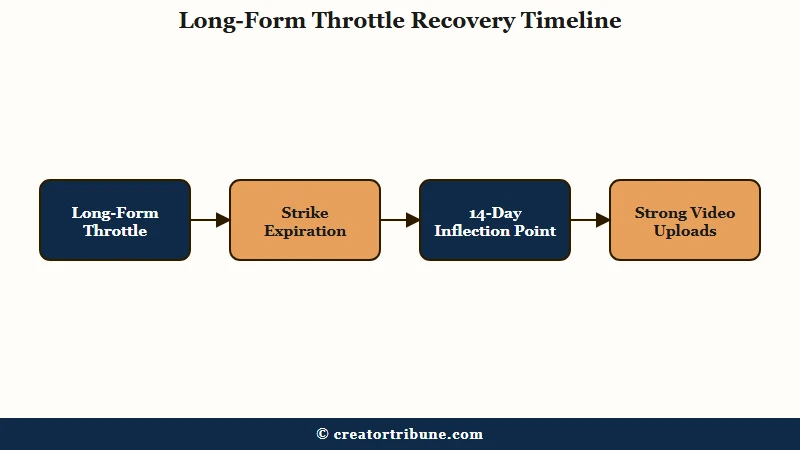
In my experience, the 14-day mark after strike expiration is the first inflection point. If you have shipped three to five strong-performing videos by then, Suggested feed impressions usually start climbing back. If you have shipped weak videos or no videos, the channel reads as quiet to the algorithm and the throttle holds.
Here is the recovery timeline most creators see when they execute the plan well:
| Days from strike issue | What’s happening | What to do |
|---|---|---|
| 0 to 7 | Strike just hit, impressions starting to drop | Complete Copyright School, audit other content for risk |
| 8 to 30 | Throttle active, all uploads underperforming | Ship 1 satisfaction-optimized video per week, no experiments |
| 31 to 60 | Throttle persists, Browse and Suggested suppressed | Continue weekly cadence, add end-screen chaining |
| 61 to 90 | Strike on record but expiring soon | Ship your strongest topic, refresh older thumbnails |
| 91 to 104 | Strike expired, algorithm watching for momentum | Two to three strong uploads in 14 days re-opens the impression cap |
| 105+ | Recovery confirmed when one new upload gets pre-strike impression level | Resume normal cadence |
The timeline assumes a single strike. A second strike inside the 90-day window resets the clock and adds 90 more days plus harder restrictions. The third strike removes the channel.
The other piece worth flagging: YouTube fully decoupled the Shorts and long-form recommendation engines in late 2025. Pivoting to Shorts during a long-form recovery does not feed long-form impressions. Our YouTube Shorts views stopped guide covers Shorts recovery as a separate problem with a separate signal set.
The Four-Step Plan That Pulls Impressions Back
The four-step recovery plan is satisfaction-first uploads, end-screen chaining for session contribution, community-tab activity for authority signals, and a metadata refresh on the strongest existing videos.
Volume sprints, daily uploads, and topic experiments all hurt recovery, not help it.
The way I would think about this: the algorithm is waiting for proof that the channel is reliably useful again, and “reliable” has a much higher weight in 2026 than it did two years ago. Viewer satisfaction is now the single strongest ranking signal, ahead of raw watch time.
Here is the exact sequence:
- Audit your last 10 videos for hidden satisfaction failures. Watch the first 30 seconds of each. If the hook does not match the title’s promise, the video is dragging your satisfaction score. Either re-record an intro and re-upload as a new video, or unlist the worst offenders during recovery.
- Ship 3 to 5 satisfaction-optimized videos on your proven topic. “Proven” means topics that historically ranked above your channel median. Skip experiments. The goal is three to five videos that the algorithm sees as “this creator is reliably making good content again.”
- Chain every video with end screens and a relevant playlist. Session contribution (videos that lead viewers to watch more) is now a top-weight Suggested-feed signal. End-screen suggestions to your highest-retention video, plus playlist autoplay, both feed it.
- Refresh thumbnails and titles on 5 to 10 older performers. Updating metadata on videos that already have watch history is the highest-ROI CTR move during recovery. The algorithm reads new CTR on old videos as a positive trust signal across the whole channel.
Before: Title “My honest take on the new camera.” Thumbnail: face shot with no text overlay.
After: Title “I returned the camera after 3 days. Here’s why.” Thumbnail: face shot + text overlay “3 DEAL-BREAKERS” + red border on the camera body.
The Before is generic and earns no specific click. The After signals a stake, a number, and a specific frustration, all of which lift CTR on the same underlying video. CTR is the second-strongest 2026 ranking signal after satisfaction, per third-party algorithm-tracking analysis aggregated by Search Engine Journal.
For the longer playbook on the metadata refresh tactic specifically, our YouTube video stuck processing guide covers the related upload-cycle issues that often surface during recovery.
How to Tell the Algorithm Has Unfrozen You
The clearest signal that the throttle has lifted is one new upload reaching the same Suggested-feed impression level the channel hit before the strike, plus a CTR within 80% of the pre-strike average.
Until you see both, treat the channel as still in recovery and keep the upload discipline tight.
What I would watch in YouTube Studio Analytics:
- Reach > Impressions by source. If “Suggested videos” impressions climb back to within 70% of pre-strike average on a new upload, the algorithm is forgiving. If they stay below 30%, the throttle is still active.
- Reach > Click-through rate. CTR usually recovers faster than impressions because it is a per-impression metric. If CTR holds steady but impressions stay low, you are not the problem; the algorithm is.
- Audience > Returning viewers. If returning-viewer share on new uploads stays above 60%, your subscribers are still being served. Recovery to “discoverable to new viewers” is the bigger lift.
- Content > Average view duration. Hold this above 50% of total video length. Below 45% reads as a satisfaction failure and prolongs throttle.
Set a 7-day check cadence during recovery, not daily. Daily checks lead to over-reaction (changing thumbnails twice a week, deleting uploads that just need 72 hours). The algorithm reads thumbnail flipping as instability and weights it negatively.
For the broader question of what to do when channel-wide impression collapse has nothing to do with a strike and may instead be a soft Browse-feed re-clustering issue, our external impressions zero fix walks through the diagnostic.
What Makes the Collapse Worse, Not Better
The five recovery moves that prolong the throttle are posting daily to “catch up,” pivoting to Shorts to chase quick wins, deleting all old videos in a panic clean, experimenting with new topics during recovery, and refiling appeals on the strike with bad-faith claims.
Each one is a different version of the same mistake: signaling instability to an algorithm that rewards consistency.
From what I have seen, the panic-deletion move is the most damaging. Creators delete 30 or 40 old videos in one weekend, reasoning that “Meta is punishing weak content” or “I want a fresh start.” YouTube reads the bulk deletion as channel-quality collapse and downgrades the trust signal further. The right move is to unlist underperformers if you must, then revisit the decision after recovery.
Specific moves to avoid during the 90-day window and the 30-day post-expiration tail:
- Do not upload daily or near-daily. Three uploads per week maximum during recovery; one per week is often better.
- Do not switch primary topic or format. The algorithm’s micro-niche clustering needs you to stay in the cluster it already knows you in.
- Do not bulk-edit thumbnails on more than 10 videos in 7 days. Read as instability.
- Do not file a counter-notification on a clear-cut copyright claim hoping it gets ignored. False counters open the channel to legal action and accelerate strike escalation.
- Do not pivot to Shorts as a “fix” for long-form impressions. The two algorithms are fully decoupled in 2026; Shorts traffic does not feed long-form.
If you are in the middle of recovery and a brand sponsorship is on the line, the right move is the same as during an Instagram suspension: email the brand within 24 hours, explain the timeline honestly, and offer a recovery-window delay rather than a half-rate underperforming upload that drags both your channel and the brand’s CTR.
Frequently Asked Questions
Does deleting the video that caused the strike remove it from my channel?
No. The strike record sits on your channel for 90 days from the issue date whether the video exists or not. The only ways to remove a strike before day 90 are a successful retraction request from the copyright owner or a winning counter-notification.
How long does the long-form impression throttle actually last after a strike?
Most channels see the throttle persist 14 to 30 days after the strike expires, then lift if recovery uploads are strong. The total window from strike issue to full recovery is typically 100 to 120 days for first-time strikes.
Will posting Shorts help recover my long-form impressions?
No. YouTube decoupled the Shorts and long-form recommendation engines in late 2025. Viral Shorts performance does not feed long-form Suggested impressions. Treat Shorts and long-form as separate recovery problems with separate signal sets.
Should I upload more frequently to “tell the algorithm I am back”?
No. Posting volume actively hurts recovery in 2026. The algorithm weights consistent moderate cadence (one to three high-quality videos per week) higher than high-volume sprints. Daily uploads during recovery are read as instability.
What single metric tells me the algorithm has forgiven the strike?
One new upload reaching at least 70% of your pre-strike Suggested-feed impression level, with CTR within 80% of pre-strike average. Both numbers must hold for two consecutive uploads before treating the channel as fully recovered.
Can a second strike during the 90-day window reset the recovery clock?
Yes, and worse than a reset. A second strike adds another 90 days of channel-level penalty plus stricter feature restrictions (no live, no long uploads, monetization paused). A third strike removes the channel permanently.