Google Search Profiles and How Creators Can Claim Theirs
Google Search Profiles and How Creators Can Claim Theirs
Google Search Profiles let creators claim a branded hub in Search. See who qualifies, how to claim one, and what to do if you are under the follower cap.
- 1What Are Google Search Profiles
- 2Do You Already Have a Profile You Cannot See
- 3Who Is Eligible for a Google Search Profile
- 4How Do You Claim Your Search Profile
- 5Does a Search Profile Help Your Reach or Ranking
- 6What If You Are Under the Follower Threshold
- 7What If You Are Outside the US
- 8Frequently Asked Questions
- Is a Google Search Profile free?
- How long does it take for my content to show up?
- Will claiming a profile boost my Google ranking?
- Can I track how my profile performs?
- What happens to my unclaimed profile?
- 9Quick Takeaways
TL;DR: Google Search Profiles are free, claimable pages inside Search that gather your latest videos and posts into one branded hub. You qualify with 100,000 followers on YouTube, Instagram, or X, or 300,000 on TikTok, and you claim yours at profile.google.com/claim. It is a brand and Discover tool, not a ranking or revenue boost.
There is a decent chance Google has already built you a Search Profile, and you cannot see it. Google Search Profiles, the feature that rolled out in the US in June 2026, generate a profile page for known creators and brands before anyone claims it. The catch is that every unclaimed profile carries a noindex tag, so it stays invisible in search until you go and claim it.
If you make short-form video on TikTok, Instagram, or YouTube, this is the first time Google has handed creators a branded home base directly inside Search. It is not a ranking trick, and it will not move your ad revenue. What it does is give your audience one place to follow you, and that follow feeds your content into their Google Discover feed.
Here is what these profiles are, who qualifies, how to claim yours in a few steps, and the one move worth making if you are nowhere near the follower cap. Most coverage so far has repeated Google’s announcement word for word, so I have kept the details that matter for creators and dropped the ones that do not.
What Are Google Search Profiles
Google Search Profiles are free, claimable pages inside Google Search that pull a creator’s latest videos, posts, and articles into one branded hub.
Google launched them in the US on June 4, 2026, and has said it plans to expand to more countries later in the year.
The page itself holds a cover image, an avatar, a short bio, a website link, and links out to your social platforms. You do not upload content to it directly. Instead it aggregates your recent work from the accounts you connect, and you can pin up to eight standout posts to the top.
What is a Knowledge Panel: the information box that appears beside Google results for a known person, brand, or entity, built from data in Google’s Knowledge Graph.
The way I see it, this is less a new social network and more Google formalizing the brand profile it already quietly keeps on you. Claiming one can also create a fresh Knowledge Panel if you do not have a panel yet, or enhance an existing one with your updated avatar and a direct link to the profile.
Do You Already Have a Profile You Cannot See
Many creators already have an auto-generated Search Profile, but it stays hidden because unclaimed profiles carry a noindex tag.
That tag tells Google not to index the page, so it will not surface in results and no one can stumble onto it until you claim and verify it.
The fastest check I would run is to search your own name on Google. If a Knowledge Panel shows up with a “View Search Profile” option, a profile already exists and you can move straight to claiming it.
Before: Your auto-generated profile sits live at a fixed URL but carries a noindex tag, so it never appears in search and no follower can find it.
After: Once you claim and verify the profile, Google drops the noindex tag and the page becomes a real, shareable destination people can follow.
What I find useful here is that the profile is not something you are creating from nothing. In most eligible cases the data is already assembled, and claiming is closer to unlocking a page than building one.
Who Is Eligible for a Google Search Profile
Eligibility requires 100,000 followers on YouTube, Instagram, or X, or 300,000 on TikTok, plus a US base and an account holder who is at least 18.
Your content also has to meet Google’s community guidelines.
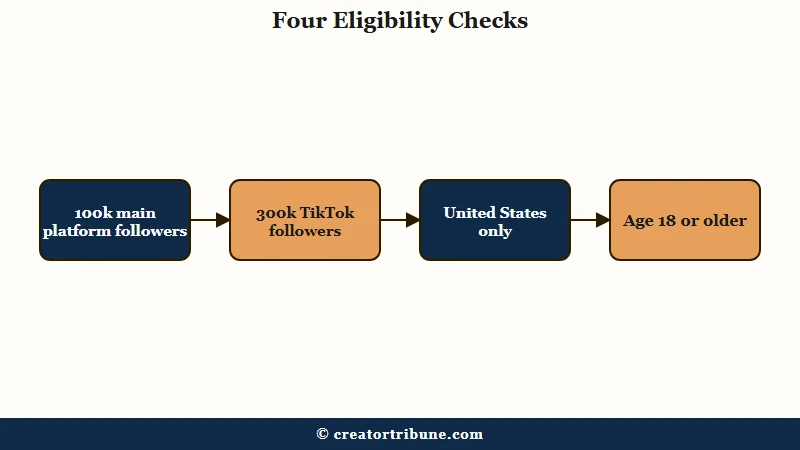
| Platform | Minimum followers to qualify |
|---|---|
| YouTube | 100,000 subscribers |
| 100,000 followers | |
| X (Twitter) | 100,000 followers |
| TikTok | 300,000 followers |
One detail most write-ups skip: Google has not explained why TikTok needs triple the audience of the other platforms. If short-form video on TikTok is your main channel, that 300,000 bar is a real gap worth knowing about before you get your hopes up.
I would also treat the thresholds as a floor, not a guarantee. According to Search Engine Journal’s breakdown, Google has minted profiles for some accounts sitting under the stated numbers, including a beta participant with roughly 63,000 Instagram followers and 21,500 on X. The follower count is the public rule, but Google’s own entity recognition seems to bend it.
How Do You Claim Your Search Profile
You claim a profile at profile.google.com/claim by signing in with the Google account tied to your largest platform and verifying your identity.
From my read of Google’s own setup docs, the flow is short but has a few traps worth flagging before you start.
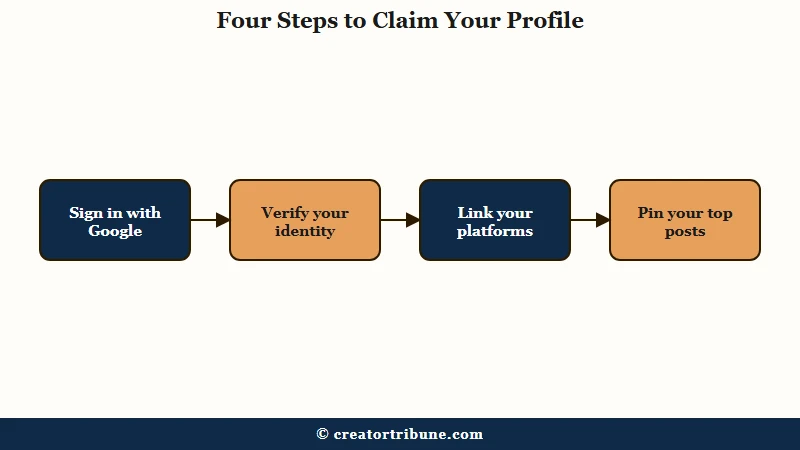
- Search your name first. If a Knowledge Panel already offers “View Search Profile,” start there instead of the claim URL.
- Go to profile.google.com/claim and sign in. If you run a YouTube channel, use the Google account attached to that channel.
- Sign into at least one eligible platform to verify you own it. You can link up to three.
- Complete identity verification, which may ask for a selfie with your ID.
- Set your handle. Google assigns it automatically from your most-followed linked account.
- Pin up to eight posts, chosen from your latest 100 published in the past 365 days.
Two things tripped up early users, so plan for them. New linked accounts take 24 to 48 hours to sync, so do not panic when your videos do not appear instantly. And edits behave differently depending on the field, which the table below sorts out.
| Field type | Examples | How it updates |
|---|---|---|
| Suggestion fields | Name, About or bio text | Sit in a pending status and wait for Google to review and approve |
| Editable fields | Order of linked platforms, pinned post selection | Update instantly the moment you save |
One real limitation if you work with a team: there is no multi-user or admin role yet. Only the single Google account that claims the profile can manage it, so agencies and social managers will be sharing one login for now.
Does a Search Profile Help Your Reach or Ranking
No. Google states plainly that a Search Profile does not change your Search or Discover ranking. Its only reach lever is the Follow button, which routes your content into followers’ Discover feeds.
That distinction matters more than the hype around the launch suggested. The strongest evidence I have seen against treating this as a growth hack comes from Google’s own private beta.
Across 54 US publishers, 96 percent enabled pinned posts but only 24 percent used the feature, and researchers found no correlation between filling out a profile and any change in Discover visibility.
So I would set expectations honestly. A complete, well-branded profile is worth having because it shapes how you look when someone searches you, and the Follow button is a genuine new distribution path. It works as a branding and loyalty surface rather than a lever that lifts reach on individual posts.
If reach is the actual problem you are trying to solve, the fixes live elsewhere. A drop in views usually traces back to timing, format, or a distribution issue, which is why I would start with why your Instagram reach dropped and the best times to post before expecting a profile to do that work.
What If You Are Under the Follower Threshold
If you are under the cap, build your entity instead. Person or Organization schema, a Wikidata entry, and citations from credible sites can earn you the same Knowledge Panel without a single follower.
This is the part of the story almost no one is telling smaller creators, and I would argue it is the more useful path for most people reading this.
A Search Profile is really a front end for Google’s understanding of you as an entity. You can grow that understanding directly: add structured data to your own site with sameAs links to your social accounts, claim or create a Wikidata entry, and earn mentions from sources Google already trusts. Do that consistently and the Knowledge Panel can show up on its own.
The deeper lesson is to stop renting your audience entirely on platforms whose algorithms you do not control. Owning a direct line to your followers is the hedge, which is where a clean link in bio setup and a real plan to convert viewers into subscribers earn their keep.
If you want a ready-made starting point, our free Creator Money Page template gives you one page to centralize and monetize that audience.
What If You Are Outside the US
The claim flow is US-only for now, but if Google has already generated your profile you can view it from anywhere using your Knowledge Graph ID.
Google has said an international rollout is coming later in the year.
If I were outside the US, here is the workaround I would use. Every profile lives at a fixed URL built from the entity’s Knowledge Graph ID, and once Google has generated yours, that URL opens from any country. You can see what Google already knows about you, even though you cannot edit or formally claim the page until the feature reaches your region.
Keep the noindex catch in mind though. Until you can officially claim it, that auto-generated page stays unindexed and hidden in search, so treat viewing it as a preview rather than a launch.
Frequently Asked Questions
Is a Google Search Profile free?
Yes. Claiming and managing a Search Profile costs nothing, and there is no paid tier or ad component attached to it. The feature is purely a branding and audience tool.
How long does it take for my content to show up?
When you link a new platform, content syncs to your profile within 24 to 48 hours. If your latest videos do not appear right away, that delay is expected behavior, not a bug.
Will claiming a profile boost my Google ranking?
No. Google has stated directly that creating or editing a Search Profile does not affect your ranking in Search or Discover. The only reach benefit comes from followers seeing your content in their Discover feed.
Can I track how my profile performs?
A beta Insights dashboard, spotted in June 2026 and powered by Search Console, tracks total clicks, total impressions, top posts by clicks, and audience reach by country. The data is private to the account that claimed the profile.
What happens to my unclaimed profile?
It sits live at a fixed URL but carries a noindex tag, so it will not appear in search results. Until you claim and verify it, no one can find it organically.
Quick Takeaways
- Google likely already generated a profile for you, but a noindex tag keeps it invisible until you claim it at profile.google.com/claim.
- You need 100,000 followers on YouTube, Instagram, or X, or 300,000 on TikTok, plus a US base, to claim one right now.
- A profile is a branding and Discover-follow tool, not a ranking or ad-revenue boost, so set expectations accordingly.
- Under the threshold, build your entity with schema, a Wikidata entry, and credible citations to earn the same Knowledge Panel.
- Own your audience directly with a link in bio and a subscriber funnel rather than waiting on follower-gated features.