YouTube Auto Labels AI Videos in May 2026
YouTube Auto Labels AI Videos in May 2026
YouTube began auto labeling undisclosed AI videos in May 2026. Here is what creators must disclose, what stays exempt, and how it affects reach.
What Happened: YouTube rolled out more visible AI labels and automatic detection in May 2026. The platform will now label realistic AI videos itself if a creator skips disclosure, but a label alone does not cut your reach or monetization. The risk is hiding AI, not using it.
Audience enthusiasm for AI-made content fell from 60 percent in 2023 to 26 percent in 2025, and YouTube’s new AI labels land right on top of that trust problem. On May 27, 2026, the platform announced more prominent disclosure labels plus an automatic system that tags realistic AI content even when the creator says nothing.
This story is still worth your attention a couple of days after it broke, because the automatic detection is rolling out through May and most creators have not checked how it changes their upload flow. The labels move to spots viewers cannot miss, and the detection runs whether you opt in or not.
I have read the panic takes already, and most of them get the stakes backwards. The label itself is not the threat to your channel. What I want to walk through is what changed, whether it touches your reach or your money, exactly what you have to disclose, and what happens if you try to hide it.
What Did YouTube Change About AI Labels?
YouTube made AI labels more visible and added automatic detection that labels realistic AI content even without creator disclosure.
The update was announced on the official YouTube blog on May 27, 2026.
The label position is the first thing you will notice. On long-form videos it now sits directly below the player and above the description, and on Shorts it appears as an overlay on the video itself. Disclosures for clearly unrealistic or animated content stay tucked in the expanded description where they were before.
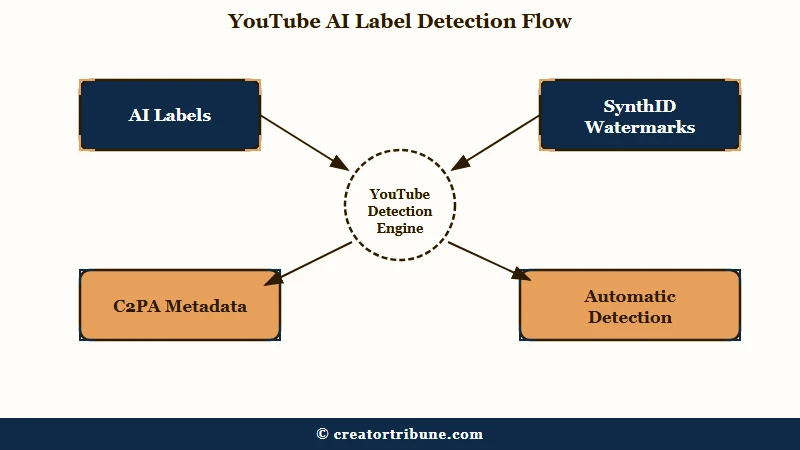
The bigger shift is detection. From my reading of the announcement, YouTube is leaning on internal signals plus Google’s SynthID watermarking, which has already been applied to over 100 billion AI-generated images and videos. It also reads C2PA version 2.1 or higher metadata, the provenance standard founded by Adobe, Arm, the BBC, Intel, Microsoft, and Truepic.
| Content | Where the label shows | Can you remove it |
|---|---|---|
| Long-form realistic AI | Below the player, above the description | Only by correcting a wrong auto-label in Studio |
| Shorts realistic AI | Overlay on the video | Only by correcting a wrong auto-label in Studio |
| Made with Veo or Dream Screen | Permanent label | No, the label is locked |
| Unrealistic or animated | Expanded description only | Not prominently labeled |
Will an AI Label Hurt Your Reach or Money?
No. YouTube states that an AI disclosure label alone does not change how a video is recommended, ranked in search, or whether it earns money.
Performance still rides on watch time and viewer satisfaction, not on the presence of the tag.
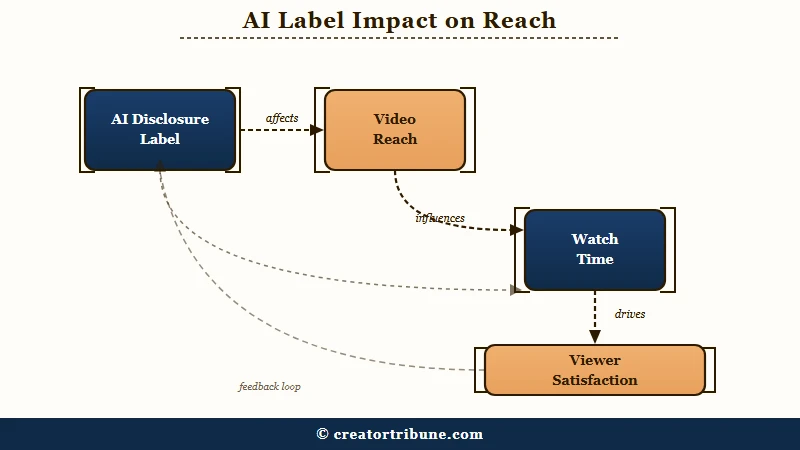
This is the part most of the scared commentary gets wrong, and I think it matters a lot. The label is informational for viewers, not a demotion switch for the algorithm. Properly disclosed AI content reportedly earns RPM rates in line with non-AI content in the same niche, so the math does not collapse the moment a tag appears.
What does damage a channel is mass-produced filler with zero human input. That is a separate policy fight, and it is harsh. YouTube’s AI slop crackdown wiped 16 channels, 4.7 billion lifetime views, and an estimated 9.8 million dollars in annual revenue.
The way I see it, disclosure protects you and slop sinks you. Those are not the same lever.
What Do You Have to Disclose Now?
You must disclose realistic, meaningfully altered AI content, such as making a real person appear to say or do something they did not. Production help and minor edits are exempt.
The trigger is photorealism plus alteration, not whether AI touched the file at all.
I find the exemptions are where creators waste the most worry, so here is the clean split. If AI only assisted the work behind the scenes or the result is obviously fake, you are clear. If AI makes a synthetic thing look real, you disclose.
| Disclosure required | Exempt from prominent labels |
|---|---|
| A real person made to say or do something they didn’t | AI-written scripts and outlines |
| Realistic scene of an event that never happened | Beauty filters and color correction |
| Altered footage of a real place or event | Background music or production assistance |
| Photorealistic synthetic people or voices | Clearly animated or fantastical scenes |
Here is the call I would make on a borderline upload.
Before: You shot a real talking-head video, used AI to clean the audio and grade the color, then ticked the AI disclosure box anyway out of fear of a penalty.
After: You leave it unchecked, because audio cleanup and color correction are exempt, and you save the disclosure for the clip where AI generates a realistic background that was never there. Over-disclosing trains viewers to ignore the label and signals nothing useful.
What Happens If You Skip Disclosure?
Consistently failing to disclose realistic AI triggers a three-strike system: a warning, then a 90-day monetization suspension, then permanent removal from the YouTube Partner Program. The penalty is for deception, not for using AI.
From what I have seen, creators who cross-post should be even more careful, because the cross-platform cost is steeper. TikTok, for comparison, cuts an account’s reach by roughly 60 percent for 30 days after three unlabeled AI videos, so a sloppy disclosure habit on YouTube can follow your content everywhere you publish it.
There is also a regulatory clock behind all of this. The European Commission’s AI Act transparency obligations take effect in August 2026, which is why YouTube is moving now rather than later. If you ever face a monetization rejection tied to authenticity, a clean disclosure record is the cheapest insurance you can carry.
What Should Creators Do Right Now?
Audit your upload habits this week so the automatic system never has to label for you. Self-disclosure keeps you in control of the wording and the dispute trail.
I would not overhaul anything dramatic, but I would run this short sequence before your next upload.
- Check the Attributes section in YouTube Studio so you know where the AI disclosure toggle lives.
- Disclose only realistic, meaningfully altered AI, and leave production help and obvious animation unchecked.
- Archive your project files, raw footage, and prompt logs for any AI-assisted video in case you need to dispute a wrong auto-label.
- If the system mislabels you, correct it in Studio rather than deleting and reuploading.
Leaning into visible human signals also helps more than it used to. With audience trust in AI work down to 26 percent, proof that a real person made the thing is becoming a ranking-adjacent advantage, which is exactly why creators are doubling down on showing their videos are human-made and protecting their channel trust score.
Quick Takeaways
- YouTube began auto-labeling realistic AI videos in May 2026, even when creators skip disclosure.
- A disclosure label alone does not reduce reach, search ranking, or monetization eligibility.
- Disclose realistic, altered AI only; scripts, filters, and color grading are exempt.
- Hiding AI risks a three-strike path ending in removal from the Partner Program, so disclose and archive your project files now.