
Why YouTube Stay-to-Watch Dropped to 25%
Why YouTube Stay-to-Watch Dropped to 25%
YouTube Stay-to-Watch ratio collapsed from 60-70% to 25-30% in late May 2026. It is a Lambda speed-layer reporting glitch, not lost audience.
What Happened: Around May 24-25, 2026, partnered YouTube creators watched the Stay-to-Watch ratio in YouTube Studio fall from a normal 60-70% to 25-30% across hundreds of channels. The cause is a speed-layer failure in YouTube’s analytics pipeline, not an algorithm change or audience collapse, and the fix is to do nothing.
Partnered YouTube creators woke up on May 24, 2026 to a Stay-to-Watch ratio that had dropped to roughly a third of its usual level overnight, and the panic on creator forums was real.
View counters froze, likes kept incrementing, and AdSense estimates wobbled across hundreds of monetized channels. The symptoms match the same Lambda-pipeline anomaly that knocked real-time view counts to zero around the same window.
The way I read the official Studio notification, this is not a punishment from the algorithm and it is not the audience suddenly losing patience with everyone’s videos at once. The metric is broken, not the channel. The technical pattern that produces a 25% Stay-to-Watch reading on a video that normally holds 65% is identical to the pattern that produces a “zero views, normal likes” display on a Short.
This piece walks through what Stay-to-Watch measures, why the speed-layer architecture inside YouTube Studio can flatline a retention metric while the underlying watch time is fine, and the four moves to avoid until the batch layer catches up.
The single rule that matters today is the rule that matters every time YouTube Studio analytics goes weird. Do not edit, do not delete, do not panic. Reindexing a healthy video during a reporting glitch is the only way to turn a temporary display problem into a permanent ranking problem.
What Happened on YouTube Studio Around May 24, 2026
The Stay-to-Watch ratio on hundreds of monetized YouTube channels dropped from a typical 60-70% range to 25-30% over a 60-180 minute window on May 24-25, 2026, while view counts and likes diverged in a way that signals a reporting-pipeline failure rather than a real audience collapse.
Creators across travel, gaming, tech, and finance niches all reported the same collapse in the same window. One channel running 500 to 700 real-time views per hour on long-form content saw the counter drop to roughly seven views per hour during the outage.
Engagement on some channels was reported down as much as 90% during the same window. The Stay-to-Watch number was the most visible symptom because it is one of the few retention indicators surfaced on the Studio Real-Time card itself.
What is Stay-to-Watch: A YouTube Studio retention metric showing what percentage of viewers stay through the early portion of the video instead of swiping or clicking away within the first few seconds of playback.
YouTube acknowledged the problem in an official notification inside Studio, dated May 24, 2026: “We are experiencing issues with the systems for realtime data. This may cause inaccurate view counts and reports of video performance.” That notification points the finger at the data pipeline, not the recommendation system, and the official source for the original incident is on the YouTube Help thread. The same speed-layer failure is what produced the May 24-25 view-counter freeze covered in the YouTube views glitch breakdown.
The diagnostic I would trust over any third-party take is this. If likes are still climbing while views or retention are frozen or collapsed, the audience is fine and the dashboard is wrong. Likes follow a simpler validation path inside YouTube’s analytics pipeline, and views or retention pass through a heavier path that ties into ad impressions and payments. The heavier path is what stalled.
Why This Is a Bigger Deal Than It Sounds
The May 2026 Stay-to-Watch collapse is the third real-time analytics anomaly inside six weeks, which suggests YouTube’s Lambda pipeline has a recurring reliability problem that creators now need a personal protocol for.
The previous two incidents landed on March 30 and May 13, 2026. The March anomaly affected impression counts and the May 13 anomaly disrupted the Shorts feed and the Homepage recommendation surface.
The May 24-25 collapse is the first one that has hit a retention metric so visibly. Three pipeline failures inside the same quarter is no longer a one-off, and creators who treat it as one will keep panic-editing healthy videos every time it happens.
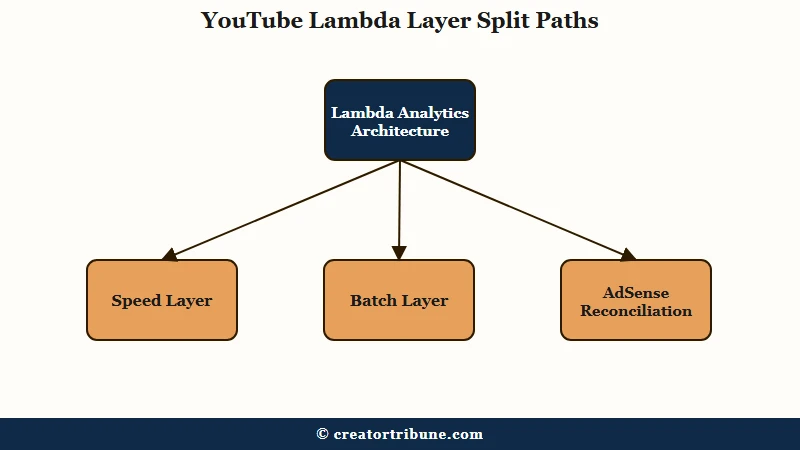
The way I would frame it, YouTube Studio’s real-time surface is a “speed layer” view of the data. It is fast, advisory, and lossy by design.
The “batch layer”, which is what AdSense pulls from, reconciles inside a 24 to 48 hour window and is what pays you. The speed layer can be wrong for up to two days while the batch layer is right the whole time. That gap is the source of most of the panic, because creators check the speed-layer dashboard hundreds of times during a launch and the dashboard does not say “this number is provisional”.
There is a technical mechanism behind the gap called “retractions”. The pipeline can emit a value, like a view count or a retention percentage, and then later cancel it with a negative correction once a downstream fraud check completes.
This is why view counts sometimes jump up and then drop back the next day. It is also why a Stay-to-Watch number can flatline at 25% during an outage and then snap back to 65% once the watermark catches up. The number was never wrong about the audience, it was wrong about itself.
| Signal | What it tells you |
|---|---|
| Views frozen, likes climbing | Reporting-layer failure. Audience is fine. Do nothing. |
| Views frozen, likes also frozen | Possible distribution suppression. Investigate other signals. |
| Stay-to-Watch dropped, video age old | Almost certainly a glitch if it happened across your channel at once. |
| Stay-to-Watch dropped, video age fresh | Could be a real hook problem. Wait 48 hours, then judge. |
| Third-party trackers (VidIQ, Social Blade) normal | Studio dashboard is the problem, not your channel. |
What This Means for You as a Creator Watching the Numbers Drop
The single most important thing to do during a YouTube analytics glitch is nothing. Do not edit the video, do not change the thumbnail, do not delete underperforming uploads, and do not reupload. Wait 24 to 48 hours for the batch layer to reconcile.
Editing a video while the reporting pipeline is in retraction mode is the worst move available, and it is the one creators instinctively reach for. Trimming two seconds off the intro, swapping a thumbnail, or rewriting the title triggers a reindex.
When the speed layer recovers, the video is treated as a fresh upload with no watch-history continuity, and the existing momentum is gone for real. A temporary display problem becomes a permanent ranking problem because the reindex was provoked.
Deleting the video is even worse because it removes watch time from the channel-level history, breaks any internal links pointing at it, and signals to the algorithm that the creator panicked. The mid-flight edit mistakes breakdown covers the broader pattern of edits and panic-deletes that have wrecked otherwise-healthy uploads.
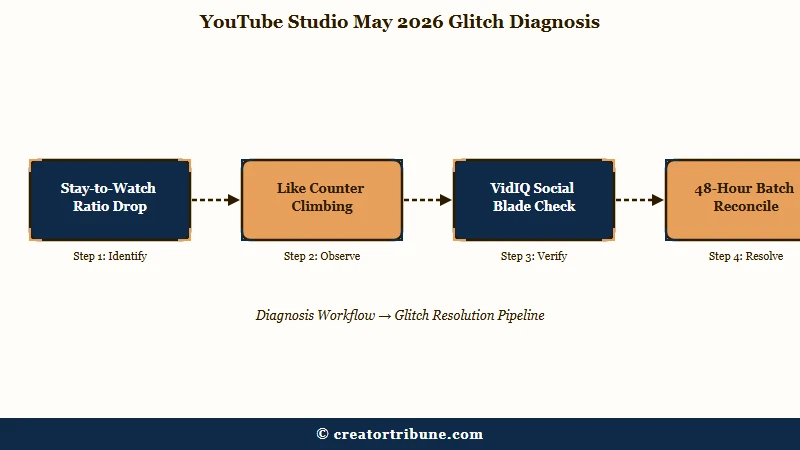
Here is the four-step protocol I would walk through the next time Studio numbers look impossible:
- Check the like counter. If likes are still incrementing and only views or Stay-to-Watch is frozen, the audience is fine. The dashboard is what failed.
- Open the public watch page in an incognito window. If it loads normally and the embedded view count looks reasonable, Studio is the problem, not the algorithm.
- Cross-reference with a third-party tracker like VidIQ or Social Blade. These tools pull from different endpoints and usually show normal numbers (with some lag) during a speed-layer failure.
- Wait 48 hours, then judge. Once the batch layer reconciles, retention will snap back. If it does not, look at the YouTube channel trust score signals for a real distribution issue.
Before: “My Stay-to-Watch just dropped 40 points overnight. I am trimming the intro right now and reuploading because the hook must be broken.”
After: “Stay-to-Watch dropped 40 points overnight and likes are still climbing. The algorithm is fine, the dashboard is glitched. I am leaving the video alone and checking back in 48 hours.”
The decoupling between Shorts and long-form, fully separated as of late 2025, also means a Shorts-feed problem does not drag down long-form retention readings even though they share the same Studio surface. If you only saw the Stay-to-Watch ratio collapse on Shorts, the May 13, 2026 Shorts-feed incident is the more likely root cause. If you saw it on long-form, you are looking at the May 24-25 speed-layer failure.
The two-step real revenue check during any anomaly is the YouTube external impressions zero fix workflow: pull yesterday’s AdSense estimate, compare it to your seven-day baseline, and only worry if the batch-layer numbers come in low after 48 hours of reconciliation. Speed-layer panic costs creators more channels than any algorithm change.
What Comes Next on YouTube Analytics Reliability
The May 24-25 incident is the third real-time analytics outage in six weeks, and the pattern suggests creators should expect at least one more before the end of summer 2026.
YouTube has not publicly acknowledged a root cause for the cluster of pipeline failures, and the official communication has stayed inside Studio notifications rather than a blog post. The most likely structural issue, based on how the three 2026 incidents have presented, is watermark progression inside the streaming layer.
When the watermark stalls, every downstream consumer of the data sees zeros or phantom-low numbers until the watermark catches up. The reconciliation window is the saving grace.
AdSense pays from the batch layer, not the speed layer, and the batch layer has not been affected in any of the three 2026 incidents. Revenue is intact even when the dashboard is broken. The harder problem is that creator psychology runs on the speed layer, and a 25% Stay-to-Watch reading triggers a flood of decisions before the batch layer has a chance to disagree.
For anyone running a 2026 channel, what I would recommend internalizing is one rule and one habit. The rule is “do not act on real-time numbers”. The habit is “check the public watch page in incognito, then check VidIQ”. Together they buy 48 hours of patience, which is the exact window the batch layer needs to set the record straight.
The Stay-to-Watch ratio will read normally again by the time most creators read this. The video is fine and the audience is fine. The dashboard was wrong for an afternoon.