
What Is Skip Rate on Instagram and What Counts as Too High
What Is Skip Rate on Instagram and What Counts as Too High
Skip rate on Instagram is the share of Reel views that swipe away in 3 seconds. See what Meta documents, real averages, and how to lower yours.
- 1What Is Skip Rate on Instagram?
- Where Do You Find Skip Rate on Instagram?
- 2What Is a Good Skip Rate on Instagram Reels?
- Is a 68 Percent Skip Rate Bad?
- 3Does Skip Rate Affect Your Reach on Instagram?
- 4Why Is My Instagram Skip Rate So High?
- Does Showing Reels to Non-Followers Raise Skip Rate?
- 5How Do You Lower Your Skip Rate on Instagram?
- Should You Make Shorter Reels to Lower Skip Rate?
- 6Quick Takeaways
TL;DR: Skip rate on Instagram is the percentage of a Reel’s initial views that swipe away during the first 3 seconds, and Instagram has not published a target for it. Socialinsider’s study of 140,000 business Reels from January to June 2026 found average skip rates between 60.5 and 65.5 percent in every follower tier it measured. A skip rate in the high 60s on a small account is close to normal, so judge yours against your own median before you re-edit anything.
What is skip rate on Instagram, and why does yours still read 68 percent after you cut every Reel down to the frame? Skip rate is the Reels Insights number that counts how many views ended inside the first three seconds.
Instagram announced it in August 2025, and a high reading is now the first thing small creators blame when their views fall.
That is the exact spot one r/Instagram thread describes. A lifestyle creator with 195 followers edits hard cuts and captions in the Edits app, still lands a 68 percent skip rate, and watches Reels that once pulled 1,000 to 6,000 views settle at 500 to 800.
The popular skip rate benchmarks call that a broken hook, since they draw the warning line at 40 to 50 percent. For an account that size, that cutoff is the piece of skip rate advice I push back on hardest.
This guide covers what the number measures in Meta’s own documents, what counts as too high for your account size, how it connects to reach, and the checks worth running before you touch your editing.
What Is Skip Rate on Instagram?
Skip rate on Instagram is the percentage of a Reel’s initial views that swipe away during the first 3 seconds of playback.
Meta counts an initial view as the first time a Reel starts playing in a viewing session, so replays inside that session never enter the math.
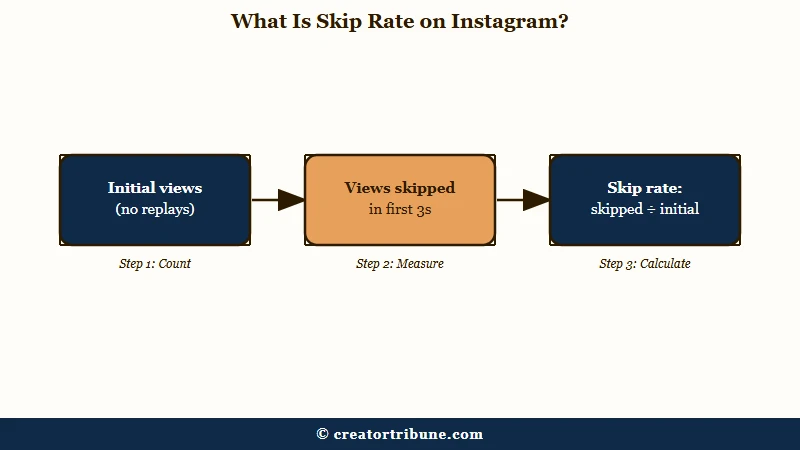
That wording comes from Meta’s developer documentation for the Instagram API, where the metric is called reels_skip_rate. Meta divides the views that skipped during the first 3 seconds by the number of initial views, and it labels the whole metric estimated and in development.
Skip rate began replacing View Rate in August 2025. Instagram’s announcement, quoted by Social Media Today, explained the swap this way: “While view rate shows what percentage watched past the first 3 seconds of your Reel, skip rate is the percentage of views from people who decided to skip your reel during those first 3 seconds.”
The two numbers are mirror images, so a 68 percent skip rate is roughly what the old screen would have shown as a 32 percent view rate. I find the old framing kinder to small creators, because it describes the same Reel as a third of its views lasting past three seconds.
Two details in Meta’s definition change how you read your own number. Skip rate counts views, so one follower who scrolls past the same Reel in two separate sessions adds two skips. A Reel that people loop also cannot dilute its own skip rate, because only the first play of a session counts.
That loop rule is why you cannot rebuild skip rate from the Views figure on the same screen. Instagram’s Help Center defines Views as the number of times a Reel starts to play or replay, so Views includes the loops that skip rate leaves out. The same split between plays and people sits behind whether Instagram counts your views.
Where Do You Find Skip Rate on Instagram?
Skip rate appears in each Reel’s insights, next to the retention graph that shows when viewers drop off.
Go to the Reels tab on your profile, open the Reel, tap View insights and scroll to the retention section.
Instagram’s Help Center says any public account, personal or professional, can see reel insights for up to two years after a Reel goes live. That same Help Center page lists views, watch time, viewers, average watch time and follows, and it never mentions skip rate, so the fullest first-party definition sits in the developer docs.
Meta has also opened the number to outside tools. Social Media Today reported on December 4, 2025 that Reels Skip Rate joined the Instagram Marketing API, which lets analytics dashboards connected to your account pull it.
What Is a Good Skip Rate on Instagram Reels?
A good skip rate on Instagram Reels is one that beats your own recent median, because Instagram has not published a target.
The largest measured sample puts typical Reels between 60.5 and 65.5 percent, far above the 20 to 40 percent healthy bands that most guides repeat.
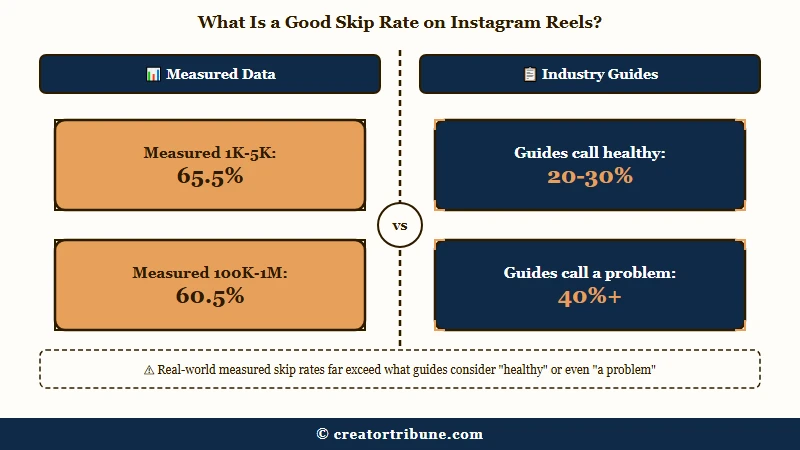
Socialinsider’s 2026 Reels study measured 140,000 Reels from business pages between January and June 2026. Every account tier averaged a skip rate above 60 percent, and the average fell as accounts grew.
| Account size (followers) | Average skip rate | Points above the 40 percent “problem” line |
|---|---|---|
| 1,000 to 5,000 | 65.5% | 25.5 |
| 5,000 to 10,000 | 65.3% | 25.3 |
| 10,000 to 50,000 | 63.4% | 23.4 |
| 50,000 to 100,000 | 62.6% | 22.6 |
| 100,000 to 1 million | 60.5% | 20.5 |
The bands that circulate tell a very different story. Retensis calls anything under 15 percent exceptional, 20 to 30 percent healthy and anything above 40 percent a problem. BabbleBoxx puts the warning line near 50 percent while conceding that Instagram has published no official benchmark, and neither page explains where its bands come from.
I put more weight on 140,000 measured Reels than on a band with no method behind it. The bands still work as a stretch goal for your strongest openers.
Is a 68 Percent Skip Rate Bad?
A 68 percent skip rate on a small account sits within a few points of the measured average for accounts with 1,000 to 5,000 followers.
Socialinsider’s smallest tier averaged 65.5 percent, and an account with 195 followers sits below even that tier.
Small Reels also carry a lot of noise. At 500 views, chance alone moves a skip rate near 65 percent by about 4 points either way, using the standard 95 percent margin of error. At 100 views the swing is closer to 9 points.
| Views on the Reel | Chance swing either way (95% margin) |
|---|---|
| 100 | About 9 points |
| 200 | About 6.6 points |
| 500 | About 4.2 points |
| 1,000 | About 3 points |
| 5,000 | About 1.3 points |
Set against a 65.5 percent average, a 68 on a Reel with 500 to 800 views is a gap the data cannot separate from luck. Stop grading single Reels. I grade the median of my last ten, and that one habit removes most of the panic.
My line for too high is a Reel that lands 10 or more points above my own ten-Reel median. On a few hundred views that gap is bigger than chance explains, so that Reel’s opener is the one I rework.
Ten comparable Reels take steady posting, which is the first thing to slip once you run more than one account. Some creators hand the schedule to an automation tool, and SMTasker is one built for Instagram, TikTok and Threads that runs accounts on real Android devices, with a trial before you pay. It covers the posting side only, so the first frame of each Reel is still yours to fix.
The fall from 1,000 to 6,000 views down to 500 to 800 is a separate question from skip rate. A Reels reach drop has its own set of causes, and it is worth checking those before you blame the opener.
Does Skip Rate Affect Your Reach on Instagram?
The behavior skip rate measures feeds Meta’s ranking system, which predicts how likely each viewer is to watch less than three seconds of a Reel.
Meta publishes that prediction but no weight for it, and the top signals Adam Mosseri has named are watch time, likes and sends.
Meta’s Reels Chaining system card, a public explainer for one of the AI systems that ranks Reels, lists “How likely you are to watch less than three seconds of a reel” among its predictions. The signals feeding it include 3-second watches of the Reel anywhere on Instagram, dismissals, plays with the sound on, and “How many times the post has been skipped within two seconds of being opened.”
A separate prediction on the same card, whether you would tap the Interested option Instagram sometimes shows under a Reel, uses “The authors of reels you’ve spent less than three seconds watching” as an input. So the system keeps track of the creators each viewer skips inside three seconds, and uses that when predicting whether the viewer would tap Interested.
Meta does not rank on skip rate alone. In a Reel quoted by Emplifi, Instagram head Adam Mosseri said “the top three signals that matter most for ranking are watch time, likes, and sends,” and added that sends count slightly more for reaching people who do not follow you.
The skip prediction matters to me because it sits in front of all three: a Reel that loses most viewers in its first seconds has little chance to earn watch time, likes or sends. One growth guide goes further and puts skip rate at “48.7% of reach impact” without citing any Meta document, and I don’t plan around numbers with no source behind them.
Why Is My Instagram Skip Rate So High?
An Instagram skip rate runs high for two main reasons: who the Reel is shown to, and what fills its first second.
A Reel shown mostly to strangers starts cold, and an opener that starts slow gives a stranger an easy reason to swipe.
I use the table below as a quick triage before touching any edit, matching what the retention graph shows to the most likely cause.
| What you see | Likely cause | What to check first |
|---|---|---|
| Every Reel skips 60 to 70 percent on a small account | That is the measured normal range for small accounts | Compare each Reel with your own median |
| Views run far past your follower count and skips climb | The Reel is reaching strangers | Compare trial Reels with other trial Reels |
| The retention graph falls hardest in the first second | A still or slow first frame | Cut to the first movement |
| The graph slides between second one and second three | The opening line takes too long to land | Put the promise on screen as text |
| Skip rate jumps 10 points from one Reel to the next | Small view counts | Use the median of your last ten Reels |
| A reposted TikTok skips worse than your native Reels | A visible watermark or a reused clip | Export a clean file before posting |
The last row has its own fix list, and cross-posting without a watermark covers the clean export for each app.
Does Showing Reels to Non-Followers Raise Skip Rate?
Showing Reels to non-followers very likely raises skip rate, though Meta has not published a follower split for the metric.
Meta’s documentation describes one skip rate per Reel, with no follower breakdown listed.
The measured pattern points the same way. In Socialinsider’s data the smallest accounts skipped most, at 65.5 percent against 60.5 percent for accounts with 100,000 to 1 million followers.
Socialinsider credits larger accounts with “more established audiences, stronger brand recognition, and more refined content production.” A pattern across account tiers is not proof, so treat the non-follower effect as likely rather than settled.
An account with 195 followers that pulls 500 to 800 views a Reel is reaching well past its follower list, unless every follower replays it two or three times. Trial Reels make that audience visible: TechCrunch reported at launch in December 2024 that trial Reels go to non-followers first and show their views, likes, comments and shares after 24 hours.
I compare trial Reels only with other trial Reels, because a regular Reel also reaches your followers and starts with a warmer audience. How trial Reels work covers the setup and who sees them.
How Do You Lower Your Skip Rate on Instagram?
You lower skip rate on Instagram by changing what a stranger sees in the first second, then judging the result across several Reels.
Start with the retention graph, cut everything before the first real movement, and put the Reel’s promise on screen as text.
This is the order I work through, cheapest fix first:
- Find where the drop happens. Open the retention graph for your last few Reels. A cliff at the very start points at the first frame, while a slide across seconds two and three points at an opener that takes too long to land.
- Cut to the first movement. Trim greetings, logo animations and dead air, so frame one already shows the payoff or a person mid-action.
- Put the promise on screen. Add a short line of text to the first frame so the Reel makes sense with the sound off. Keep a spoken hook for people listening, since Meta’s skip prediction counts sound-on views as one of its signals.
- Test new openers on strangers. Post a changed opener as a trial Reel, which reaches non-followers first, and compare its insights with your earlier trial Reels.
- Change one thing at a time. Track the median skip rate of your last ten Reels, because a single Reel with a few hundred views can swing 4 to 9 points on chance alone.
Here is step two on a get-ready-with-me Reel:
Before: The Reel opens on a mirror shot while you say “okay, so today I’m showing you my morning routine,” and the first product appears at second three.
After: The Reel opens on the finished look mid-turn, with “the drugstore concealer that replaced my expensive one” written across the top, and the concealer is in your hand in the first second.
Both versions can carry identical content after second three. Only the second one gives a stranger a reason to stop in the first second.
Should You Make Shorter Reels to Lower Skip Rate?
Shorter Reels do not lower skip rate by themselves, because the skip decision happens in the first three seconds whatever the Reel’s length.
Meta’s Reels card also compares watch time against Reels of the same length, predicting “How likely you are to watch more of a reel than 95% of users who watched reels of the same length.”
Cutting length can cost reach, too. Socialinsider found that Reels of 30 to 60 seconds averaged the highest reach rate in its sample, at 5.6 percent, against 5.2 percent under 30 seconds and 3.5 percent past two minutes. Trimming a Reel into a weaker length to chase a first-seconds number is a bad trade, and it is one I skip.
Quick Takeaways
- Skip rate is the share of a Reel’s initial views that swipe away in the first 3 seconds, and Meta labels the metric estimated.
- Measured averages run 60.5 to 65.5 percent across account sizes, so the 20 to 40 percent bands in most guides work only as a stretch goal.
- A Reel with a few hundred views can swing 4 to 9 points on chance, so judge the median of your last ten Reels.
- Meta’s Reels ranking predicts each viewer’s chance of watching under three seconds and tracks which creators each viewer skips fast.
- Fix the first second before anything else, starting with a cut to the first movement and a line of on-screen text.