
Does Instagram Count Your Own Views and What Meta Never Says
Does Instagram Count Your Own Views and What Meta Never Says
Instagram has never published whether your own views count. Here is what its Help Centre defines, why the grid and Insights differ, and how to test it.
- 1Does Instagram Count Your Own Views on Your Posts?
- 2Why Do the Grid Count and Insights Views Disagree?
- 3What Does Instagram Officially Document About Views?
- 4Does Rewatching a Reel Count as Another View?
- 5Why Do the Top Results Give Four Different Answers?
- 6How Do You Test Whether Your Own View Counts?
- 7Does Your Own View Show in Story Views or Profile Visits?
- 8What Should You Track Instead of the View Count?
- 9Frequently Asked Questions
- Does Instagram count your own views on posts and not just Reels?
- Would my own view show as a follower or a non follower?
- Did the 2025 views change alter how self views are handled?
- Does the same person viewing twice count as two views?
- Will viewing from a second account inflate my numbers?
- 10Quick Takeaways
TL;DR: Instagram has never published whether your own views count on your own posts. What it does define is narrower than most guides admit, and the profile grid number and the Insights Views number run on two different rules, so the question has two answers depending on which one you are staring at. The one number that is documented to exclude repeat viewing is Accounts reached.
Does Instagram count your own views? Type the question into Google and you get a confident no in the first inch of the page, sourced to a Quora answer that is ten years old. Scroll a little and the picture falls apart.
This is the rare question where the confident answers are the ones I trust least. Four of the guides ranking for it give four different rules, and not one of them points at a Meta page to back the claim.
In one r/Instagram thread, the question gets asked in four parts: whether Reels and static posts follow the same rule, whether a self view lands in the follower or non follower bucket, whether it reaches the total, and whether any of this changed recently. The reply underneath it says nothing findable is both current and trustworthy.
Instagram passed three billion monthly users in late 2025, per Statista. A metric that big has a documentation gap sitting in the middle of it, and this page is about mapping the gap precisely rather than filling it with a guess.
Does Instagram Count Your Own Views on Your Posts?
Instagram has never published an answer. No Meta or Instagram documentation states whether the content owner’s own views are excluded from the public Views count, a finding confirmed by a measurement study that checked both the Help Centre and the Graph API reference.
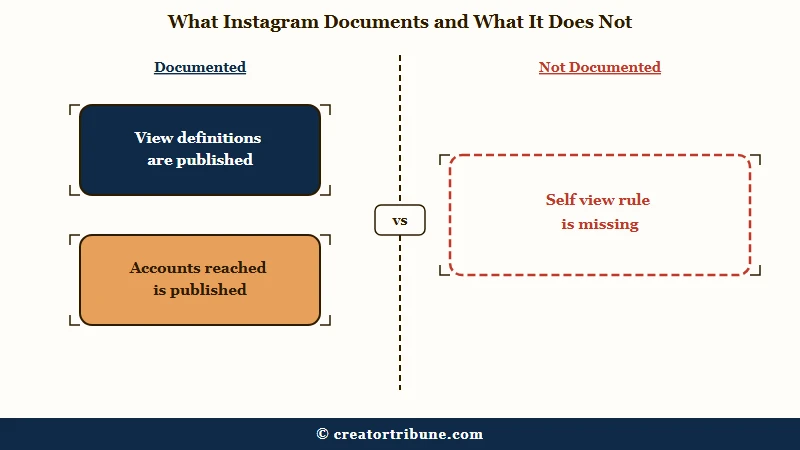
That gap between a confident answer and a documented one bothers me. Google’s AI Overview on this query states plainly that Instagram does not count your own plays. Its citations are a Quora thread and a single creator Reel, with no Meta page anywhere in the set.
The absence cuts both ways. Nobody has shown that your view is counted either, and the platform has no obvious reason to want its own numbers padded.
What you can do is stop treating “views” as one number. Once you split it by surface, three of the four sub questions get real answers.
Why Do the Grid Count and Insights Views Disagree?
The number under a Reel on your profile grid and the Views figure inside Insights are two different metrics. Instagram’s help page for the grid count says that figure does not include replays. The Insights definition of Views explicitly does include them.
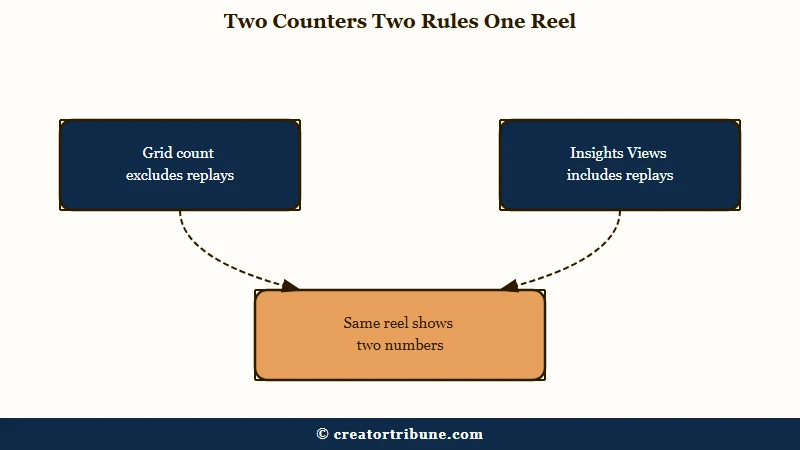
This is the detail I check first whenever a view count looks wrong. Two counters, two rules, sitting a tap apart in the same app. Almost nobody writing about this mentions it.
The consequence for the self view question is direct. Watching your own Reel five times could move the replay inclusive Insights figure while leaving the replay exclusive grid figure alone, and you would read that as a bug.
It also means a test that only checks one surface proves nothing about the other. Check both, or the result means nothing.
| Surface | What Instagram defines it as | Counts replays |
|---|---|---|
| Profile grid count under a Reel | The view number shown on the grid | No |
| Insights Views, Reels | The number of times your reel starts to play or replay | Yes |
| Insights Views, feed post or carousel | The number of times your content was displayed | Yes |
| Insights Views, Story | The number of times your story was played or displayed | Yes |
| Accounts reached | Unique accounts that saw it on screen at least once | No |
What Does Instagram Officially Document About Views?
Instagram documents four things: a reel view is every time the reel starts to play or replay, a feed or carousel view is every time the content was displayed, a story view is every time the story was played or displayed, and Accounts reached counts unique accounts rather than plays.
These four definitions are the only ground I will stand on here. Everything else on this page is either an inference I flag as one, or a claim I attribute to whoever made it.
The Accounts reached wording is the useful one, because Instagram spells out the contrast itself. Its help page says Accounts reached is different from views, which may include multiple views of your reel by the same accounts.
Read that sentence twice. Instagram is telling you, in its own words, that Views is not deduplicated per account.
What is Accounts reached: The number of unique accounts that saw your content on screen at least once, counted once per account no matter how many times they watched.
Does Rewatching a Reel Count as Another View?
Yes, on the Insights Views metric. The definition is the number of times your reel starts to play or replay, with no minimum watch time. On the profile grid count, replays are excluded, which is why the two numbers drift apart on rewatchable content.
The replay rule is the one that surprised me most, because it quietly demolishes the most popular reason offered for the confident no. The reasoning runs like this. Instagram counts one view per unique account, so your account adds one at the very most, and one is not worth filtering.
The first half of that is wrong. Views counts plays; the metric that counts accounts is Accounts reached, and Instagram keeps the two apart for exactly this reason.
The other zombie claim is the three second rule. That threshold belonged to a metric called video_views, which stopped being supported on 8 January 2025, and it survives in guides written years later because nobody rechecked it.
Why Do the Top Results Give Four Different Answers?
Because none of them is sourced. Four pages ranking for this question state four incompatible rules, and every one of them asserts it without citing a Meta or Instagram page.
I do not blame anyone for believing the first result. The answers are stated flatly and they sound researched, with no visible seam between the ones built on documentation and the ones built on nothing.
The table below is the whole problem in one screen. Note that the two sources arguing hardest for the confident no are also the two that get the replay mechanics wrong.
| Position taken | What it claims | Cites Meta docs |
|---|---|---|
| Your views count | Your own views on your Reels and videos get added to the total count | No |
| Your views are filtered | Your own views do not contribute to the public count or to Insights | No |
| It depends on format | Reels and feed count your view once with replays ignored, Stories count every rewatch | No |
| It changed in 2026 | Self views used to count and were removed from analytics this year | No |
| Nobody knows | No Instagram or Meta documentation states whether the owner’s views are excluded | Checked and found none |
The format specific claim in row three is the one that contradicts Instagram directly. It says replays do not add new views on Reels, and the Help Centre says a view is every time the reel starts to play or replay.
How Do You Test Whether Your Own View Counts?
Post a Reel, view it only from the posting account, and record the grid number and the Insights Views number before and after. Static posts cannot be tested this way, because a measurement of 425 posts found that image and carousel posts never expose a public view count at all.
The sequence I would run first is short, and the whole point is changing one variable at a time.
- Post a Reel at a quiet hour and leave it completely unshared.
- Screenshot the grid count and the Insights Views count within the first minute.
- Open the Reel from your own profile grid once, let it play through, and back out.
- Wait ten minutes, then screenshot both numbers again.
- Replay it four more times from your own account, wait ten minutes, and screenshot both a third time.
- Compare all three pairs, and treat the grid and Insights columns as separate results.
Ten minutes is not an arbitrary pause. That same measurement study pulled 190 posts twice, roughly six to seven minutes apart, and the counters had already moved, so these numbers update live rather than in a nightly batch.
Before: Open your Reel a few times, glance at the view count, decide it feels high, and conclude Instagram is padding your numbers.
After: Log the grid count and the Insights count at minute zero, after one self view, and after five, then compare the two columns against each other rather than against a feeling.
The honest limit of this test is that it tells you what happened on your account this week. It cannot tell you the rule, because a filter that runs on a delay or applies above some threshold would look exactly like no filter at all in a ten minute window.
Anything you see on a post with real traffic is worthless here, since you cannot separate your own view from a stranger’s. The unshared Reel is the whole method.
Does Your Own View Show in Story Views or Profile Visits?
Profile visits have a documented answer and views do not. Instagram’s private profile visit counter, tested on a 14 day rolling window, excludes visits to your own profile while counting repeat visits from other accounts separately.
Profile visits are the one surface with a straight answer, and it is the answer I expected. Repeat visits from an outsider each add to the count, while your own trip to your own grid adds nothing.
Story viewer lists are a different matter, and here the documentation runs out again. The list is visible only to you and only while the Story is live, and Instagram has never stated whether the posting account appears on its own list.
Read why Story views drop before you draw conclusions from a shrinking number, because view drops usually have a duller cause than a counting rule.
One neighbouring platform does have a settled answer, which is what makes Instagram’s silence stand out. On X a self view counts so freely that refreshing your own post inflates the number within seconds. TikTok sits closer to Instagram, and how TikTok handles Story views covers what is and is not pinned down there.
What Should You Track Instead of the View Count?
Accounts reached, watch time and skip rate. Accounts reached is documented as deduplicated per account, so a self view moves it by one at most, and watch time carries far more weight in distribution than any view total.
My take is that watch time is the number worth protecting, and it is the one your own habits can genuinely damage. Views is a vanity counter running on a rule nobody has published. Retention is a ranking input, and its definition sits right there in the Help Centre.
Consider what happens when you open your own Reel to check the caption, watch two seconds, and back out. Instagram tracks a skip rate measuring the share of viewers who swipe away inside the first three seconds, which is a live metric rather than the retired view threshold from earlier. Nothing about that measurement announces itself as coming from you.
Whether Instagram strips your session out before it hits that calculation is, once again, undocumented. The safe habit costs nothing: check your caption in the editor before you post, not by reopening the live Reel eleven times.
That is also the better answer to the worry underneath the original question. If your numbers look inflated relative to your follower count, the cause is far more likely to be non follower distribution than a counting quirk, and why reach suddenly drops will get you further than auditing your own taps. The same logic applies in reverse when a viral post then stalls.
Frequently Asked Questions
Does Instagram count your own views on posts and not just Reels?
There is no published rule for either. Static posts and carousels never show a public view count, so the only place to look is Insights, where a feed view is defined as every time your content was displayed.
Would my own view show as a follower or a non follower?
Instagram has not documented this. You do not follow yourself, so a counted self view would have to land in the non follower bucket, which is an inference rather than a stated rule.
Did the 2025 views change alter how self views are handled?
Nothing in the rollout addressed it. Meta gave 90 days notice on 8 January 2025, and on 21 April 2025 impressions and plays were retired across all Instagram API versions in favour of a single Views metric.
Does the same person viewing twice count as two views?
Yes on Views and no on Accounts reached. Instagram states that Accounts reached is different from views, which may include multiple views of your reel by the same accounts.
Will viewing from a second account inflate my numbers?
A second account is a separate account, so nothing about the owner exclusion question applies to it. Repeatedly viewing your own content from alts is engagement manipulation and is not worth the risk to your reach.
Quick Takeaways
- Instagram has never published whether your own views count, and every confident answer ranking for the question is uncited.
- The profile grid count excludes replays while the Insights Views count includes them, so the two numbers answer different questions.
- Accounts reached is the documented deduplicated metric, so a self view can move it by one at most.
- Test it on an unshared Reel and log both counters at minute zero, after one view, and after five.
- Stop reopening your own Reels to check them, because skip rate and watch time carry real ranking weight and views does not.