Instagram AI Creator Label Lets You Remove It
Instagram AI Creator Label Lets You Remove It
Instagram new AI Creator label is opt-in and removable. Here is what that means for your Reels before the EU deadline hits.
- 1How Does the Instagram AI Creator Label Work?
- 2Can You Remove an AI Label Instagram Applied Automatically?
- 3Why Is Instagram Making This Optional Instead of Mandatory?
- 4What Does the EU AI Act Mean for Instagram Creators?
- 5What Content Triggers an AI Label on Instagram?
- 6What Should Visual Creators Do Before August 2?
- 7Quick Takeaways
Updated September 19, 2026: Instagram renamed the “AI creator” label to “AI-generated profile” on August 31, 2026 and narrowed it to profiles that feature an AI-generated person, saying creators who “simply use AI tools as part of their creative process don’t need to add the label”. Profiles featuring an AI-generated person that skip the label may see their reach limited, while adding it changes nothing about reach. The EU AI Act’s Article 50 transparency duties took effect on August 2, 2026 as scheduled.
Instagram rolled out an account-level “AI creator” label in May 2026, sitting in your bio and following your content across Feed, Reels, and Explore with a line reading “This profile posts content that was generated or modified with AI.” That label no longer exists under that name.
On August 31, 2026 Instagram renamed it to “AI-generated profile” and changed who it is aimed at. The old wording caught anyone leaning on AI tools. The new one is meant for profiles whose subject is an AI-generated person.
On individual posts where Instagram auto-applies an “AI info” tag, you can open Edit and deactivate the tag after publication.
The EU AI Act’s Article 50 transparency rules took legal effect on August 2, 2026, with fines reaching up to 15 million euros or 3 percent of global annual turnover. The Digital Omnibus amended the AI Act but left the creator-facing disclosure duties out of its deferrals, so they landed on the original date.
How Does the Instagram AI Creator Label Work?
It is a single profile-wide toggle, renamed “AI-generated profile” on August 31, 2026 and now meant only for profiles that feature an AI-generated person.
It is separate from the post-level “AI info” tag that Instagram auto-applies to individual pieces of content.
When you enable the AI Creator label, it appears in three places: your profile bio, next to your username on posts in the Feed, and alongside your Reels in Explore.
The exact text reads “This profile posts content that was generated or modified with AI.” I’d describe it as a blanket signal, one toggle that covers your entire presence on the platform rather than flagging individual uploads.
That wording belongs to the retired version. In its announcement of the change Instagram said it renamed “the AI creator label to AI-generated profile to make it more clear to people when a profile features an AI-generated person rather than a human”. Creators who “simply use AI tools as part of their creative process don’t need to add the label”.
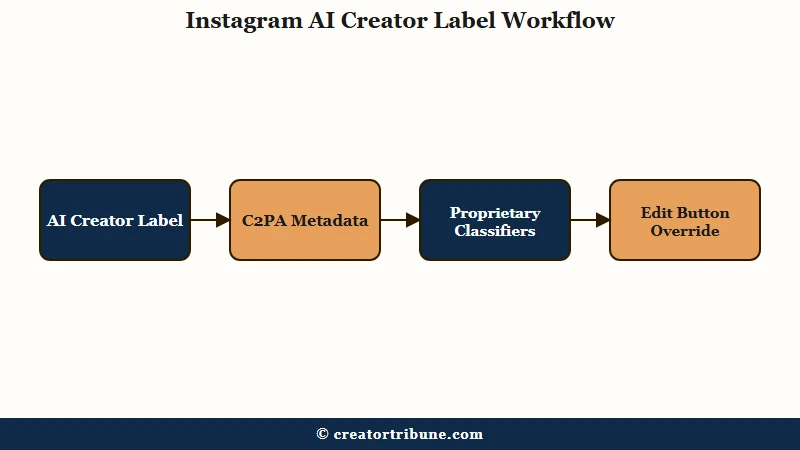
Instagram’s detection layer runs underneath this. Meta scans uploads using C2PA metadata, IPTC digital source type fields, and proprietary classifiers to identify AI-generated or AI-modified content.
When the system flags a post, it applies a smaller “AI info” tag at the post level. If your account already carries the AI Creator label and a specific post also triggers the AI info tag, the post-level tag takes priority on that particular piece of content.
The two layers interact in a way that matters for working creators. The account label is your choice. The post-level tag is the platform’s choice, but you can override it.
Can You Remove an AI Label Instagram Applied Automatically?
Yes, you can manually deactivate an auto-applied AI tag on a published post by tapping Edit and turning off the label. This is the detail that most coverage of the feature has glossed over.
Here is the sequence I’d walk through if you want to check or remove a label:
- Open the post with the “AI info” tag on your profile grid.
- Tap the three-dot menu in the top right corner.
- Select Edit.
- Look for the AI disclosure toggle near the bottom of the editing options.
- Deactivate it and save.
The tag disappears, and at the post level Instagram has announced no penalty for removing it. The account level is where that changed. Instagram now says creators who “don’t appropriately label their AI-generated profiles may see limits to their profile’s reach”, while creators who add it “will not see a change to their profile’s reach”.
Removing the account-level label is a different job in a different place, and it is the one that trips people up. Open Edit profile and switch “AI-generated profile” off.
Instagram documents that control as a toggle applied “by editing their profile and toggling on AI-generated profile”, and the creators reporting this problem describe using that same switch. Instagram says creators who carried the old label “will now see the new name and have a chance to review the AI-generated profile label, confirm if it still fits or remove it if it no longer applies”.
Whether it stays off is a separate question. On r/Instagram a creator posted on September 11, 2026 that the label “keeps coming back” after being switched off in Edit profile, on an account that had “never used or posted any ai”, and a reply said the behaviour “has been popping up for a few weeks now even if you never touched the stuff”. A September 10 post on r/InstagramSupport from an automotive photographer describes a hand-edited photo tagged as AI content, with no answer from anyone.
Two posts are not a measured failure rate, and Instagram publishes nothing about a label that re-applies itself. Treat one pass through Edit profile as provisional and check the profile again a few days later. The reply above suggested clearing the app cache and toggling it off through a browser instead of the app, which is worth trying as a reader workaround rather than a documented fix.
Instagram does publish a route for the reverse problem, a profile limited when it should not have been. Its announcement says unlabelled profiles it detects “will be notified and can check Account Status to see if they’re no longer eligible to appear in recommendations”, and that “creators can check Account Status to see if there are any limits to their account’s reach and appeal restrictions that they believe were made in error”.
Instagram names two ways back for a profile that has been made non-recommendable: add the label, or appeal the decision. It prefaces that appeal route with “Our systems might not always be perfect”, and says “If their appeal is successful, the profile and its content will be eligible to appear again in recommendations”.
Before: A Reel you color-graded with an AI filter carries an “AI info” badge you did not ask for, and you are not sure if it is scaring off brand deal prospects.
After: You open Edit, deactivate the tag, and the Reel displays without any AI indicator. Your content looks the same as a manually edited post.
If the label genuinely describes your profile, keeping it is now the cheaper option. Instagram’s own line is that creators who proactively add the AI-generated profile label “will not see a change to their profile’s reach”, which makes disclosure the only route carrying no distribution risk.
Why Is Instagram Making This Optional Instead of Mandatory?
Instagram’s opt-in approach stands in direct contrast to TikTok’s mandatory labeling and YouTube’s permanent, non-removable tags. The gap between these three platforms creates a real compliance problem for creators who cross-post.
Meta has taken a deliberately cautious regulatory position. According to AuditSocials’ cross-platform analysis, Meta refused to sign the EU’s voluntary Code of Practice for AI content. That signals a platform betting that minimal self-regulation buys time before mandatory rules arrive.
Here is how each platform handles AI labels right now:
| Platform | Label type | Mandatory? | Removable? | Penalty for non-disclosure |
|---|---|---|---|---|
| Account-level + post-level | Opt-in, but expected on AI-person profiles | Yes (Edit profile and Edit post) | Reach limits on unlabeled AI-person profiles since Aug 31, 2026 | |
| TikTok | Post-level, auto-detected | Yes, for realistic AI content | No | 48-hour distribution cut (1st), 7-day suppression (2nd) |
| YouTube | Below-player label, auto-detected | Yes, for photorealistic AI | No (permanent for C2PA/Google tools) | Warning, then 90-day monetization suspension, then permanent YPP removal |
TikTok’s automated face-detection systems operate at 94.7 percent accuracy, meaning roughly 1 in 20 detections is wrong. YouTube’s labels for content created with Google’s own AI tools or carrying C2PA metadata are permanent. Instagram is the only major platform where you can undo what the algorithm decided.
The practical problem for anyone posting the same Reel to Instagram, TikTok, and YouTube Shorts is clear. Your TikTok version may carry a mandatory label, your YouTube version gets a permanent one, and your Instagram version has no label at all because you removed it. That inconsistency has been a legal question since August 2, 2026.
What Does the EU AI Act Mean for Instagram Creators?
The EU AI Act’s Article 50 has made AI content disclosure a legal requirement since August 2, 2026, with fines up to 15 million euros or 3 percent of global turnover, whichever is higher.
That date turned disclosure from a platform preference into a legal duty for anyone reaching EU audiences.
Article 50 covers four scenarios: AI systems interacting directly with people (chatbots), AI generating synthetic content (images, video, audio, text), emotion recognition systems, and deepfakes. If you use AI to generate or modify a Reel, Story, or carousel image and your audience includes EU viewers, you fall under these rules.
The penalty structure exceeds GDPR. Transparency violations carry fines of up to 15 million euros or 3 percent of global annual turnover. The highest tier, for prohibited AI practices like social scoring, reaches 35 million euros or 7 percent.
For SMEs and startups, the fine is capped at the lower of the two thresholds, which is still substantial. In the US, the FTC can levy per-violation penalties of up to $53,088 for synthetic endorsements under 16 CFR Part 255.
There is one grace period worth knowing. The AI Omnibus provisional agreement from May 2026 gives generative AI systems already on the market until December 2, 2026, to meet machine-readable marking requirements. That extra four months applies to the technical implementation (embedding C2PA metadata in outputs), not to the creator-facing disclosure obligation, which started on August 2.
For anyone posting AI-assisted content to EU audiences, the grace period is over. YouTube’s AI disclosure system showed where enforcement was heading, and Instagram followed on August 31 with a reach consequence of its own for undisclosed AI profiles.
What Content Triggers an AI Label on Instagram?
Photorealistic AI-generated images, AI-manipulated video, and cloned or synthetic audio all require disclosure across major platforms. Standard editing tools like cropping, brightness adjustment, and color correction do not.
The gray zone sits between those extremes, and it is where most visual creators work. Here is the breakdown I’d use to decide whether a specific workflow needs a label:
- AI background removal or replacement in a product photo or portrait: currently does NOT trigger Instagram’s auto-detection in most cases, but would require disclosure under Article 50 if the result could be mistaken for a real scene.
- AI color grading or style transfer (applying a preset that an AI model generated): does not currently require a label on any platform, though Instagram’s classifiers occasionally flag it as a false positive.
- AI-generated B-roll or stock footage spliced into a Reel: requires disclosure on TikTok and YouTube, opt-in on Instagram.
- AI voiceover or voice cloning: mandatory disclosure on all three platforms if the voice could be mistaken for a real person.
- AI-written captions or scripts: no user-facing label required on any platform. Meta requires internal disclosure for AI-generated ad copy in Ads Manager, but regular posts and Reels carry no visible tag for AI text.
That last point is the most surprising gap in the current system. AI-generated text, the most common form of AI assistance creators use, has no visible disclosure requirement anywhere. Your script can be entirely AI-written and no platform will tag it.
The visual and audio outputs get flagged while the written foundation stays invisible. For creators working on proving content is human-made, the threshold is moving. What counts as “substantially AI-modified” will keep tightening as detection improves and Article 50 is enforced.
What Should Visual Creators Do Before August 2?
The August 2, 2026 deadline has passed, so a disclosure audit is catch-up work now rather than preparation. Article 50 has been in force since that date, and Instagram added its own reach consequence four weeks later.
The first question is whether the label applies to you at all. Instagram has drawn that line explicitly, reserving the AI-generated profile label for profiles that feature an AI-generated person and telling creators who use AI tools inside an otherwise human profile that they do not need it.
Here is the 5-step audit I’d recommend:
- Check every post from the last 30 days on Instagram for auto-applied “AI info” tags. Note which ones triggered and which did not.
- Cross-reference with your TikTok and YouTube uploads of the same content. Identify any posts where labeling is inconsistent across platforms.
- Add the AI-generated profile label only if your profile features an AI-generated person. Instagram says creators who use AI tools inside an otherwise human profile do not need it, so switching it on anyway misdescribes your account.
- Re-check the account-level toggle a few days after you change it. Creators have reported the label returning on profiles that never posted AI, so one pass through Edit profile is not proof it stuck.
- Document your AI workflow (which tools, which steps, how much human direction) so you can respond quickly if a brand or regulator asks for specifics.
The Instagram aggregator crackdown already showed that Meta is willing to penalize accounts that lack transparency about content origins. AI disclosure is the next front in that same push. Creators who built consistent channel trust signals will be better positioned than those who spent the opt-in window hiding labels.
Quick Takeaways
- The AI creator label became “AI-generated profile” on August 31, 2026, and it now marks profiles featuring an AI-generated person rather than anyone using AI tools.
- Instagram says adding the label costs nothing in reach, while skipping it on a profile that features an AI-generated person can cost you reach.
- YouTube’s AI tags are permanent, TikTok’s are mandatory with distribution penalties, and Instagram is the only platform where you can still remove them.
- EU AI Act fines for transparency violations reach 15 million euros or 3 percent of global turnover, exceeding GDPR penalties.
- Creators report the account label returning after being switched off, so re-check Edit profile a few days after any change.