How Creators Make Money Without Platform Payouts
How Creators Make Money Without Platform Payouts
How creators make money without platform payouts, from the income mix that survives demonetization to selling your own products with the right tools.
- 1How Creators Make Money Without Platform Payouts
- 2Why Platform Payouts Will Never Be Enough
- 3The Income Mix That Survives a Demonetization
- 4Start With Your Own Product for the Best Margin
- 5The Tools That Make Owned Income Possible
- 6Which Income Stream to Add First
- 7Frequently Asked Questions
- How much do platform creator funds pay?
- What is the best income stream to start with?
- Do I need to quit posting on platforms?
- What tools do I need to sell my own products?
- How many income streams should a creator have?
- 8Quick Takeaways
TL;DR: Creators make real money without platform payouts by treating ad and creator-fund revenue as a small slice, not the whole pie. The stable model caps platform income at 20 to 30% and fills the rest with sponsorships, affiliate revenue, and your own digital products. Owning the audience and selling to it directly is the part you control.
Plenty of creators learn how to make money without platform payouts the hard way, after a demonetization email or a payout that quietly shrinks. The platforms were never built to pay you a living wage, and the numbers prove it.
Consider the math on a creator fund. TikTok’s fund pays roughly $0.02 to $0.04 per 1,000 views, so a million monthly views earns somewhere between $200 and $400 before the algorithm even decides whether to show your next video.
That is why more than half of all creators still earn under $15,000 a year. The ones who break past it are not getting better payouts, they are building income the platform cannot switch off.
This guide covers the income mix that survives a demonetization, the highest-margin stream to build first, and the tools that make owned income realistic on a creator budget.
How Creators Make Money Without Platform Payouts
Creators make money without platform payouts by diversifying into sponsorships, affiliate revenue, and their own digital products, then routing the audience to channels they own.
Platform ad money becomes a bonus, not the foundation.
The data is blunt on this. Creators earning from three or more revenue streams make about 5x more than those leaning on a single platform, which reframes diversification as a growth strategy rather than a safety net. The creator economy is on track to near half a trillion dollars by 2027 per Goldman Sachs, and the creators capturing it are the ones who built income past ad revenue.
The way I see it, the goal is not to quit the platforms. It is to use them as the top of the funnel, then move the relationship somewhere a policy change cannot erase. Everything below is how that gets built.
Why Platform Payouts Will Never Be Enough
Platform payouts will never be enough because the per-view rates are tiny and the rules can change without warning.
Building a business on them means renting your income from a landlord who can evict you.
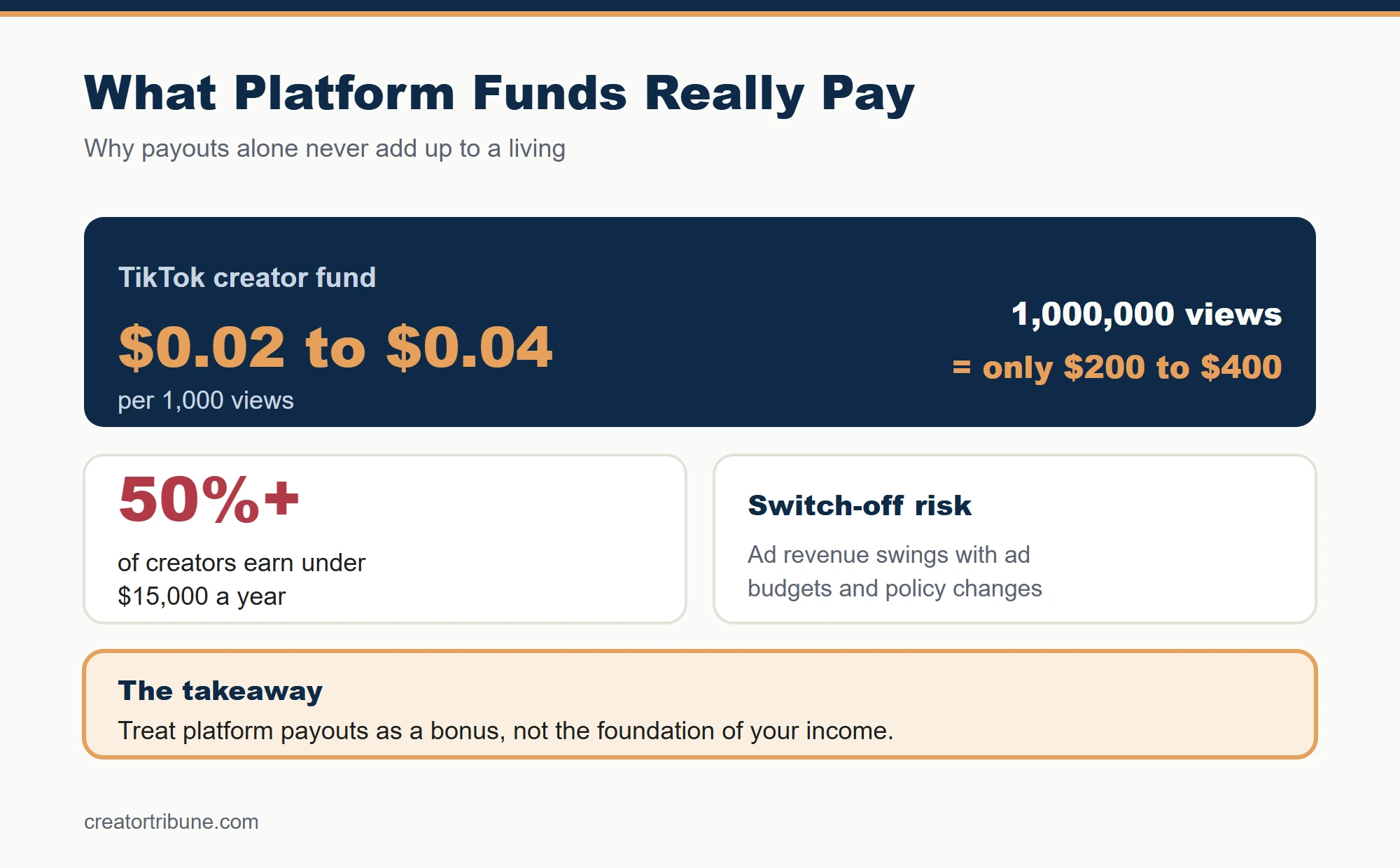
The pay rates tell the story. A creator fund paying pennies per thousand views cannot replace a salary, and ad revenue swings with seasonal advertiser budgets that have nothing to do with your work.
Then there is the switch-off risk. Plenty of creators discover this when YouTube monetization gets denied or when TikTok payouts drop overnight, and the appeals process is notoriously slow and opaque.
I would keep platform ad revenue to a minority of total income for exactly this reason. When it is 80% of your money, one policy update is an existential threat.
The Income Mix That Survives a Demonetization
The income mix that survives a demonetization keeps platform ad revenue at 20 to 30% and builds the rest from sponsorships, products, and affiliates.
That ratio is the difference between a scare and a catastrophe.
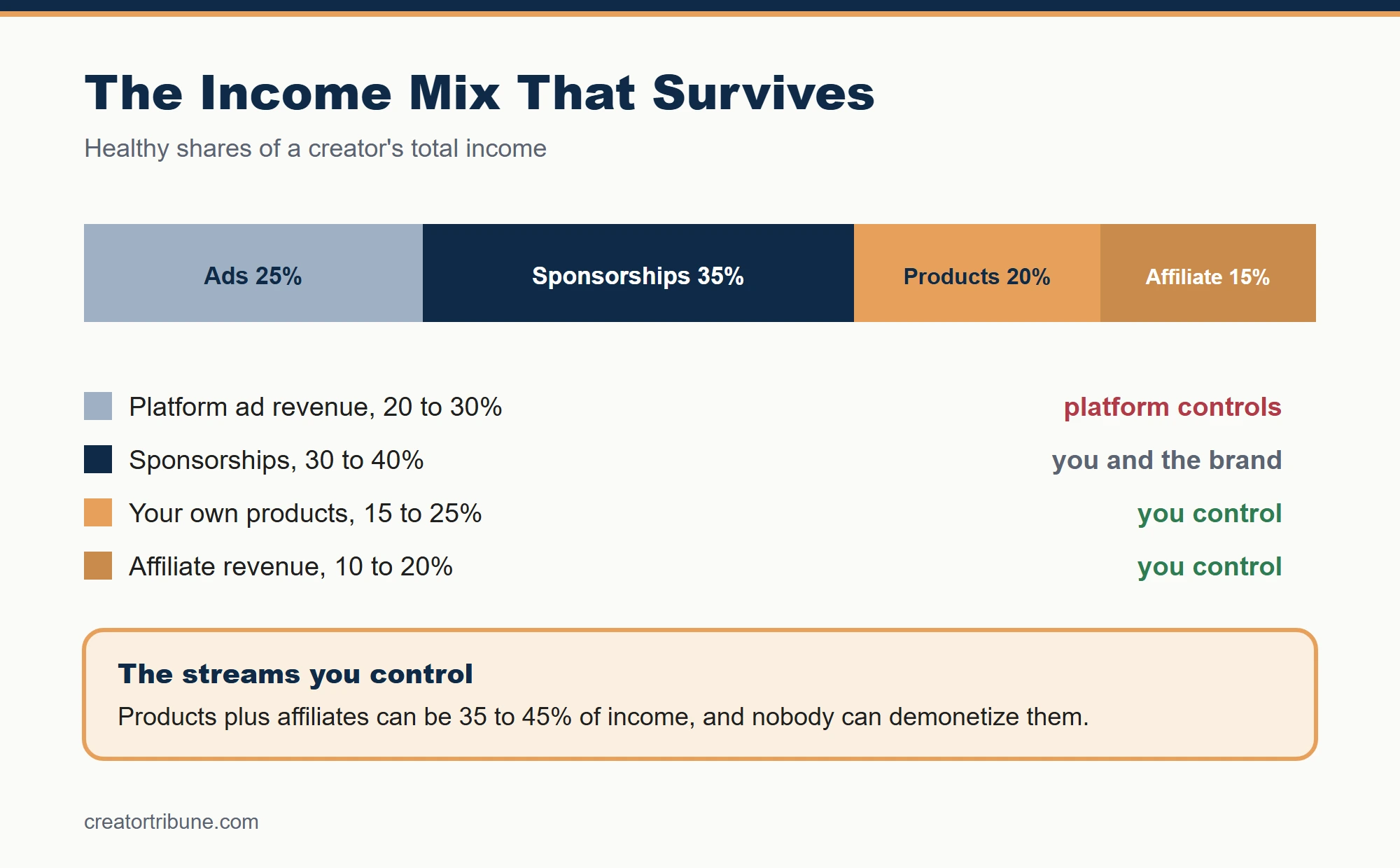
Here is the blueprint stable creators tend to follow. Use it to audit where you are over-exposed to a single platform.
| Income stream | Healthy share of total | Who controls it |
|---|---|---|
| Platform ad revenue | 20 to 30% | The platform |
| Sponsorships | 30 to 40% | You and the brand |
| Your own products | 15 to 25% | You |
| Affiliate revenue | 10 to 20% | You |
What stands out to me is how little of a resilient income comes from the platform. The two streams you fully control, products and affiliates, can make up 35 to 45% of the total, and they are the ones nobody can demonetize.
Start With Your Own Product for the Best Margin
The highest-margin stream to build first is your own digital product, because you keep nearly all of the revenue and you own the customer.
It is the single biggest step away from platform dependence.
A sponsorship still depends on brands choosing you, and affiliate income depends on someone else’s program. A product you make and sell is yours start to finish, which is why I would build it before anything else.
Here is the sequence I would follow:
- Pick one small digital product your audience already asks for, like a template, preset, or short guide.
- Set up a simple landing page and an email capture so followers become contacts you own.
- Sell the product directly through that page, not through a platform that takes a cut.
- Reinvest the first sales into a second product or an email sequence that sells while you sleep.
Before: You post a video, earn $3 in ad revenue per 1,000 views, and own nothing once the view count fades.
After: That same video sends 40 viewers to your email list, and a $39 product converts 3 of them into $117 you keep, plus 40 contacts you can sell to again.
The full walkthrough lives in our guide on how to sell digital products, which covers pricing and the first-sale path in detail.
The Tools That Make Owned Income Possible
The tools that make owned income possible are a landing page, an email list, and a checkout, and you can run all three for free.
You do not need a developer or a $99 a month stack to start.
For a creator on a budget, I point people to Systeme.io first, because its free plan bundles funnels, email, and a course in one place at 0% transaction fees. If you are comparing the bigger paid names, our ClickFunnels alternatives breakdown shows where each one earns its price.
The setup is genuinely fast. You can create a free Systeme.io account and have a landing page and email capture live the same afternoon, and if you want a shortcut, clone our free creator money page funnel and just swap in your details.
Which Income Stream to Add First
Add your own product first, then layer affiliate revenue, and treat sponsorships as the stream that scales once your audience grows.
Sequence matters more than chasing all of them at once.
Affiliate marketing is the easiest second stream, and the data backs that up: only about 54% of creators use it today, so it is still underused relative to how well it pairs with content. Recommend tools you genuinely use and the commissions compound quietly in the background.
What I would not do is wait for a brand deal to save you. Sponsorships are real money, but they arrive on the brand’s timeline, while a product and an affiliate link are levers you can pull this week.
Frequently Asked Questions
How much do platform creator funds pay?
Very little. TikTok’s creator fund pays roughly $0.02 to $0.04 per 1,000 views, so even a million monthly views earns only $200 to $400. That is why diversified income, not platform payouts, is what pays the bills.
What is the best income stream to start with?
Your own digital product. You keep nearly all the revenue and own the customer relationship, unlike sponsorships or affiliate programs that depend on a third party. A simple template or guide is enough to start.
Do I need to quit posting on platforms?
No. Platforms are the top of your funnel for discovery. The goal is to move that audience to channels you own, like an email list, so a single algorithm change cannot erase your income.
What tools do I need to sell my own products?
A landing page, an email list, and a checkout. Free all-in-one platforms like Systeme.io bundle all three at 0% transaction fees, so you can start without a monthly subscription or a developer.
How many income streams should a creator have?
At least three. Creators with three or more streams earn about 5x more than single-platform creators, and a stable mix keeps platform ad revenue to just 20 to 30% of the total.
Quick Takeaways
- Platform funds pay pennies: TikTok’s runs about $0.02 to $0.04 per 1,000 views, so payouts alone will not sustain you.
- Creators with three or more income streams earn roughly 5x more than single-platform creators.
- Keep platform ad revenue to 20 to 30% of total income, fill the rest with sponsorships, products, and affiliates.
- Build your own digital product first, it is the highest-margin stream and the one nobody can demonetize.
- Start free: a landing page, email list, and checkout on a free tool turn followers into income you own.