Views vs Viewers on Instagram and What a Big Gap Tells You
Views vs Viewers on Instagram and What a Big Gap Tells You
Instagram views count every play, viewers count each account once. See what a normal gap looks like and what a 2-second watch time means.
- 1What Does Views vs Viewers Mean on Instagram?
- Is Viewers the Same as Accounts Reached?
- 2Why Do I Have More Views Than Viewers on Instagram?
- 3How Many Views per Viewer Is Normal on Instagram?
- 4What Does a 2-Second Average Watch Time With High Views Mean?
- 5Can Viewers Be Higher Than Views on Instagram?
- 6Does a Big Gap Between Views and Viewers Mean Fake Views?
- 7What Should You Change When the Gap Looks Wrong?
- 8Quick Takeaways
TL;DR: On Instagram, Views counts every time your content starts to play or shows on screen, replays included, while Viewers counts each account once. Instagram publishes no normal gap, but Reels in creator-posted stats sit near 1.2 to 1.7 views per viewer, and 3 to 5 second loops run near 2 to 2.7. A big gap next to a 2-second average watch time points to a Reel that kept starting for the same people and losing them fast, so the opening needs work.
One creator posted a set of Reel stats on September 27, 2026 that sums up the confusion: 5,000-plus views, 1,200-plus viewers and a 2-second average watch time, two days after upload.
Views vs viewers on Instagram looks like a plain split between plays and people. The trouble starts when the numbers stop agreeing with each other.
Misreading that gap costs hours. Read it as fake views, or as fans rewatching, and you can spend a week re-cutting a Reel that was fine or keep posting an opener that loses people in two seconds.
The question also feels new because the label is new. Instagram renamed Accounts reached to Viewers in 2026, and its own help pages caught up months after the app did.
The gap between those two numbers is the first thing I check when a Reel’s insights make no sense to me. Read it right and one screen tells you whether to leave a Reel alone, re-cut its first three seconds or report a counting fault.
What Does Views vs Viewers Mean on Instagram?
Views vs viewers on Instagram is plays against people: Views counts every time content starts to play or appears on screen, replays included, and Viewers counts each account once.
Instagram’s reel insights page defines Views as “the number of times your reel starts to play or replay.” Viewers is “the number of unique accounts that have seen your reel on screen at least once, whether or not your reel was played.”
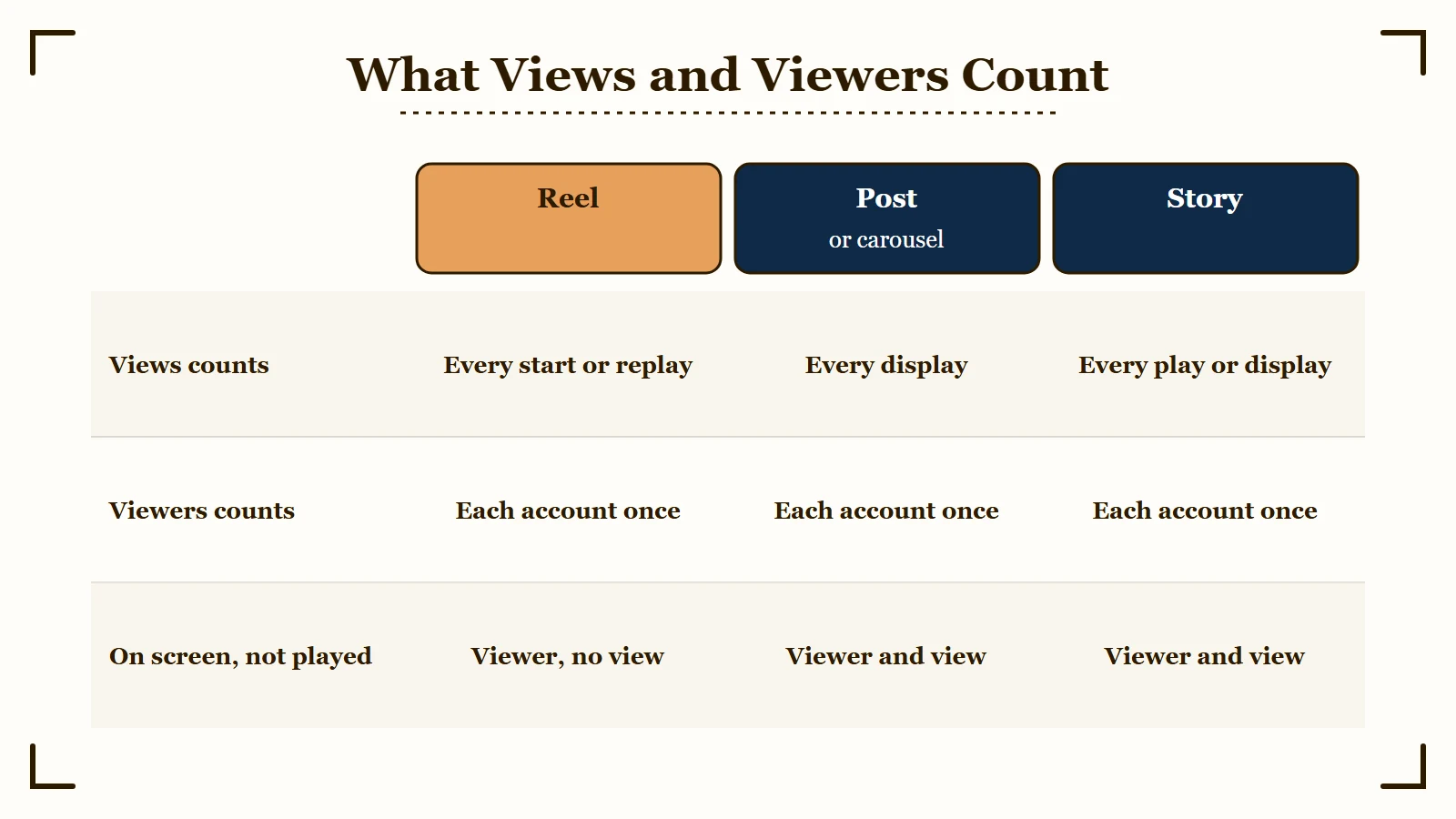
Under that wording, a follower whose screen shows your Reel without it ever starting still counts as a viewer without adding a single view, which is why the two numbers can cross.
Each format counts a view a little differently. Here is how Instagram’s help pages for posts, Stories and the account overview define the pair:
| Where you see it | What Views counts | What Viewers counts |
|---|---|---|
| A Reel | Each time the Reel starts to play or replay | Accounts that saw it on screen at least once, played or not |
| A feed post or carousel | Each time the post was displayed | Accounts that saw it on screen at least once |
| A Story | Each time the Story was played or displayed | Accounts that saw the Story at least once |
| Your account overview | Plays or displays across reels, posts, Stories, live videos and ads | Unique accounts, with demographics once you pass 100 |
Meta labels Viewers “estimated and in-development” on its About Instagram insights page, so small mismatches are normal. A Story from March 2025 showed 66 viewers, 74 views and 62 accounts reached for the same Story.
I trust this pair more than any other number on that screen, because Meta defines both in writing. The number printed under a Reel on your profile grid is a third count with its own rule, and the self-view question covers how that one differs from Insights.
Is Viewers the Same as Accounts Reached?
Yes, Viewers is the metric Instagram used to call Accounts reached, and its definition was kept word for word.
The reel insights page defined Accounts reached as “the number of unique accounts that have seen your reel on screen at least once, whether or not your reel was played.”
That wording appears in nine Internet Archive copies from December 2024 to April 23, 2026, and a September 16, 2026 copy has it under the Viewers label.
The app moved first. On May 3, 2026, one creator noticed older Reels still showing “accounts reached” while a Reel posted that week showed only “views” and “viewers.”
The About Instagram insights page still said Accounts reached in an Internet Archive copy from August 5, 2026, and it says Viewers today.
The old name has not gone away, and that is what trips people up:
| Where you read it | What it is called | How Meta words it |
|---|---|---|
| Instagram app and help center | Viewers | Unique accounts that saw your reel on screen at least once |
| Meta’s Edits video app | Reach | “The number of unique views your reel has received” |
| Meta’s developer API, which outside analytics tools read | reach | “Number of unique Instagram users that have seen the reel at least once,” marked “Metric is estimated” |
| Guides written before mid 2026 | Accounts reached | The same definition as Viewers |
What bothers me is that Meta’s own pages still mix the two names. The live About page defines Viewers and then describes “the accounts you’ve reached” in the same sentence.
Some marketing guides describe Viewers as a stricter count that comes in lower than reach. ExtraDigital’s February 2026 guide says it “yields lower totals than reach because it is based on more meaningful visibility rather than simple feed rendering,” without naming the Meta product it means.
Instagram’s own Reels wording gives no sign of a stricter count, since only the label changed.
Why Do I Have More Views Than Viewers on Instagram?
You have more views than viewers because one account can start your Reel many times, and every start or replay adds a view while that account stays one viewer.
Most of the gap comes from three ways people watch:
- Loops. A Reel replays on its own when it ends, and each replay counts as a view. Short Reels rack up loops fastest.
- Return visits. The same person can meet the Reel again later in the Feed, the Reels tab or on your profile, and each new start counts again.
- Re-displays of posts and Stories. A photo or carousel adds a view each time it shows on someone’s screen, and a Story adds one each time it plays or displays.
A common claim says every swipe through a carousel adds a view per slide. Instagram’s post insights page defines a post view only as “the number of times your content was displayed” and says nothing about slides, so treat that claim as unconfirmed.
Replays also feed your average watch time. Instagram adds replayed seconds to total watch time but divides only by “initial views,” the first play in a reel session. A Reel that loops can show an average longer than the Reel itself.
That formula is newer than most explanations of it. When Instagram added average watch time in 2023, TechCrunch reported it as watch time divided “with the number of total plays.” The help page has divided by initial views since at least December 2024, so older readings of the number no longer hold.
I read every gap through those three habits before I worry about anything else. Work out which one fits your format first, then look at the size of the gap.
How Many Views per Viewer Is Normal on Instagram?
A normal views-to-viewers ratio on Instagram Reels sits roughly between 1.2 and 1.7 in creator-posted stats, while 3 to 5 second loops run near 2 to 2.7.
Instagram publishes no benchmark of its own, so numbers creators have shared publicly are the closest reference.
Here are Reels whose creators published both numbers and an average watch time:
| Reel | Views / viewers | Views per viewer | Average watch time |
|---|---|---|---|
| 3-second loop, Aug 2026 | 3,646 / 1,364 | 2.7 | 10 seconds |
| 5-second Reel, Aug 2026 | 3,291 / 1,571 | 2.1 | 8 seconds |
| 15-second Reel, Aug 2026 | 499 / 342 | 1.5 | 9 seconds |
| Reel, Sep 2026 | 3,058 / 2,269 | 1.3 | 24 seconds |
| Educational Reels, Jun 2026 | 36k / 21k and 2,790 / 2,328 | 1.7 and 1.2 | 26 and 27 seconds |
| Two-day-old Reel, Sep 2026 | 5,000+ / 1,200+ | About 4.2 | 2 seconds |
The 15-second Reel and the two educational Reels still showed the old Accounts reached label, which counts the same thing. Across a whole account the number lands in the same range: one local travel page logged 1.3M Reel views from 754K viewers over 61 Reels in 30 days, which works out to about 1.7 per viewer.
In this set, length looks like the driver. The 3-second and 5-second loops, the only Reels whose average watch time beat their running time, carry the biggest gaps apart from the 2-second case. Every Reel averaging over 20 seconds sits under 2 views per viewer.
My rule of thumb comes straight from that table: on a Reel longer than 15 seconds, anything under 2 views per viewer is ordinary. I only dig in when a Reel lands far outside my last ten, and that baseline is the first thing to slip when you run more than one account.
Automation software is one way creators keep posting steady across several accounts. SMTasker, the successor to Jarvee and Mass Planner, is one built for Instagram, TikTok and Threads that runs accounts on real Android phones.
Like any outside automation it carries account risk under Instagram’s rules, so read the trade-offs before you connect an account.
What Does a 2-Second Average Watch Time With High Views Mean?
A 2-second average watch time next to a big views-to-viewers gap points to a Reel that kept starting for the same people and lost them within about two seconds each time.
Loops cannot explain that pairing on a Reel of normal length, because every loop pushes the average watch time up.
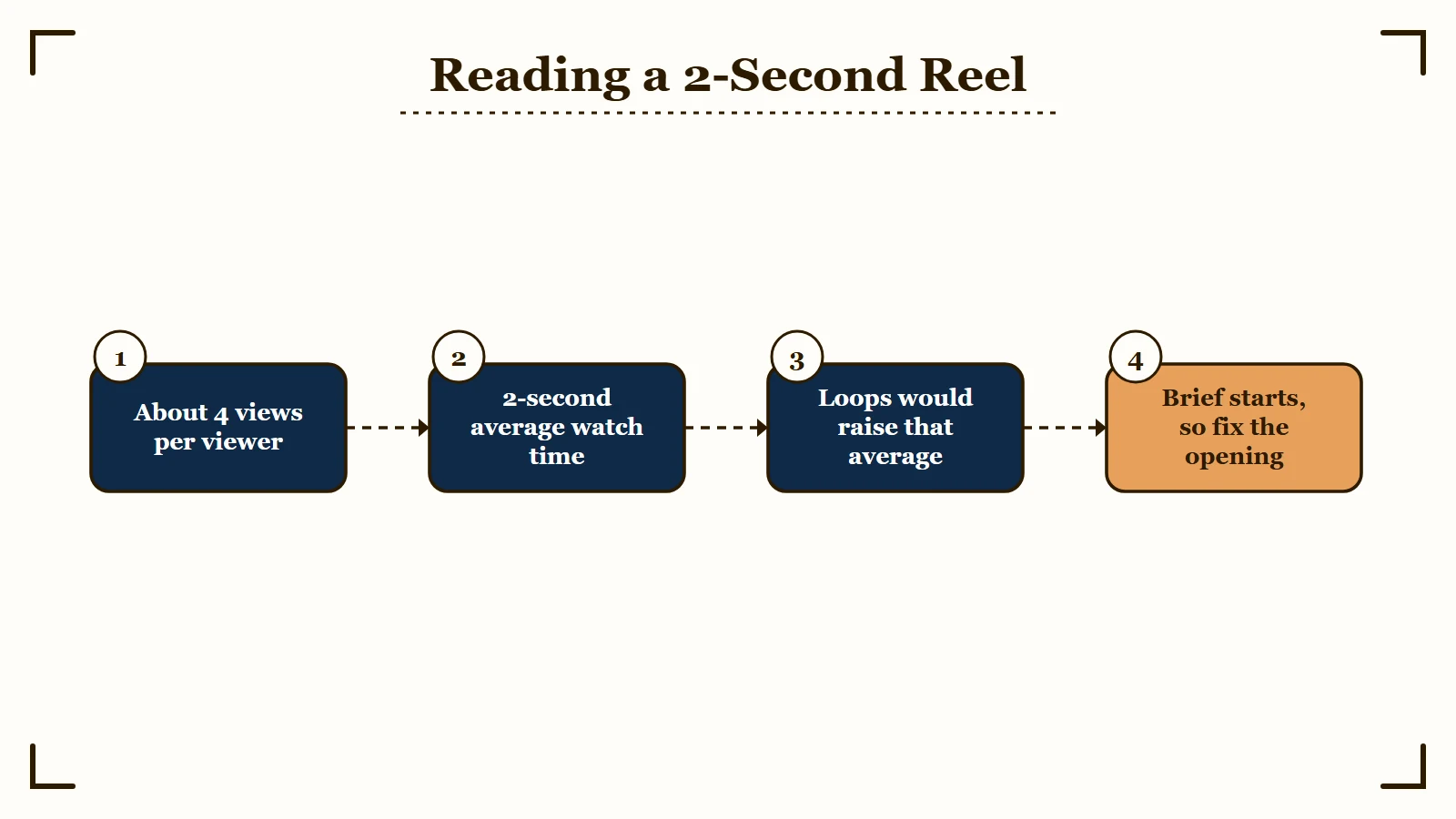
Instagram adds every replayed second to total watch time and divides by initial views only. Meta’s help pages do not define a reel session, but running the September 27 Reel through that formula splits the two explanations apart:
The Reel: 5,000 views, 1,200 viewers, 2-second average watch time

If people looped it (say it is 8 seconds long):
  1,200 first plays, each looping 4 times
  watch time = 1,200 x 32 seconds = 38,400 seconds
  average    = 38,400 / 1,200 first plays = 32 seconds

If it kept coming back and getting swiped:
  about 5,000 fresh starts, each lasting about 2 seconds
  watch time = 5,000 x 2 seconds = 10,000 seconds
  average    = 10,000 / 5,000 first plays = 2 seconds
Only the second picture produces 2 seconds. Each fresh start is what you would expect when the Reel reaches the same account again in a later scroll and gets swiped.
The same Reel had one more puzzle: its Views over time chart read about 500 on the day the stats were posted. TechCrunch’s write-up of that chart’s January 2025 launch says it shows how many views a Reel has “so far compared to the average views they normally get over the same time period.” A line near 500 can be your usual pace, so check which line you are reading before treating it as a crash.
This is the pattern I would fix first, since a 2-second average means most plays end in the opening seconds. Start with the Reel’s skip rate, the share of first plays that ended inside 3 seconds.
Then check where the views came from on the same screen. If Feed dominates, the Reel is likely circling your followers, and the Reels distribution cap is the next thing to read.
Can Viewers Be Higher Than Views on Instagram?
Yes, viewers can be higher than views on a Reel, because Instagram counts a viewer when the Reel was on screen even if it never started to play.
A small gap in that direction fits the definition, and a huge one usually means the view count broke.
In April 2026, one creator described a post where accounts reached ran “way more than the views,” while their latest post showed views at 2.5 times reach. Both can happen under the definition.
The extreme cases look like a counting fault. A May 2026 Reel showed 45k likes, 15k views and 300k accounts reached, and commenters under that post say low view counts like it cut into their bonus income. A June post showed 5 million accounts reached against 475k views.
When likes outnumber views three to one, the view count is the number most likely at fault. I screenshot the insights screen before reporting anything, so support sees my exact numbers. Then go to Menu, Help and Report a Problem, and either shake your phone on the insights screen or tap Report problem, as Instagram’s report a problem page explains, attaching the screenshot.
Does a Big Gap Between Views and Viewers Mean Fake Views?
A big gap between views and viewers is not proof of fake views, because loops and return visits create the same gap on real accounts.
The more useful question is whether viewers grew along with views.
New people arriving raise both numbers together. The same people returning raise views while viewers stay flat, which is ordinary watching. Bots belong to the first group, since each bot is its own account, so a bot wave tends to lift viewers along with views.
I don’t buy the idea that a ratio alone can prove bots, and I want to see who the extra viewers are first.
A wave of unfamiliar accounts in your Story viewers or followers, with no likes, saves or shares to match, is the sign worth chasing. The bot flood guide walks through clearing one.
What Should You Change When the Gap Looks Wrong?
What you change depends on the pattern the gap and the average watch time make together, and most patterns need no fix at all.
Use this table on any single Reel:
| What you see | What it usually means | What to do next |
|---|---|---|
| 1.2 to 1.7 views per viewer, a healthy average watch time | Ordinary watching with some replays | Nothing, compare it with your recent Reels |
| 2 to 3 views per viewer on a Reel under 6 seconds, average above its length | Loops | Judge it on shares and follows instead of views |
| 3 or more views per viewer with an average of a few seconds | Brief starts that lose people | Rework the first 3 seconds and check skip rate |
| Viewers a little above views | Accounts that saw it without it playing | Nothing |
| Viewers far above views, or likes above views | A counting fault | Screenshot and report it |
| Views and viewers both jump with no engagement to match | Possibly bought or bot traffic | Check who the new accounts are |
A loop deserves a second look before you celebrate it. The 3-second loop in the table above hit a 0% skip rate and 2.7 views per viewer, yet 91.3% of its views still came from Feed.
Here is the five-minute check I run on any Reel whose insights look off:
- Open the Reels tab on your profile, tap the Reel, then tap View insights.
- Divide Views by Viewers to get views per viewer.
- Compare the average watch time with the Reel’s length.
- Check skip rate and where the views came from.
- Hold the result against your own last ten Reels instead of other people’s.
Run it on your next Reel that looks strange, before you change a single frame.
Quick Takeaways
- Views counts every start, replay and display, while Viewers counts each account once and is marked as an estimate.
- Viewers is the old Accounts reached under a new label, and the Edits app and Meta’s API still call it reach.
- Longer Reels in creator-posted stats sit near 1.2 to 1.7 views per viewer, and 3 to 5 second loops run near 2 to 2.7.
- A big gap with a 2-second average watch time points to brief starts that lose people, so fix the opening first.
- Viewers far above views, or likes above views, points to a counting fault worth screenshotting and reporting.