Why Your Instagram Reach Dropped Overnight
Why Your Instagram Reach Dropped Overnight
Instagram reach dropped overnight? The 2026 algorithm reweight, the 30-minute engagement window, and the 7-day audit that brings reach back.
- 1What “Reach Dropped Overnight” Means in 2026
- 2The Four Signals That Now Matter
- 3Why Drops Feel Overnight
- 4The 7-Day Audit That Holds Up
- 5The Recurring-Format Discipline
- 6When the Drop Is a Real Restriction
- 7Frequently Asked Questions
- Why does it feel like my Instagram reach dropped overnight?
- What is the most important signal Instagram weighs in 2026?
- What is the typical organic reach for an Instagram account in 2026?
- How long does it take to recover from a reach drop?
- Should I post more frequently to recover reach?
- What is the difference between a reach drop and a shadowban?
- 8What to Do Right Now
TL;DR: Most “overnight” Instagram reach drops in 2026 are not penalties. They are the algorithm changing the test thresholds it applies to your content during the first 30 minutes after you post. The 4 signals that now matter are DM shares, saves, watch time, and profile clicks. Recovery starts with a 7-day audit of your last 10 Reels and a commitment to one recurring format for at least a month.
If your Instagram reach fell off a cliff this week, the first thing to check is not whether you are shadowbanned. The 2026 algorithm reweighted what makes content rank, and most creators who feel “punished” are running 2024 content under 2026 rules.
The numbers explain why it feels sudden. Average organic reach in 2026 sits at 3 to 4 percent of followers, a steep fall from earlier eras of the platform, per Statista’s tracking of social platform organic reach. Reels reach above that comes from non-followers, not from your existing audience.
The change is not a penalty against you. It is a change in what the algorithm is testing for during the first 30 minutes after a post goes live. If your content does not hit the new thresholds, distribution caps inside an hour. That is the cliff creators are seeing.
This guide is the hub for the reach collapse cluster. The diagnostic walks the four signals that matter in 2026, the 7-day audit, and the recovery loop that gets reach climbing again inside 14 days for accounts that hold the discipline.
What “Reach Dropped Overnight” Means in 2026
An overnight Instagram reach drop in 2026 is usually a threshold change in how the algorithm tests new content, not a restriction against your account.
The algorithm shows new posts to a small test group first. If engagement velocity inside the first 30 minutes fails the new bar, distribution caps and the post never expands to the broader Reels grid.
What is the 30-minute test: Instagram’s 2026 algorithm shows a new post to a small audience pool inside the first half hour and uses their engagement to decide whether to expand reach. Slow engagement equals capped distribution, even on quality content.
The way I see it, the term “overnight drop” has two meanings creators conflate. One is a real restriction event, where Account Status flags or non-follower reach collapses across multiple posts in a row. The other is a routine cadence of new posts failing the new test thresholds and never expanding, which feels like a drop but is really the algorithm doing exactly what it now does.
In my experience, the second case is far more common. Creators look at one bad Reel, then a second bad Reel, and call it a shadowban. The diagnostic that separates the two is the same first move: check non-follower reach against your 30-day trend, then check Account Status. If both are clean, the issue is your content versus the new thresholds, not a restriction.
For accounts that suspect real restriction across multiple platforms, the cross-platform shadowban test is the right first step. For Instagram-specific restriction concerns, the Instagram shadowban diagnostic handles the Account Status path. If both come back clean and reach is still down, this article is where to keep reading.
The Four Signals That Now Matter
Instagram’s 2026 algorithm weighted four signals heavier than every other input: DM shares, saves, watch time, and profile clicks.
Likes barely move the algorithm anymore. Comments help slightly more. The four signals above are what truly expand a Reel from the initial test pool to broader distribution.
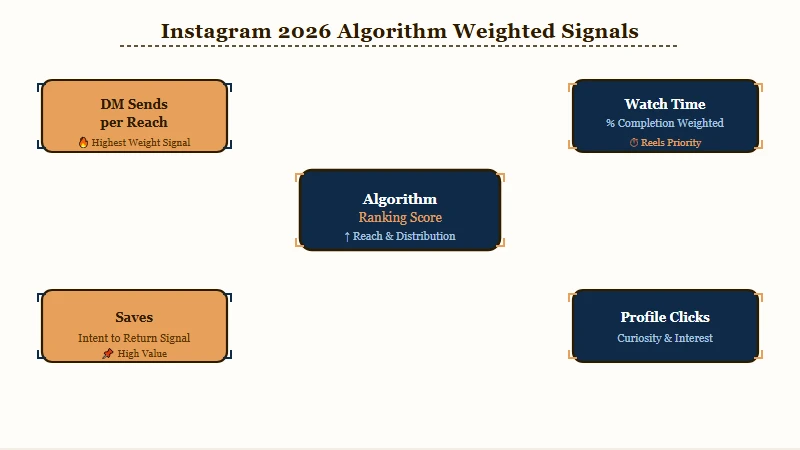
Healthy 2026 Reel performance, by signal.
| Signal | What it tells the algorithm | Target rate |
|---|---|---|
| DM Sends per Reach | “This is shareable enough to recommend personally” | 1% or higher of reach |
| Saves | “This is valuable enough to revisit” | 2% or higher of reach |
| Watch time | “Viewers consumed the content fully” | 50% or higher avg |
| Profile clicks | “Viewers wanted to know who made this” | 0.5% or higher of reach |
The single most important number is sends-per-reach. Instagram has been clear that DM shares are now the strongest signal of recommendable content, because the algorithm reads a DM share as a personal endorsement rather than a casual interaction. A Reel with even 0.5 percent sends-per-reach tends to outperform a Reel with 10 percent likes in 2026 distribution.
Saves matter for evergreen content that delivers a clear takeaway: lists, how-tos, frameworks, recipes, quotes worth coming back to. Watch time matters for everything but especially long-form Reels over 30 seconds.
Profile clicks signal that the content was strong enough to make someone want more, which is the cleanest top-of-funnel signal Instagram measures.
Why Drops Feel Overnight
The drop feels overnight because Instagram’s test group methodology is binary: pass the 30-minute threshold and reach expands, fail it and reach caps within the first hour.
There is no slow decay. A Reel either hits the new benchmarks or it does not.
Worked example of what this looks like in Insights.
Before: Reel posted at 6pm. Hits 5,000 reach by 7pm, 12,000 by midnight, 18,000 by morning. Sends-per-reach lands at 1.2 percent.
After: Reel posted at 6pm. Hits 1,200 reach by 7pm, 1,300 by midnight, 1,350 by morning. Sends-per-reach lands at 0.2 percent.
The “after” pattern is the cliff creators describe as a shadowban. It is not. The algorithm tested the Reel against the 2026 thresholds, the sends-per-reach signal failed inside the first 30 minutes, and the algorithm stopped pushing the content to new audiences. That is the entire mechanism.
The trap creators fall into is reacting to the first underperforming Reel by changing strategy on the next one, then the next one, then the next one. Without a clean 7-day audit baseline, every change feels like it should be the fix and none of them lock in.
The 7-Day Audit That Holds Up
The audit that fixes Instagram reach in 2026 is a 7-day evaluation of your last 10 Reels across the 4 signals, not a content overhaul.
The point is to find the format and topic that the algorithm already rewards on your account and then double down on it, not invent something new.
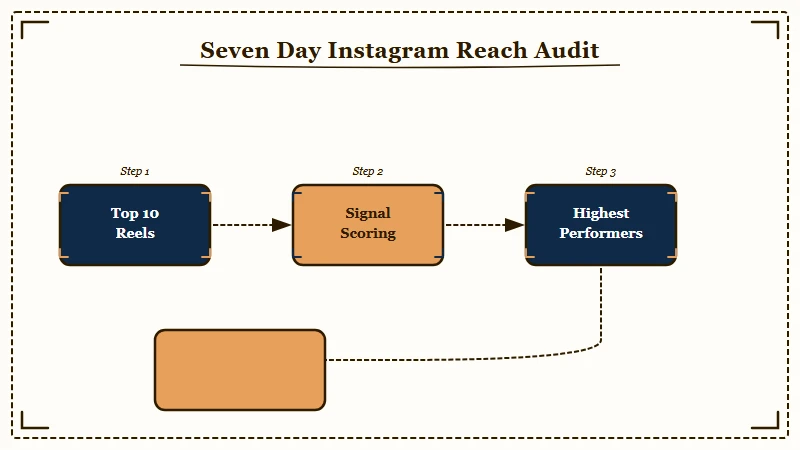
Run the audit in this order. The full process takes about 90 minutes.
- Open Insights, then Content, then filter to Reels for the last 90 days.
- Sort by reach and pull the top 10.
- For each of the 10, write down: total reach, sends, saves, average watch time, and profile clicks generated.
- Calculate the rates: sends-per-reach, saves-per-reach, watch-through percentage, profile-clicks-per-reach.
- Identify the 2 Reels that scored highest on at least two of the four signals.
Those 2 Reels are your format. The recovery move is to commit to one recurring format that mirrors what worked, and post 3 to 4 Reels per week in that format for at least 4 weeks.
Instagram’s 2026 algorithm uses topic clusters to categorize accounts, and an account with high content variety confuses the classifier. A clean format gives the algorithm a stable categorization, which is what restores reach.
The exact pacing matters. Posting more than 4 Reels per week during the recovery sprint reads as quantity-over-quality and dampens reach. Posting fewer than 3 per week is not enough signal for the algorithm to learn your category. Three to four is the band where recovery curves bend.
The Recurring-Format Discipline
The accounts gaining reach in 2026 operate like recurring TV shows: same hook structure, same visual style, same recurring location or angle, week after week.
The algorithm needs repeat-pattern signal to confidently categorize the account, and the audience needs visual recognition to consume past the 3-second hook.
This is the discipline most creators resist. Variety used to be a virtue on Instagram. In 2026 it is the single biggest reach killer for accounts that do not have a strong personal brand recognition layer built in advance.
Working examples of formats that travel in 2026.
Vague: “I post a mix of behind-the-scenes, tutorials, and lifestyle content.”
Specific: “Every Monday I post a 25-second Reel filmed in the same kitchen with the same overhead angle, ending with the same on-screen text framework. Every Thursday I post a 15-second talking-head Reel from the same chair with the same brand color in the background. Every Saturday I post a Story-driven still photo with a 1-sentence caption framework.”
The specific version is what Instagram’s topic clustering rewards. The vague version is what creators default to and then wonder why their reach dropped.
For creators dealing with Reels-specific reach issues at the format level, the Reels reach low breakdown covers the within-Reels distribution patterns.
For cross-platform comparison, the TikTok For You page views low diagnostic shows the same mechanism on TikTok, and Facebook reach throttling covers the Meta-side parallel. If your YouTube Shorts views stopped at the same time, the pattern is cross-platform, not account-specific.
When the Drop Is a Real Restriction
About one in ten “overnight reach drops” turns out to be a real restriction event rather than a 2026-threshold failure.
The diagnostic for separating the two is the same: check Account Status and the non-follower reach trend. If both flag, you are in restriction territory, not threshold territory.
The cases where restriction is the real cause typically share three features. First, non-follower reach drops below 5 percent across multiple consecutive Reels, not just one or two. Second, Account Status shows a recommendation-eligibility flag or a content-removed entry. Third, the drop coincided with a specific event, like joining an engagement pod, using a third-party scheduler, or posting content that touched a community-guidelines line.
If those three are present, the recovery path is different. The threshold-failure recovery in this article focuses on content discipline. The restriction recovery in the Instagram shadowban guide focuses on a 48 to 72 hour blackout plus app disconnections plus archiving flagged content.
The honest rule of thumb. If Account Status is clean, this article is your fix. If Account Status is flagged, the shadowban guide is your fix. If both are clean and a YouTube account in your network is also seeing reach drops, the YouTube shadowban diagnostic covers the parallel symptoms there.
Frequently Asked Questions
Why does it feel like my Instagram reach dropped overnight?
The 2026 algorithm tests new content in a small audience pool inside the first 30 minutes after posting. If engagement velocity fails the new thresholds, reach caps within an hour and never expands. There is no slow decay, so the drop reads as overnight even when it is just a threshold test failing.
What is the most important signal Instagram weighs in 2026?
DM shares (sends-per-reach). A DM share is read by the algorithm as a personal endorsement, which it weights heavier than likes, comments, or any other public engagement. A Reel hitting 1 percent sends-per-reach typically outperforms one with 10 percent likes in 2026 distribution.
What is the typical organic reach for an Instagram account in 2026?
Average organic reach in 2026 sits at 3 to 4 percent of followers. The platform now operates as a recommendation engine where follower count is far less important than content matching the algorithm’s recommendation thresholds for non-follower audiences.
How long does it take to recover from a reach drop?
Most accounts see initial recovery within 7 to 14 days if they fix the underlying signals: a stronger 3-second hook, content that prompts DMs or saves, and consistent format commitment. Full categorization recovery in topic clusters takes 4 to 6 weeks of disciplined formatting.
Should I post more frequently to recover reach?
No. The 2026 algorithm reads a flood of new posts as instability, and quantity-over-quality content during recovery deepens the drop. The sweet spot is 3 to 4 Reels per week in one recurring format for at least 4 weeks before evaluating.
What is the difference between a reach drop and a shadowban?
A reach drop is the algorithm capping distribution because content failed the new thresholds. A shadowban is a restriction event flagged in Account Status. The diagnostic is the same: check Account Status and the non-follower reach trend before changing strategy.
What to Do Right Now
Run the 7-day audit before changing anything. Identify your top 2 Reels on the four signals. Commit to one recurring format for 4 weeks. Stop reacting post-by-post. Reactive content changes are how creators stay stuck at 3 to 4 percent reach for months when the recovery curve is only 14 days away.
If Account Status is clean and non-follower reach is at 3 to 5 percent across the last 28 days, you do not have a shadowban. You have an Instagram 2026 reach economy issue, and the fix is format discipline plus the four-signal optimization in this guide.
If Account Status shows a flag or non-follower reach has collapsed below 5 percent across multiple consecutive Reels, the issue is restriction-side, not threshold-side. Run the Instagram shadowban diagnostic instead.
If reach is dropping across multiple platforms simultaneously, including Facebook and YouTube, the root cause is usually a cross-platform content pattern rather than any single algorithm change. Start with the cross-platform shadowban diagnostic and work through each platform’s playbook from there.
The discipline matters more than the tactics. Pick one format. Commit for 4 weeks. Measure DM shares, saves, watch time, and profile clicks weekly. The four-signal mindset is the only thing that consistently works on Instagram in 2026, and it works for accounts that hold it.